

Understanding Sound-Damping Drywall: How It Differs from Standard Gypsum
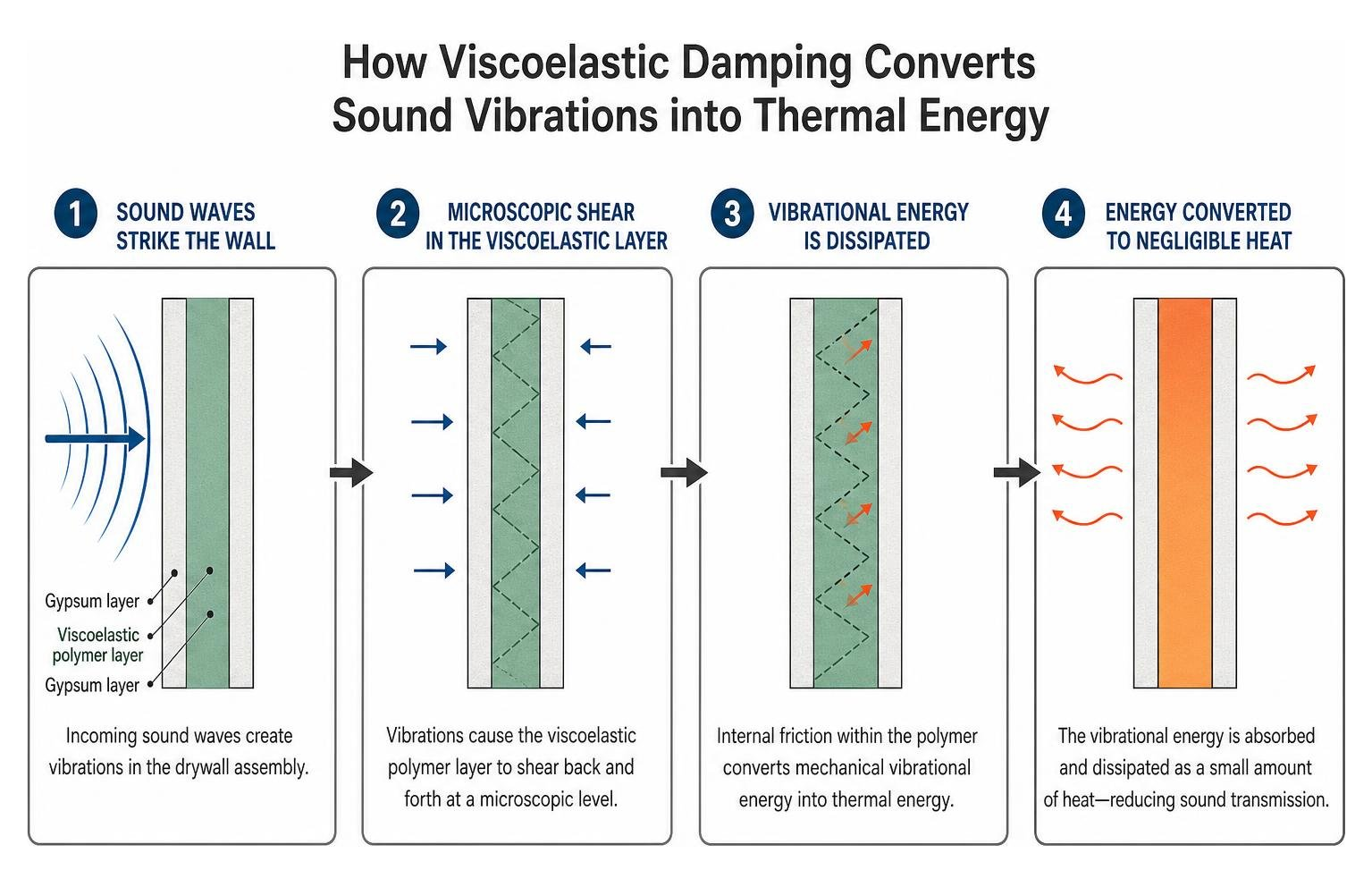
For homeowners and builders seeking the best soundproofing drywall, the answer lies in constrained-layer damping technology rather than simply adding more mass. The best soundproofing drywall panels, such as Quietrock EZ Snap, sandwich a thin, flexible viscoelastic polymer between two dense gypsum sheets. When sound waves collide with the wallboard, this internal polymer layer shears microscopically, converting mechanical vibrational energy directly into negligible heat. This engineering approach achieves STC ratings of 50–55+ in a single panel, dramatically outperforming standard gypsum board.
Standard gypsum board has been the backbone of interior construction for decades. It is cost-effective, straightforward to hang, and provides a clean, paintable surface. However, when it comes to acoustics, standard gypsum presents a physics problem. Because it is rigid and relatively light, acoustic energy hits the panel and easily passes right through the wall studs into the next room.
This internal dampening disrupts the resonance that normally allows sound to travel freely. According to the classic acoustic “mass law,” doubling the mass of a solid wall only yields an approximate 5 to 6 dB increase in sound reduction. By adding viscoelastic damping to the board itself, you break the limitations of mass alone. You achieve significant acoustic performance without adding cumbersome wall thickness.
For builders and homeowners shopping our commercial and residential drywall supplies, understanding this difference is the key to creating quiet living spaces.
| Feature / Metric | Standard 1/2″ Gypsum | Sound-Damping Gypsum (e.g., Quietrock EZ Snap) |
|---|---|---|
| Core Structure | Solid gypsum core | Dual gypsum layers with viscoelastic polymer |
| Acoustic Mechanism | Mass only | Constrained-layer damping plus mass |
| Typical Single-Layer Wall STC | 33–35 | 50–55+ |
| Panel Thickness | 1/2″ or 5/8″ | 1/2″, 5/8″, or specialized multi-ply |
| Low-Frequency Damping | Poor (transmits bass resonance) | Superior (dissipates vibrational energy) |
| Usable Space Loss | Baseline standard | Minimal (eliminates extra framing/layers) |
Acoustic Physics: Mass, Damping, and Decoupling
To choose the right board, you need to understand the three core pillars of acoustic isolation:
- Mass: Heavy, dense materials block airborne sound waves simply by being hard to move. Dense drywall sheets reflect a portion of incoming sound energy.
- Damping: Constrained-layer damping acts like a shock absorber for the wall, keeping panels from ringing or vibrating like a drum head.
- Decoupling: Mechanically separating the two sides of a wall (such as using staggered framing or isolation clips) stops structural vibration from moving directly from one side of the partition to the other.
When sound waves travel, they also seek the path of least resistance through “flanking transmission.” Flanking noise bypasses the main wall through unsealed floor gaps, electrical boxes, shared ceiling plenums, and heating ducts. Mastering these soundproofing drywall fundamentals ensures you do not waste money on premium wallboards only to let noise leak around the edges.
Fire Resistance and Moisture Protection in Acoustic Boards
Sound isolation should never compromise building safety or structural durability. Fortunately, high-performance acoustic boards are designed to meet rigorous building codes across residential and commercial sectors.
Most 5/8-inch sound-damping panels feature a non-combustible Type X gypsum core, making them fully compliant with 1-hour and 2-hour fire-rated wall assemblies under ASTM International E119 testing standards. Additionally, premium acoustic wallboards feature specialized paper facings and core additives that meet ASTM D3273 standards for mold resistance. This makes them suitable for high-humidity areas like basements, master bathrooms, laundry rooms, and multi-family party walls.
Top Options: Comparing Soundproofing Drywall Panels
Choosing the right soundproofing board requires balancing acoustic targets, room dimensions, wall depth, and installation practicality.
Acoustic performance is standardized by Sound Transmission Class (STC). An STC rating is an integer rating that measures how well a building partition attenuates airborne sound like speech, media systems, and television noise. A standard single-stud wall with conventional drywall achieves an STC of 33 to 35, where conversational speech is easily understood through the partition. Upgrading to high-performance sound-damping wallboards pushes partitions past STC 50 to 55+, making loud speech and entertainment sound completely inaudible.
| Product Type | Thickness | Weight (lb/sq ft) | Primary Advantage | Ideal Application |
|---|---|---|---|---|
| Quietrock EZ Snap | 5/8″ | 2.6 | Easy score-and-snap; 1-hr fire-rated | General residential, offices, party walls |
| Heavy-Duty Damped Board | 5/8″ | 2.8+ | Enhanced impact & shear resistance | High-traffic hallways, commercial spaces |
| Studio-Grade Multi-Ply | 1-3/8″ | 6.3 | Extreme low-frequency bass isolation | Home theaters, music studios, mechanical rooms |
| Mold-Resistant Acoustic Gypsum | 1/2″ or 5/8″ | 2.3–2.6 | Moisture defense with viscoelastic core | Basements, bathrooms, hospitality units |
Quietrock EZ Snap: A Sound-Damping Drywall Option Carried by Western Wholesale Supply
At Western Wholesale Supply, we supply Quietrock EZ Snap because it provides strong acoustic performance while eliminating the installation headaches historically associated with soundproof drywall. Early generation acoustic boards contained heavy steel cores or rigid cementitious layers that required circular saws, creating excessive dust and dulling blades rapidly on the jobsite.
Quietrock EZ Snap utilizes an engineered polymer core that allows installers to score and snap the board using standard utility knives, matching the installation speed of conventional gypsum. It delivers:
- Laboratory-Tested Performance: Delivers wall assemblies rated up to STC 55 on single steel or wood stud framing.
- Fire & Mold Defense: Features a Type X fire-rated core and achieves a perfect 10/10 rating under ASTM D3273 mold resistance testing.
- Space Savings: Achieves high acoustic separation in a single 5/8″ panel, saving valuable floor space compared to multi-layer drywall assemblies.
Mold-Resistant Sound-Damping Boards
When building in moisture-prone climates or soundproofing exterior-facing perimeter walls, moisture and mold resistance are top priorities. High-density acoustic panels often incorporate specialized water-repellent face paper and anti-microbial core treatments.
Many modern sound-damping panels also include printed fastener alignment guides across the face paper, speeding up installation and ensuring that installers sink screws directly into framing members without guessing. Exploring the full spectrum of sound-damping drywall options allows you to select the precise balance of moisture protection, fire safety, and acoustic dampening your project requires.
Soundproof Drywall vs Alternative Noise Reduction Methods
When planning a sound isolation project, homeowners and builders often weigh sound-damping drywall against traditional multi-layer drywall assemblies.
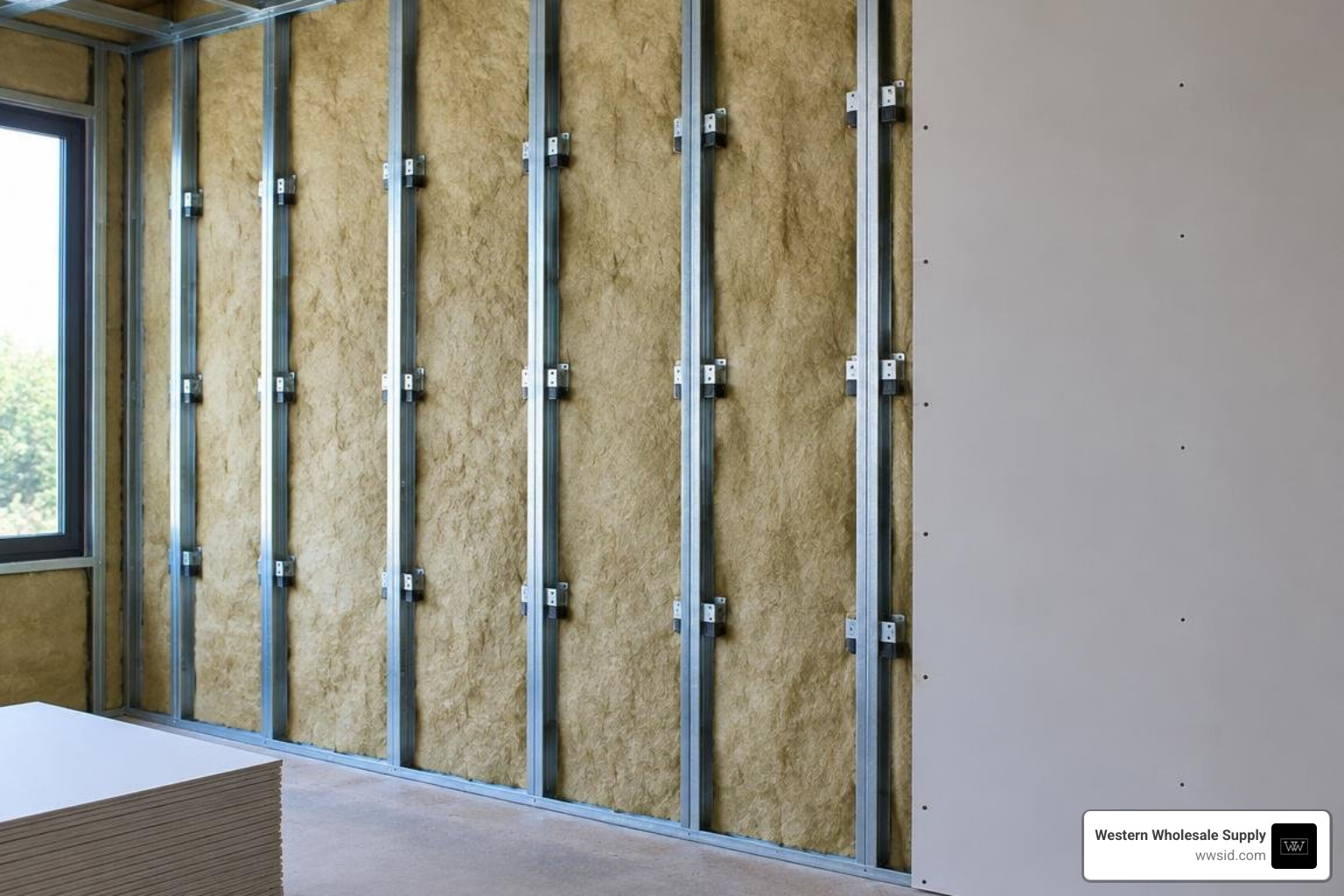
A common traditional method involves hanging two layers of standard 1/2″ or 5/8″ drywall on each side of the wall framing. While adding standard layers increases overall wall mass, it does not provide the viscoelastic damping necessary to eliminate lower-frequency resonances.
| Soundproofing Method | Typical Assembly STC | Wall Thickness Increase | Labor Complexity | Installation Timeline |
|---|---|---|---|---|
| Single Layer Standard Gypsum | 33–35 | Baseline | Simple | 1–2 Days |
| Double Layer Standard Gypsum | 40–45 | +1/2″ to 5/8″ per side | Moderate (double hanging/taping) | 3–5 Days |
| Single Layer Quietrock EZ Snap | 50–55+ | None (direct replacement) | Standard drywall hanging | 1–2 Days |
| Damped Double Assembly | 58–65+ | +5/8″ per side | Advanced multi-step process | 3–5 Days |
Evaluating Cost vs Performance: Is Soundproofing Drywall Worth It?
When comparing materials on a store shelf, standard drywall is significantly cheaper per sheet than dedicated sound-damping boards. However, looking only at board cost overlooks the total installed project economics.
- Labor Savings: Installing two or three layers of conventional drywall means hanging, taping, mudding, and sanding multiple times. Single-layer sound-damping boards like Quietrock EZ Snap cut installation time by 40% to 60%, drastically lowering contractor labor hours.
- Space Preservation: In smaller rooms, home offices, and narrow hallways, adding multi-layer drywall assemblies steals valuable square footage and creates alignment issues with door jambs, window casings, and electrical outlet boxes.
- Acoustic Reliability: Standard double-layer drywall without internal damping compounds often fails to attenuate critical mid-to-low frequencies. Dedicated sound-damping wallboards ensure dependable vibration control across a broad frequency spectrum.
If you are evaluating whether to add mass or re-sheet entirely, review our guide to double drywall soundproofing methods to calculate the best approach for your floor plan.
Double-Drywall vs Damped Drywall Assemblies
For high-demand environments—such as dedicated home theaters, music rehearsal spaces, or mechanical equipment rooms—contractors often combine both techniques. Applying a sound-damping panel over an existing wall layer or pairing damped boards with acoustic insulation achieves STC ratings exceeding 60. At this level, even screaming guitar amplifiers or heavy bass subwoofers are reduced to a faint, indistinct murmur.
For a complete breakdown of multi-layer assemblies and construction details, read our soundproofing drywall guide for 2026.
Installation Best Practices and Retrofit Techniques for Maximum Sound Isolation
Even the highest-rated sound-damping board will underperform if installed with improper fasteners or unsealed gaps. Following proven trade installation practices ensures you achieve the lab-tested STC rating on your jobsite.
- Framing & Insulation: Ensure framing members are plumb. In residential walls, fill stud cavities completely with sound-attenuating mineral wool or fiberglass batt insulation. In commercial warehouse spaces, prioritizing thermal insulation (aiming for R-30+ in ceilings and R-13+ in exterior walls) helps stabilize interior environments alongside acoustic treatments.
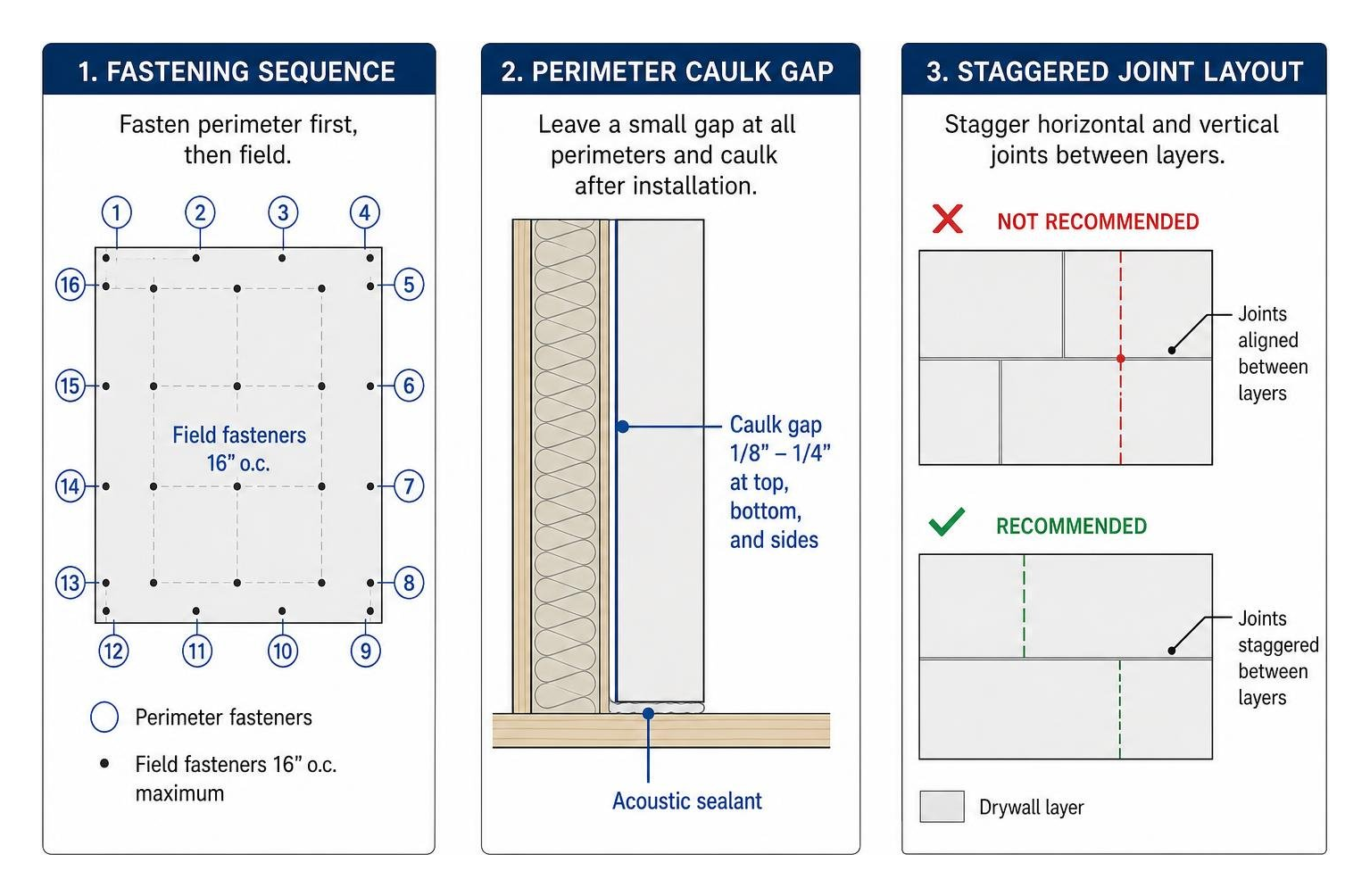
- Fastener Selection: Never use generic wood screws that can strip or back out. Secure your soundboards using premium drywall fasteners from Grabber or Brighton Best. Space fasteners 12 inches on center along the perimeter and 16 inches on center in the field.
- Professional Finishing: When taping and mudding your acoustic board joints, rely on professional-grade finishing tools. We stock and recommend drywall taping knives and finishing tools from Hyde, USG Sheetrock Tools, Columbia Taping Tools, and Marshalltown to achieve flat, seamless Level 4 and Level 5 finishes.
For deeper technical execution steps, refer to our guide on effective drywall acoustic techniques.
Critical Air Sealing and Flanking Noise Control
Acoustic energy behaves like water: if air can pass through a crack, sound will pour right through it. A 1% unsealed gap along a wall perimeter can degrade an STC 55 wall assembly down to below STC 35.
- Leave a Perimeter Expansion Gap: During hanging, hold the drywall sheets 1/4-inch off the finished subfloor, adjacent walls, and ceilings. Do not bridge this gap with joint compound.
- Apply Acoustic Sealant: Fill the entire 1/4-inch perimeter perimeter channel with a permanently flexible, non-hardening acoustic caulk before taping.
- Seal Electrical Penetrations: Electrical outlet boxes, switch plates, and HVAC registers represent massive sound leaks. Seal the back of gang boxes with moldable acoustic putty pads and caulk around the drywall cutouts.
Common Installation Pitfalls to Avoid
Avoid these frequent mistakes that can compromise your soundproof wall:
- Over-Driving Fasteners: Sinking screws too deeply punctures the face paper and fractures the viscoelastic core, reducing the panel’s damping efficiency. Set screw heads just below flush.
- Aligning Wall Seams: If you are installing a soundproofing layer over an existing drywall base, always stagger the new vertical and horizontal seams by at least 12 to 16 inches from the original seams.
- Using Rigid Caulk: Standard painters’ caulk or silicone dries rigid and will crack over time as the building shifts, opening up air paths for flanking noise. Always use dedicated, non-hardening acoustic sealants.
Frequently Asked Questions About Soundproofing Drywall
Can you install soundproof drywall over existing drywall?
Yes. Direct retrofit overlay is one of the most effective and popular ways to soundproof an existing room without the mess, expense, and waste of wall demolition. Simply locate the wall studs, apply a continuous bead of acoustic sealant around the perimeter, and fasten the new sound-damping board directly through the existing drywall into the framing using extended Grabber drywall screws.
What STC rating is needed to block loud talking and bass?
To block normal conversational speech, an STC rating of 40 to 45 is sufficient. However, if your goal is to block loud shouting, television soundbars, gaming systems, and musical instruments, you need an assembly rated at STC 50 to 55+. Low-frequency bass frequencies (under 125 Hz) have long wavelengths that are tough to isolate; stopping low-end thumps requires combining dense, damped wallboards with resilient decoupling techniques.
How much thickness and room space does soundproof drywall take up?
Standard sound-damping panels like Quietrock EZ Snap are 5/8-inch thick—the exact same dimension as standard commercial Type X drywall. By swapping standard drywall for a viscoelastic soundboard, you lose zero additional floor space while gaining substantial acoustic isolation.
Conclusion
Creating a quiet, acoustically isolated environment is all about selecting the right materials and constructing a balanced, fully sealed wall assembly. Whether you are soundproofing a home office, quiet bedroom, basement rental unit, or commercial facility, sound-damping wallboards like Quietrock EZ Snap provide the ultimate combination of high STC performance, fire code compliance, and straightforward jobsite handling.
For complete building projects, we also provide specialized acoustical ceiling solutions, proudly carrying high-performance ceiling tiles from CertainTeed, as well as moisture-resistant tile backer boards from Durock.
As an independent, veteran-owned, third-generation family business, Western Wholesale Supply has supplied premium drywall, steel framing, insulation, and acoustical supplies across Eastern Idaho, South East Idaho, Western Wyoming, and Western Montana since 1963. Backed by over 60 years of hands-on industry experience, we are dedicated to providing contractors, builders, and homeowners with reliable, on-time jobsite delivery and exceptional customer service.
Visit our showrooms in Idaho Falls, Pocatello, Jackson, Driggs, Victor, Rexburg, Rigby, Shelley, Blackfoot, Chubbuck, Burley, Kimberly, and Twin Falls to explore our inventory of sound-damping boards, Grabber fasteners, and professional Marshalltown and Columbia taping tools. For more technical wall designs, consult our detailed guide to drywall soundproofing or contact our team today to get your soundproofing project started right.
