

What Is Aluminum Bubble Wrap? (Quick Answer)
Aluminum bubble wrap is a reflective insulation material made of polyethylene air bubbles laminated between one or two layers of aluminum foil. It blocks radiant heat, resists moisture, and acts as a vapor barrier — all in a lightweight, flexible roll.
At a glance:
| Feature | Detail |
|---|---|
| Main function | Reflects radiant heat, resists moisture |
| Reflectivity | 96–97% |
| R-value range | R-4.9 to R-14.6 (varies by orientation) |
| Common formats | Single bubble, double bubble |
| Typical uses | Attics, HVAC ducts, crawl spaces, metal buildings, RVs |
| Fire rating | Class A (flame spread of 0) |
It is not a replacement for traditional bulk insulation like fiberglass batts on its own — but it works well alongside other insulation or in applications where thin, flexible material is needed.
Radiant heat travels through the air and warms whatever it hits. Aluminum foil reflects up to 97% of that heat back toward its source. The bubble layer adds a small air pocket that slows heat conduction. Together, they make a product that’s easy to handle and install in tight spaces where fiberglass or rigid foam would be awkward.
At Western Wholesale Supply, we are third-generation building materials professionals, and we’ve helped contractors across Eastern Idaho and Western Wyoming spec and source aluminum bubble wrap and other insulation products for both residential and commercial projects. In the sections below, we’ll walk you through everything you need to know to choose and use it correctly.
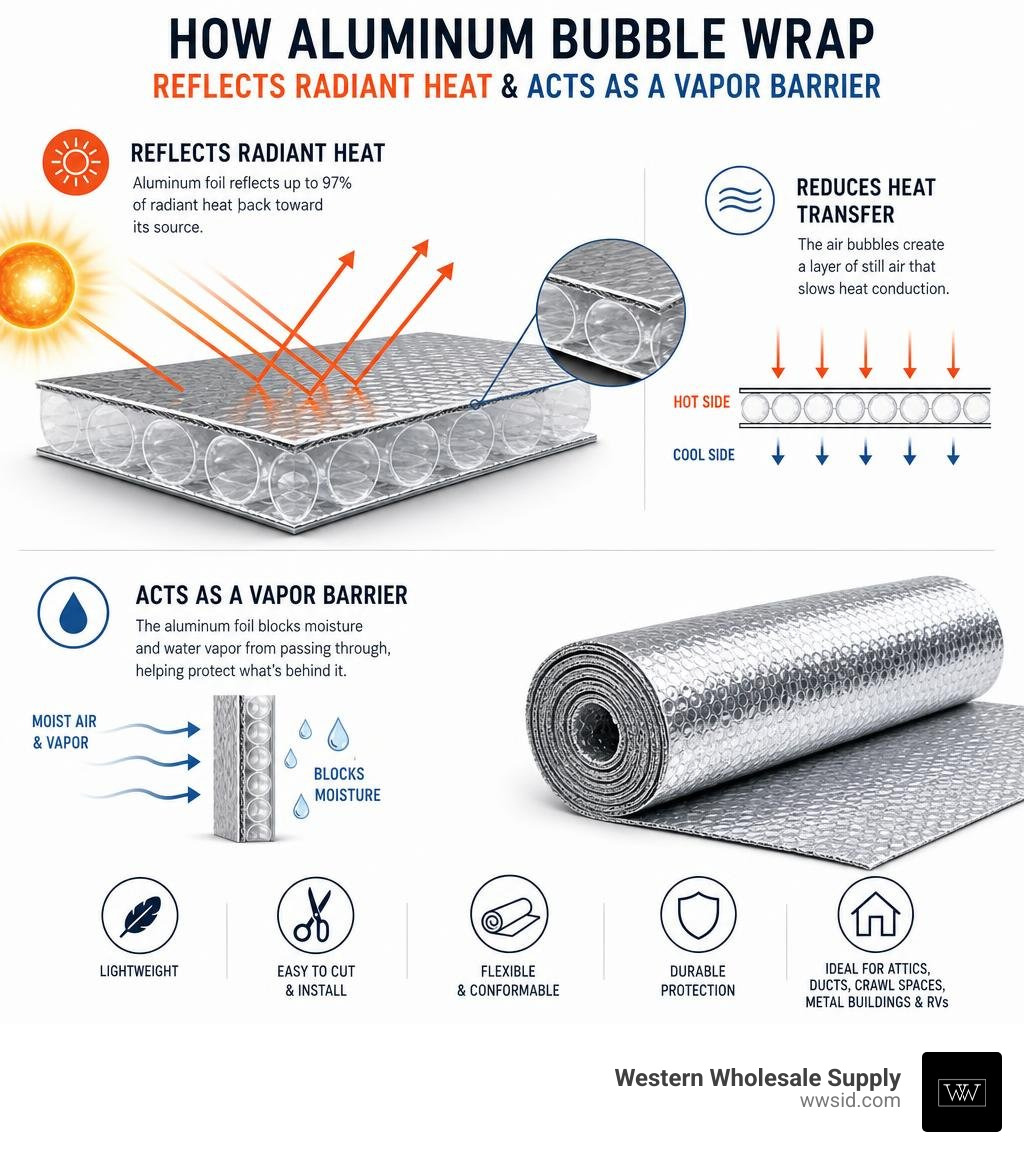
Aluminum bubble wrap vocab explained:
What is Aluminum Bubble Wrap and How Does It Work?
To understand how aluminum bubble wrap (often sold as reflective bubble foil insulation) works, we have to look at the three ways heat moves: radiation, conduction, and convection.
Standard insulation materials like fiberglass batts or foam boards work by slowing down conductive heat transfer (heat moving through solid objects) and convective heat transfer (heat moving through air currents). They do this by trapping millions of tiny air pockets within their structures. However, they do very little to stop radiant heat, which is the infrared energy emitted by hot surfaces like a metal roof baked by the summer sun.
This is where radiant barriers and reflective foil insulation step in. Standard aluminum foil has an incredibly low emissivity rate (around 0.03) and an exceptionally high reflectivity rate (96% to 97%). This means it reflects up to 97% of the radiant energy that strikes its surface, preventing it from passing into your living or working space.
Products like Aluminum Foil 5mm Laminated Reflective Bubble Wrap Insulation – esdantistaticbags combine this high-performance reflective foil with a core of polyethylene bubbles. The bubbles serve two critical purposes:
- Thermal Break: They provide a physical separation (a thermal break) between the outer foil sheets, which significantly reduces conductive heat transfer through the material.
- Convective Barrier: The sealed air pockets prevent air movement, further limiting heat transfer.
Additionally, because the polyethylene bubble core is sandwiched between solid sheets of aluminum foil, the assembly functions as a highly effective vapor barrier. When properly taped and sealed, it prevents moisture vapor from passing through walls or ceilings, protecting building envelopes from condensation, rot, and mold.
Key Benefits of Aluminum Bubble Wrap Insulation
When we talk to builders from Pocatello, Idaho, to Jackson, Wyoming, they often ask why they should choose reflective bubble wrap over other materials. Here are the primary benefits we highlight:
- Lightweight and Easy to Handle: Unlike heavy rolls of fiberglass or rigid sheets of foam, aluminum bubble wrap is incredibly light. You can easily carry a 500-square-foot roll under one arm.
- Highly Durable: The laminated structure resists tearing, puncturing, and crushing. It doesn’t degrade, crumble, or pack down over time like some loose-fill options.
- Excellent Moisture Protection: It is completely waterproof and acts as an impermeable vapor barrier (with a water vapor permeability rating of 0.000). This is crucial for preventing condensation in metal buildings and crawl spaces.
- Class A Fire Rating: Quality foil bubble products achieve a Class 1 / Class A fire rating, meaning they have a flame spread index of 0 and produce minimal smoke, making them safe for exposed indoor applications.
- Clean and Fiber-Free: There are no itchy fiberglass fibers to breathe in or get stuck in your skin. You don’t need a respirator or special protective suits to install it.
For a deeper dive into these benefits, you can read our guide on Bubble Up Your Barrier: Everything You Need to Know About Thermal Bubble Wrap.
Single Bubble vs. Double Bubble Foil Insulation
When sourcing aluminum bubble wrap, you will generally choose between single bubble and double bubble configurations.
The difference comes down to thickness, strength, and thermal performance:
- Single Bubble Foil: This material features a single layer of bubbles laminated between foil. It typically has a nominal thickness of 1/8 inch to 3/16 inch. It is highly flexible and cost-effective, making it excellent for tight curves, wrapping ducts, or lining shipping boxes.
- Double Bubble Foil: This version features two stacked layers of air bubbles between the foil facings, giving it a nominal thickness of 1/4 inch to 5/16 inch. The extra bubble layer provides a stronger thermal break and slightly higher R-values. It is also stiffer and easier to span across framing members without sagging.
For industrial applications requiring extreme durability, some products like 5mm PE Weave ALU Bubble Foil , Fireproof Aluminium Foil Bubble Wrap – prepaintedgalvalumesteecoil include a woven polyethylene layer. This woven scrim dramatically increases the tensile and tearing strength of the wrap, making it perfect for demanding environments like metal warehouses, agricultural barns, and heavy-duty shipping covers.
If you are looking for packaging and transport solutions rather than structural building insulation, you might encounter lighter variations such as Bubble wrap on roll | Biopack or specialty thermal shipping items like Aluminum Foil Bubble Envelope PM002 , which protect temperature-sensitive goods during transit.
Comparing Reflective Bubble Foil to Traditional Insulation
A common point of confusion for DIYers and professional builders alike is how aluminum bubble wrap compares to traditional bulk insulation materials like fiberglass batts or rigid foam boards.
The most important distinction to understand is that reflective foil insulation relies on air spaces to achieve its maximum R-value.
If you install fiberglass batts, the material has a rated R-value (such as R-13 or R-19) that remains relatively constant regardless of how it is installed (as long as it isn’t compressed). However, if you sandwich foil bubble wrap tightly between two solid surfaces—such as drywall and wood studs—without an air gap, its R-value drops dramatically to about R-1.1 to R-2. This is because without an air gap, heat transfers directly through the material via conduction, rendering the reflective foil surface useless.
When installed with a proper air gap of 1/2 inch to 3/4 inch on at least one side of the foil, the system can achieve impressive thermal performance by stopping radiant heat transfer.
To help you visualize the differences, we’ve put together a comparison table:
| Insulation Type | Typical Thickness | R-Value (Per Inch / System) | Primary Heat Transfer Blocked | Best For |
|---|---|---|---|---|
| Foil Bubble Wrap | 1/8″ to 5/16″ | R-1.1 (no air gap) up to R-14.6 (with proper air gaps) | Radiant Heat & Vapor | HVAC Ducts, Metal Buildings, Crawl Spaces, Attics |
| Fiberglass Batts | 3.5″ to 12″ | R-3.0 to R-3.8 per inch | Conductive & Convective Heat | Wood-framed walls, Attics, Floors |
| Rigid Foam Board (Polyiso) | 1″ to 3″ | R-6.0 to R-6.5 per inch | Conductive & Convective Heat | Exterior Sheathing, Cavity Walls, Basements |
If you compress fiberglass batts, their R-value drops. For example, compressing an R-19 batt into a shallower wall cavity can reduce its effectiveness to R-18 or lower. Bubble wrap is even more sensitive to compression. If you step on it, crush it behind drywall, or install it under heavy pressure, the bubbles pop or flatten, destroying the thermal break.
To explore traditional insulation choices further, read our article Beyond Batts: A Comprehensive Look at Building Insulation Materials.
Performance in Warehouse Environments
In commercial and industrial settings across Eastern Idaho—from agricultural storage in Rexburg to commercial warehouses in Idaho Falls—thermal control is vital. Uninsulated metal buildings act like giant ovens in the summer and freezers in the winter.
For warehouses, we recommend a hybrid approach. To meet modern building energy standards, you generally need high R-values:
- Warehouse Ceilings: R-30+ thermal performance is typically targeted to prevent massive heat loss through the roof.
- Warehouse Walls: R-13+ thermal performance is standard for exterior walls.
Using aluminum bubble wrap as a radiant barrier directly under a metal roof deck is an outstanding way to knock down the summer heat load. By reflecting 97% of the sun’s radiant energy, it keeps the interior of the warehouse significantly cooler, reducing the load on your HVAC systems. To meet the R-30+ ceiling requirement, you can pair the reflective bubble wrap with thick fiberglass batts or commercial blow-in insulation installed below it.
For more information on commercial setups, check out The Ultimate Guide to Warehouse Insulation Materials.
Common Applications for Bubble Foil Insulation
Because of its unique moisture-resistant and reflective properties, aluminum bubble wrap is incredibly versatile. Here are some of the most common ways we see it used:
- HVAC Duct Wrap: Metal ductwork in unconditioned spaces (like attics or crawl spaces) is a major source of energy loss. Wrapping ducts with products like Single Sided Thermal Aluminium Air Bubble Insulation Wrap Sheet 10m-100m or double-sided foil wrap prevents the conditioned air inside from warming up or cooling down on its way to your rooms. It also prevents condensation from forming on cold metal ducts during humid summer months.
- Metal Buildings & Pole Barns: Installing bubble foil rolls over the purlins before screwing down metal roofing sheets creates a highly effective radiant barrier and condensation control layer.
- Crawl Spaces & Basements: It can be stapled to floor joists to keep floors warm while acting as a vapor barrier that prevents damp earth moisture from rising into the subfloor.
- Attics: Stapling radiant barrier rolls like 48 in. x 25 ft. Radiant Barrier Bubble Aluminum Foil Reflective … directly to the underside of attic rafters reduces attic temperatures by up to 30°F during hot summer days.
- RVs and Camper Vans: Space is at a premium in mobile builds. The thin profile of bubble foil makes it a popular choice for lining camper walls, ceilings, and window inserts to regulate interior temperatures.
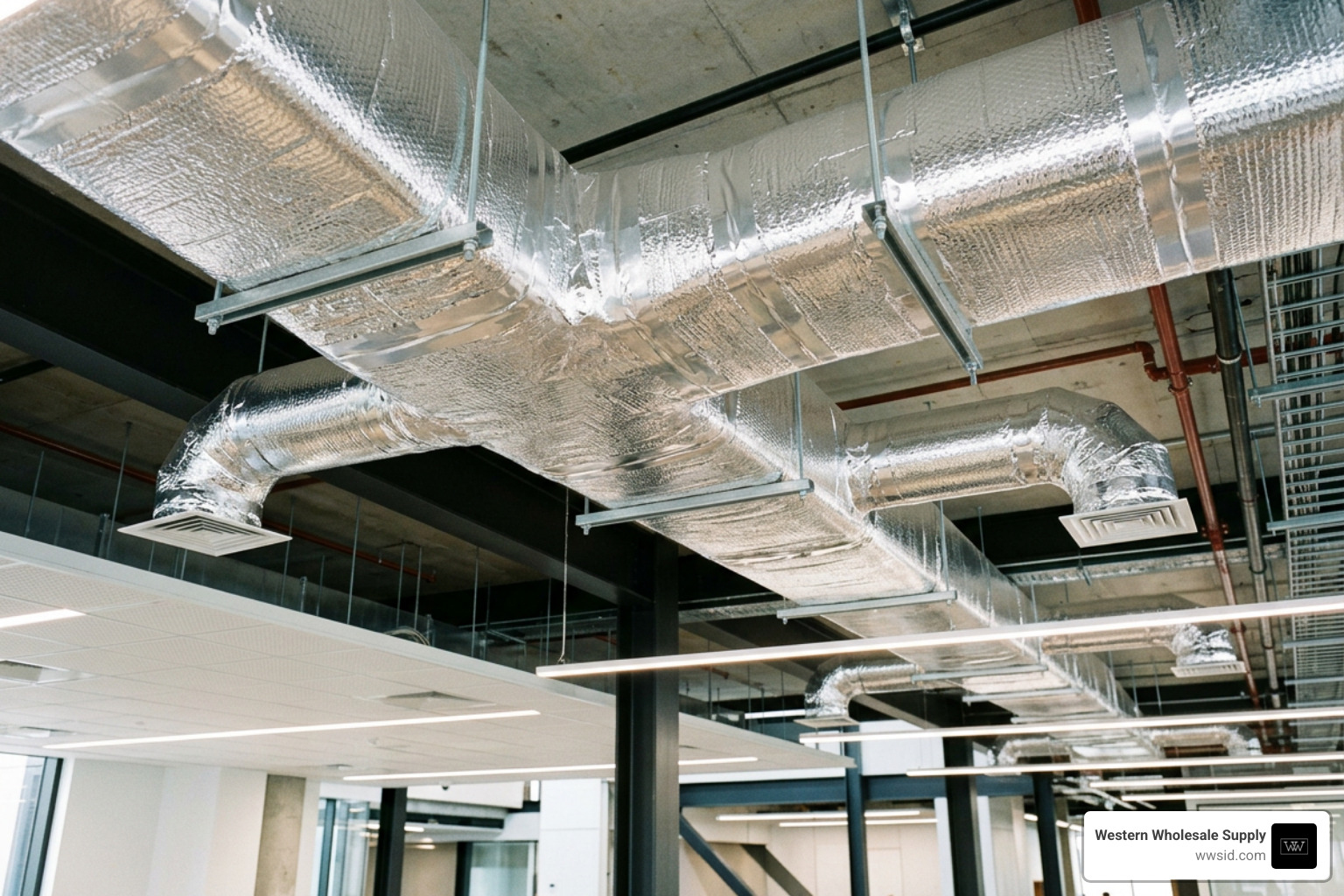
Whether you are working on a commercial build in Jackson, WY, or retrofitting a garage in Rigby, ID, choosing the right material is key. For commercial-scale sourcing, you can read Everything You Need to Know About Sourcing Commercial Insulation.
(Fun local tip: If you are looking into vehicle customizations, like wrapping your work truck in Idaho Falls or Rigby, you might find local experts at Vehicle Wraps in Idaho Falls, ID | Local Installers – Wrapmate or Rigby Car Vinyl Wrap & Vehicle Branding Company . Just don’t confuse vehicle vinyl wraps with thermal building wraps! And if you’re packing up a home in Western Wyoming, check out Moving Boxes Jackson Wy | Moving Supplies Jackson Wyoming for your shipping needs.)
Step-by-Step DIY Installation of Aluminum Bubble Wrap
One of the best things about aluminum bubble wrap is how DIY-friendly it is. You don’t need heavy machinery or specialized personal protective equipment. Here is how to install it like a pro:
Tools and Materials Needed:
- Roll of high-quality aluminum bubble wrap
- Utility knife or heavy-duty scissors
- Foil tape (specifically designed for HVAC/insulation, not standard duct tape)
- Staple gun (for wood framing) or self-tapping screws with plastic washers (for steel framing)
- Tape measure
- Safety glasses
Step 1: Measure and Cut
Measure the area you want to cover. Unroll the bubble insulation on a clean surface and cut it to size using a utility knife. Always cut slightly longer than your measurement to allow for trimming and securing.
Step 2: Create the Air Gap
To get the maximum thermal benefit, you must ensure there is an air space of at least 1/2 inch to 3/4 inch between the foil surface and any solid wall or ceiling material. You can achieve this by using wood furring strips attached to the studs or rafters, or by allowing the material to drape slightly between framing members rather than pulling it completely taut.
Step 3: Secure the Material
- For Wood Framing: Staple the wrap to the face or sides of the studs/joists every 6 to 8 inches.
- For Metal Framing: Use self-tapping screws with wide plastic washers to secure the insulation to the metal purlins or girts.
Step 4: Seal the Seams
To maintain the integrity of your vapor barrier, overlap adjacent sheets of bubble wrap by at least 2 inches. Run a continuous strip of high-tack foil tape along all seams, smoothing it down firmly with a plastic squeegee or your hand to ensure a airtight seal.
To learn more about mastering these insulation techniques, check out How to Master the World of Wholesale Building Insulation.
Frequently Asked Questions About Foil Bubble Insulation
Does aluminum bubble wrap require an air gap to work?
Yes! This is the most critical aspect of installing any radiant barrier or reflective foil product. Without an air gap of at least 1/2 inch on at least one side of the foil, the material will conduct heat directly through to the next solid surface, losing almost all of its radiant heat-blocking benefits.
What is the R-value of double bubble foil insulation?
On its own, a sheet of double bubble foil insulation has a nominal R-value of about R-1.1 to R-2.0. However, when installed in a sealed wall, ceiling, or crawl space assembly with the recommended dead air spaces, the entire system R-value can range from R-5.4 (heat flowing up) to as high as R-14.6 (heat flowing down, which is highly effective for keeping heat out of crawl spaces or attics).
Is foil bubble wrap fire safe?
Yes, high-quality commercial-grade foil bubble wrap is treated with flame-retardant additives. It typically carries a Class 1 / Class A fire rating under ASTM testing standards, which means it has a flame spread index of 0 and a low smoke development rating, making it safe for use in residential and commercial structures.
Conclusion
At Western Wholesale Supply, we’ve been serving contractors, builders, and DIYers across Eastern Idaho and Western Wyoming since 1963. As an independent, veteran-owned, third-generation family business, we pride ourselves on delivering top-tier building materials—from CertainTeed ceiling tiles and Durock cement boards to high-performance insulation products—straight to your job site with reliable, on-time service.
Whether you’re insulating a commercial warehouse in Idaho Falls, a residential basement in Pocatello, or a cozy mountain cabin in Jackson, WY, we have the products and the 60+ years of local expertise to help you get the job done right.

Ready to start your next insulation project? Explore our high-quality insulation products or stop by one of our locations to speak with our knowledgeable team today!
