

Why Galvanized Steel Studs Are a Reliable Choice for Interior Framing
For dependable interior partitions, choose galvanized steel studs with the right web width, flange size, length, and mil thickness for the wall assembly. Standard non-load-bearing studs commonly range from 15 to 33 mils; a common commercial profile is a 3 5/8-inch web, 1 1/4-inch flange, and 20-foot length. Pair studs with matching track, approved self-tapping screws, and the drywall assembly required by the project plans.
Made from cold-formed, mill-certified galvanized steel, these framing members are built for interior drywall partitions. The zinc coating helps resist corrosion, while steel will not warp, rot, mold, or attract insects like wood can. It is also noncombustible, which makes it a practical choice for many fire-rated wall assemblies when the full tested assembly is specified correctly.
For contractors, the key is not simply buying “metal studs.” Confirm whether the wall is non-load-bearing, verify the required gauge or mil thickness, and match the stud profile to the track and accessories. Some profiles also include stiffening ribs, return lips, or dimpled flanges that help improve rigidity and keep self-drilling screws from walking during installation.
At Western Wholesale Supply, our team brings three generations of building-materials expertise serving drywall and steel-framing contractors across Idaho, Wyoming, and Montana. Our experience supplying galvanized steel studs and related materials helps us focus on the details that keep framing work moving: correct specifications, compatible components, and dependable jobsite delivery.
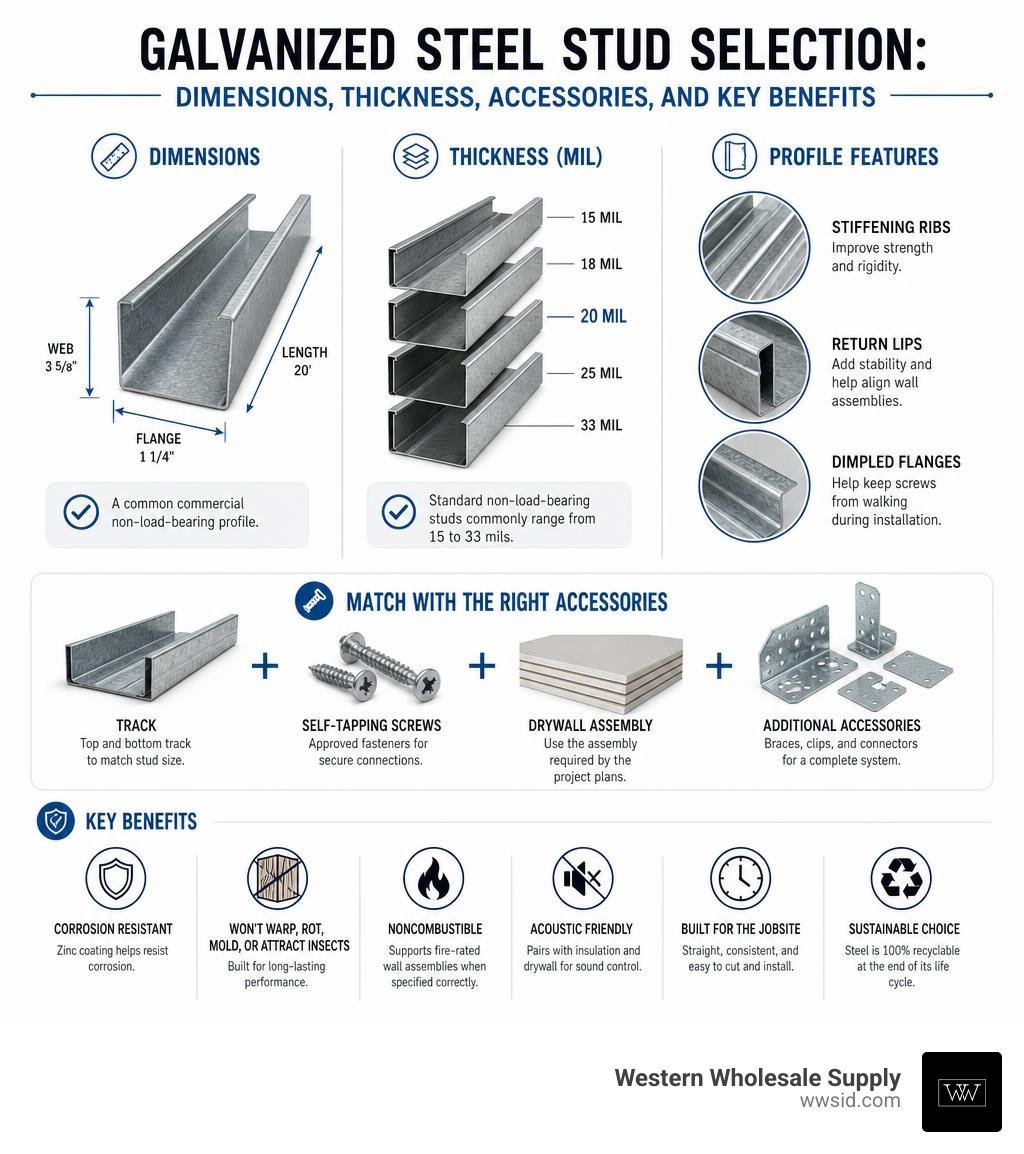
Galvanized steel studs definitions:
Manufacturing Standards and Types of Galvanized Steel Studs
The manufacturing of galvanized steel framing begins with continuous hot-dip galvanized cold-rolled steel coils. In this process, structural steel strip passes through a molten zinc bath, forming a metallurgical bond that shields the core metal from oxygen and moisture. The base sheet thickness for light gauge profiles typically spans from 0.18 mm to 0.6 mm (approximately 15 to 33 mils), tailored to meet specific non-load-bearing interior partition wall demands.
High-performance framing systems adhere to strict quality benchmarks, including ISO9001 quality management standards and recognized ASTM International manufacturing guidelines. For projects requiring enhanced durability in conditioned or semi-conditioned spaces, builders often turn to our G60 metal studs to achieve greater zinc coverage than baseline commercial coatings. Every bundle of quality steel framing arrives backed by mill certification, confirming yield strength, tensile properties, and precise zinc coating weights.
Anatomy and Profiles of Galvanized Steel Studs
A standard galvanized framing stud features a clean cross-section comprising a web, two flanges, and return lips that add longitudinal stiffness.
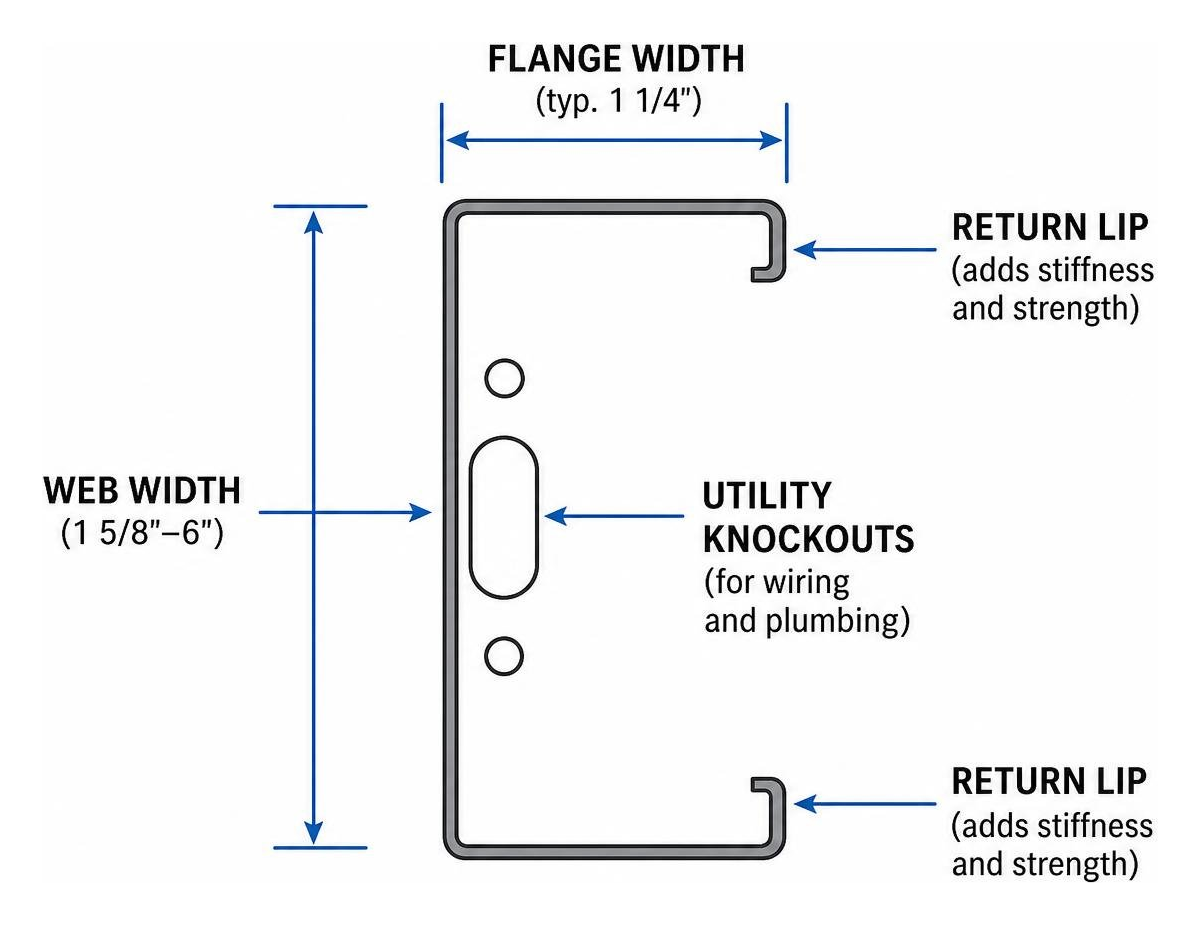
Common dimensions include:
- Web Width: Standard sizes range from 1 5/8 inches to 6 inches, with the 3 5/8-inch web serving as the industry benchmark for commercial partition walls.
- Flange Width: Typical non-load-bearing flanges measure 1 1/4 inches, providing ample surface area for securing gypsum panels.
- Length: Stock pieces are standard at 10, 12, and 20 feet, though custom pre-cut lengths help eliminate jobsite waste.
- Return Lips and Knockouts: Return lips reinforce the flange edges against bending, while factory-punched utility knockouts spaced along the web allow electrical wiring and plumbing lines to run smoothly without on-site field cutting.
Standard industry nomenclature follows an alphanumeric coding system. For example, part number 362S125-33-20 designates a 3 5/8-inch web (362 = 3.625 inches), a standard Stud profile (S), a 1 1/4-inch flange (125 = 1.25 inches), a 33-mil base metal thickness (20 gauge), and a 20-foot overall length.
Surface Enhancements and Anti-Sideslip Performance
Modern cold-formed engineering incorporates textured surfaces to streamline drywall hanging. Factory knurling or dimpled pitting along the stud flanges creates an anti-sideslip surface. When trades drive fasteners into the metal, this mechanical texture keeps sharp points from skating across the steel, protecting boards from damage and speeding up installation.
Furthermore, built-in vice-keel edge stiffeners provide enhanced structural rigidity. These longitudinal ribs run along the web and flange transitions, resisting subsidence and local buckling when panels are hung or when walls experience incidental lateral impacts.
Technical Specifications: Gauges, Mils, and Structural Profiles
Selecting the appropriate thickness is critical for meeting architectural deflection limits without over-engineering interior partitions. Review our guide on Frame Your Future Building with Cold Formed Steel to better understand how structural engineering principles apply to modern construction assemblies.
| Mil Thickness | Traditional Gauge Reference | Base Metal Thickness (in / mm) | Primary Application |
|---|---|---|---|
| 15 mil | 25 Gauge EQ (Ultra-Light) | 0.0150 in / 0.38 mm | Low-height non-load bearing interior partition walls, standard closet chases |
| 18 mil | 25 Gauge Standard | 0.0179 in / 0.45 mm | Standard residential and light commercial interior drywall partitions |
| 30 mil | 20 Gauge EQ | 0.0296 in / 0.75 mm | Commercial interior partitions with taller spans or heavier wall hangings |
| 33 mil | 20 Gauge Structural / Standard | 0.0329 in / 0.84 mm | Demising walls, tall chase walls, non-load bearing assemblies receiving heavy tile backers |
When ordering materials from Light Gauge Steel Framing Suppliers Near Me Top Local Options, verify that your interior studs are designated specifically for non-load-bearing partitions under design deflection criteria such as L/120, L/240, or L/360.
Integrating Tracks and Framing Accessories
A rigid wall framework relies on matching components to perform under real-world building movements. Studs sit inside floor runners and ceiling tracks, which come in matching web widths and mil thicknesses.
To handle floor deflection and structural movement from above, framers install deep-leg deflection tracks or slotted runners at the ceiling deck. Securing these assemblies requires professional hardware—use premium fasteners from Brighton Best or Grabber to ensure high pull-out values and prevent head stripping. For specialized anchors and heavy equipment support, consult our complete breakdown of framing clips and hardware.
When completing wall assemblies, implement proven drywall installation methods alongside proper acoustical sealants and firestop caulks to maintain required sound (STC) and life-safety ratings.
Performance Advantages of Steel Framing Over Wood

Steel provides substantial advantages over traditional timber studs:
- Fire Resistance: Steel is completely non-combustible. It does not ignite, fuel flames, or produce toxic smoke, making it straightforward to build multi-hour fire-rated assemblies.
- Moisture and Mold Resistance: Unlike lumber, steel does not absorb humidity, swell, rot, or support fungal and mold growth.
- Dimensional Stability: Steel members are manufactured straight and remain true. They do not bow, warp, twist, shrink, or crown over time, eliminating unsightly drywall fastener pops and wavy corridors.
- Pest Immunity: Termites, carpenter ants, and rodents cannot chew through or compromise galvanized steel.
To learn more about these core material advantages, read The Ironclad Truth About Steel Framing Solutions for a deep dive into building durability.
Selecting Galvanized Steel Studs for Commercial and Residential Partitions
Whether designing commercial healthcare facilities, office suites, or residential basements, proper partition planning ensures long-term performance. For sound control in media rooms and conference halls, pair light-gauge studs with high-performance sound-damping gypsum like Quietrock EZ Snap. In wet zones like commercial restrooms and kitchen areas, hang moisture-resistant tile backer boards like Durock directly onto 20-gauge framing members.
When outfitting warehouses and adjacent storage facilities, pairing proper steel framing with adequate insulation ensures thermal efficiency—aiming for Ceilings R-30+ and Walls R-13+ to maintain stable interior climates across changing seasons. Finish joints smoothly using top-tier taping knives from Hyde, USG Sheetrock Tools, Columbia Taping Tools, or Marshalltown.
Regarding regulatory standards, quality galvanized steel complies with environmental health mandates, including California Proposition 65 guidelines regarding clean manufacturing and safe jobsite handling. For deeper insights on selecting the right wall panels, check our resource on Frame Your Future Understanding Gypsum Steel Components.
Frequently Asked Questions About Galvanized Steel Framing
What gauge is best for interior non-load bearing galvanized steel studs?
For standard 8-to-9-foot interior residential partitions, 25-gauge (15 to 18 mil) studs are often sufficient for holding 1/2-inch or 5/8-inch gypsum board. For commercial environments, taller partition spans above 10 feet, or walls carrying cabinetry and heavy tile backers, 20-gauge (30 to 33 mil) studs provide the required lateral stiffness and fastener retention strength.
How do surface dimples and knurling improve steel stud installation?
Surface dimpling and knurling provide mechanical traction for sharp self-piercing and self-drilling screws. Instead of sliding off flat galvanized surfaces when driving fasteners at an angle or under pressure, the screw point seats securely in the textured surface, accelerating installation and reducing wrist fatigue.
Are galvanized steel studs susceptible to rust or corrosion?
Galvanized steel studs offer exceptional corrosion resistance because the zinc layer acts as a sacrificial barrier. Even if the steel edge is cut or scratched during framing, the surrounding zinc naturally protects the exposed core metal. Standard G40 coatings are suitable for normal indoor environments, while G60 or G90 coatings are recommended for high-humidity areas.
Conclusion
Choosing the right galvanized steel studs comes down to knowing your project’s architectural requirements: web depth, flange dimension, metal thickness, and compatible track accessories. Reviewing engineering spans and verifying mill certifications ensures your wall assemblies remain straight, durable, and code-compliant.
For contractors and builders across Idaho Falls, Pocatello, Jackson, Driggs, Victor, Rexburg, Rigby, Shelley, Blackfoot, Chubbuck, Burley, Kimberly, and Twin Falls, Western Wholesale Supply delivers top-grade steel framing solutions directly to your jobsite. We also supply premium interior ceiling products, including CertainTeed architectural ceiling tiles. As an independent, veteran-owned, third-generation family business serving Eastern Idaho, South East Idaho, Western Wyoming, and Western Montana since 1963, we back every order with over 60 years of expertise and reliable service.
Ready to get started on your next framing layout? Contact our team today to source premium steel framing materials and keep your project on schedule.
