

Choose the Right Buildex E-Z Ancor for a Strong Drywall Mount
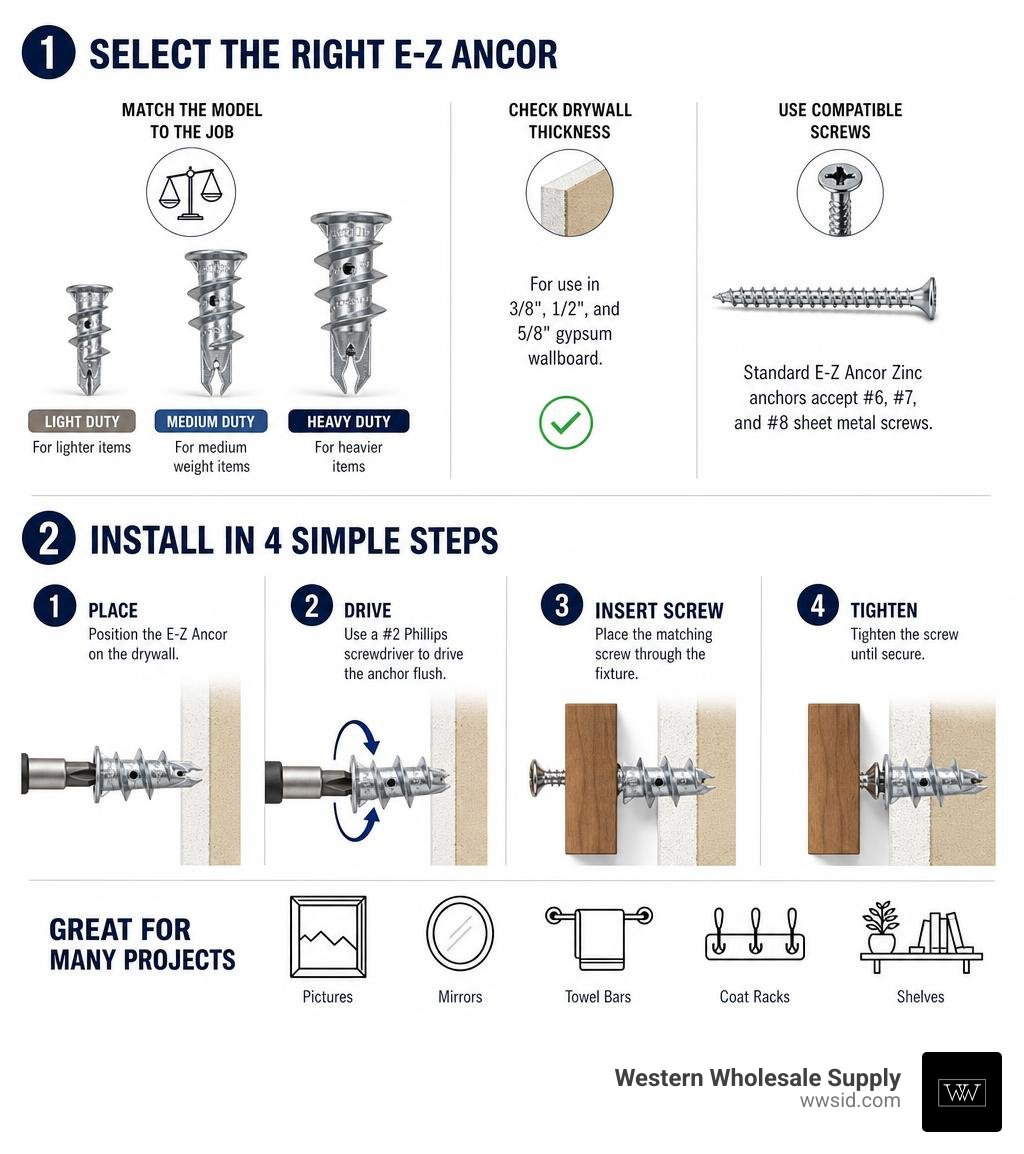
A Buildex E-Z Ancor is a self-drilling drywall anchor for securing fixtures when a stud is not available. Choose the model for the fixture weight and drywall thickness, drive it flush with a #2 Phillips screwdriver, then install the matching screw. Standard E-Z Ancor Zinc anchors accept #6, #7, and #8 sheet metal screws and are designed for 3/8-inch, 1/2-inch, and 5/8-inch gypsum wallboard.
Its wide, deep threads cut into the gypsum board and spread the load over more material than a basic plastic plug. That makes E-Z Ancors a fast option for pictures, mirrors, towel bars, coat racks, and many shelves. But ratings vary by model and wall thickness, so treat published capacity as a per-job limit, use a safety margin, and never use these anchors for ceilings or television mounts.
At Western Wholesale Supply, we work with contractors across residential and commercial projects. In this guide, we break down Buildex E-Z Ancor options in practical terms so you can select and install the right fastener with confidence.
Buildex ez ancor terms to learn:
Understanding the Buildex E-Z Ancor System and How It Works
Hanging wall fixtures without a solid wood or metal framing stud behind the gypsum board can lead to loose hardware or damaged sheetrock. The buildex ez ancor system eliminates these common frustrations by combining the pilot drilling and anchor-setting steps into a single, clean motion. Instead of using separate drill bits, standard wall plugs, and setting tools, you can install the anchor directly into the sheetrock using basic hand tools.
The anchor body functions around two critical engineering elements:
- Self-Drilling Precision Point: The tip cuts an exact, circular pilot entry into the gypsum wallboard without crushing the surrounding compressed gypsum core.
- Deep Outer Thread Profile: As the body rotates inward, wide-flange external threads carve deep channels into the gypsum panel, transferring and distributing mechanical loads evenly across the core material.
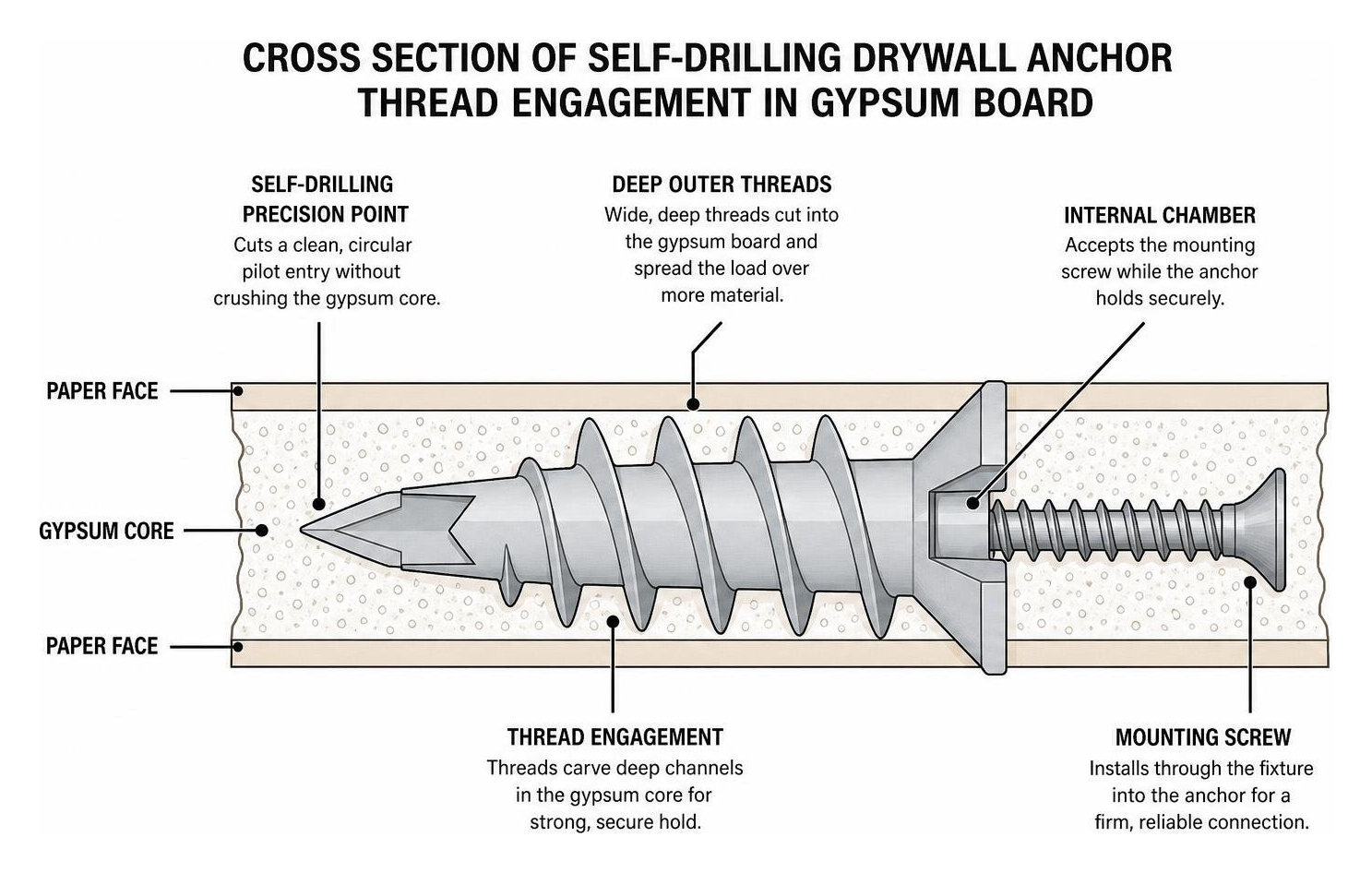
This mechanical design prevents the anchor from stripping the drywall paper face. When paired with high-quality specialty fasteners like those from Brighton Best or Grabber, the internal chamber accepts the mounting screw while anchoring itself firmly. If you are exploring various hardware options, reviewing our beginners guide to choosing the right drywall anchor can help match specific project needs to proper anchor geometries. Detailed engineering specifications can also be verified through technical documentation such as Part Number 5000902, EZ ANCOR® ZINC.
Material Choices: Die-Cast Zinc vs. Engineered Nylon
E-Z Ancors are manufactured in two primary material compositions, each tailored to distinct interior environments:
- Die-Cast Zinc Alloy: Zinc models provide exceptional structural rigidity, making them ideal when driving into denser boards or encountering tough backing materials. The zinc casting resists corrosion in standard indoor settings and provides crisp thread cutting during installation.
- Engineered White Nylon (Fiber-Reinforced Resin): High-strength nylon variants offer an alternative that is completely non-conductive. This characteristic makes them a safe choice around commercial electrical raceways and lighting junction boxes. In addition, engineered nylon delivers high chemical and moisture resistance.
Sizing, Screw Compatibility, and Drywall Thicknesses
The standard E-Z Ancor Zinc design accommodates sheet metal screw sizes #6, #7, and #8, giving you versatility when hanging various bracket gauges. The anchor is engineered to seat cleanly in 3/8-inch, 1/2-inch, and 5/8-inch gypsum wallboard panels, as well as specialty acoustic drywall like Quietrock EZ Snap.
Matching your anchor to panel thickness is critical for reliable performance; understanding how sheetrock thickness impacts anchor choice ensures your fastener maintains full mechanical engagement across the gypsum core without stripping out the backside paper.
Holding Capacities Across Different E-Z Ancor Models
Drywall anchor load ratings are measured in two directions: shear load (downward force parallel to the wall face) and tension/pull-out load (force pulling directly outward perpendicular to the wall face).
Manufacturers determine these ratings under controlled laboratory conditions in pristine gypsum board. In real-world job sites across Eastern Idaho and Western Wyoming—from Driggs, Victor, and Jackson down through Idaho Falls, Pocatello, Rexburg, and Twin Falls—gypsum age, ambient humidity, and vibration can influence performance. Always apply a safety factor (typically using no more than 25% of the ultimate laboratory capacity for sustained dead loads).
| Anchor Model | Material | Drywall Thickness | Shear Holding Rating | Primary Project Use Case |
|---|---|---|---|---|
| E-Z Ancor Lite | White Nylon | 3/8″ to 1/2″ | 25 lbs | Smoke alarms, light switch plates |
| E-Z Ancor Mini | Die-Cast Zinc / Nylon | 1/2″ (up to 5/8″) | 30 lbs – 50 lbs | Framed prints, small wall clocks |
| E-Z Ancor Zinc (#5000902) | Die-Cast Zinc | 1/2″ (up to 5/8″) | 50 lbs – 75 lbs | Bathroom mirrors, decorative shelving |
| E-Z Stud Solver | Die-Cast Zinc | 1/2″ to 5/8″ | Up to 75 lbs | Multipurpose wall mounting |
| E-Z Twist-N-Lock | Engineered Plastic | 1/2″ (up to 5/8″) | 75 lbs – 80 lbs | Floating wall shelves, coat racks |
| E-Z Toggle | Zinc / Steel Mechanism | 1/2″ (up to 5/8″) | 85 lbs – 150 lbs | Heavy decorative fixtures, towel bars |
E-Z Ancor Zinc, Lite, and Mini Performance
The standard E-Z Ancor Zinc provides a dependable 50 lb shear holding capacity in 1/2-inch gypsum wallboard, increasing up to 75 lbs in 5/8-inch heavy-duty commercial board. For lighter wall hangings where a smaller profile is preferred, the E-Z Ancor Lite supports up to 25 lbs, while the E-Z Ancor Mini holds 30 lbs on 1/2-inch drywall and up to 50 lbs on 5/8-inch drywall. Contractors looking for manufacturer product lines can review the E-Z Drywall Anchors – Buildex specifications.
Heavy-Duty Variants: E-Z Twist-N-Lock and E-Z Toggle
When mounting medium-to-heavy fixtures, specialized variants provide higher resistance against shear strain:
- E-Z Twist-N-Lock: Designed with a specialized mechanical head that emits an audible “click” once the internal screw expands the anchor wings behind the drywall. It achieves a 75 lb rating in 1/2-inch drywall and up to 80 lbs in 5/8-inch drywall.
- E-Z Toggle: Combines a self-drilling body with a heavy-duty flip-toggle bar. Once driven flush, driving the screw pivots a solid metal toggle behind the board, delivering an 85 lb rating in 1/2-inch board and reaching up to 150 lbs maximum shear capacity.
To understand how heavy-duty mechanical toggles perform compared to traditional sleeves, read our guide on how they compare to traditional molly fasteners.
Step-by-Step Installation and Fastener Comparisons
Proper installation of self-drilling anchors relies on controlled driving pressure rather than brute force. Using hand tools prevents overtightening and protects the internal gypsum core from crumbling.

For trade professionals seeking proper hollow wall methods, learning how hollow wall anchor tools work provides helpful mechanical context.
Step-by-Step Installation for the Buildex E-Z Ancor
- Mark Anchor Placement: Determine the fixture location using a level and mark the anchor entry point with a pencil.
- Engage the Gypsum Surface: Place the self-drilling point of the E-Z Ancor firmly against your pencil mark. Use a manual #2 Phillips screwdriver.
- Drive Clockwise with Steady Pressure: Press inward while turning clockwise. The cutting tip will core an entry hole, and the wide threads will begin drawing the anchor into the sheetrock.
- Seat Flush to the Surface: Continue turning until the wide, low-profile anchor head rests completely flat against the paper face of the wallboard. Avoid over-rotating, which strips out the gypsum threading.
- Attach Fixture and Drive Screw: Align your fixture bracket over the anchor mouth. Insert the recommended #6, #7, or #8 sheet metal screw through the fixture and turn clockwise into the anchor until tight. On Twist-N-Lock models, you will hear a distinct mechanical click confirming proper expansion.
E-Z Ancor vs. Plastic Expansion Plugs and Traditional Toggles
Understanding how the E-Z Ancor stacks up against older fastening systems helps clarify when to specify it on the job:
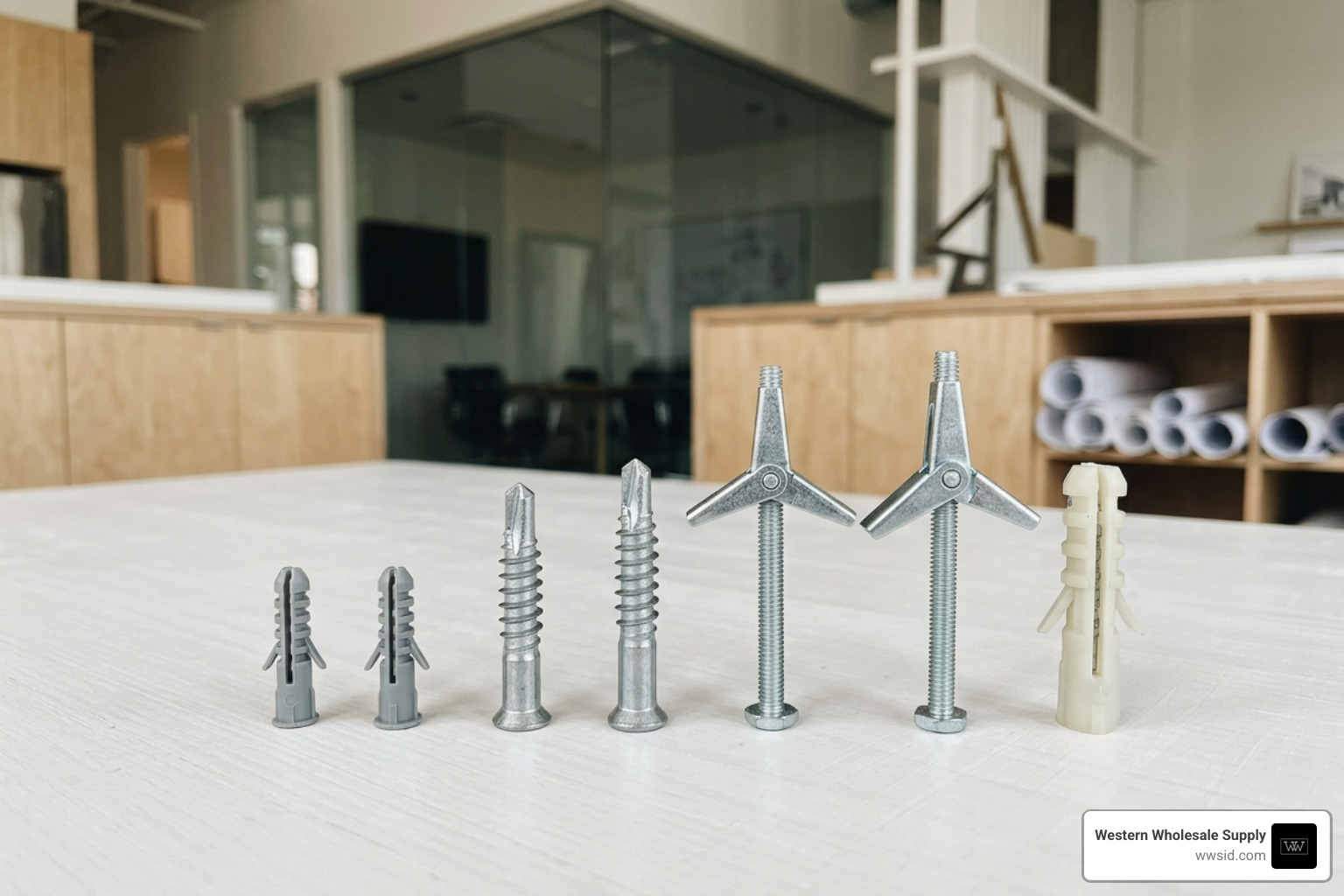
- Compared to Plastic Expansion Plugs: Standard plastic expansion plugs require a separate drill bit, produce drywall dust during drilling, and can spin uselessly inside oversized pilot holes. E-Z Ancors eliminate pre-drilling and grip a broader section of drywall core.
- Compared to Traditional Spring Toggle Bolts: Spring toggles provide solid holding capacity, but require large 1/2-inch to 5/8-inch drilled clearance holes that weaken the wall. Furthermore, if you remove the screw from a traditional toggle, the spring wing falls behind the wall cavity forever. E-Z Ancors stay threaded in place, allowing hardware to be removed and remounted easily.
Reviewing proper drywall anchor types will help you choose the right fastener configuration for any wall substrate.
Packaging Options, Practical Uses, and Critical Safety Rules
E-Z Ancors are packaged for both single-room tasks and large commercial installations. Standard trade packaging includes 100-count contractor boxes, while commercial supply orders range from bulk master cases of 1,500 to 10,000 units.
Key Applications and Limitations of the Buildex E-Z Ancor
E-Z Ancors are well-suited for everyday interior fixtures, such as:
- Hanging decorative wall mirrors and vanity accents.
- Securing framed art and commercial signage.
- Mounting bathroom towel bars, grab rings, and paper holders.
- Fastening floating wooden wall shelves and coat racks.
- Securing HVAC return grilles and lightweight thermostats.
Critical Safety Precautions
- Total Load per Job, Not per Anchor: Published capacities indicate the total load capacity for the complete fixture assembly. Adding four 50 lb anchors to a single wall bracket does not mean you can safely hang a 200 lb fixture on hollow sheetrock. The structural limitation remains the shear strength of the gypsum board itself.
- Prohibition on Ceiling Applications: Self-drilling anchors should never be installed overhead in ceiling drywall. Ceilings subject fasteners to direct, continuous tension loads, which can pull the core out under gravity. For ceiling assemblies, use dedicated framing fasteners or specialized overhead hardware.
- Prohibition on Television Mounts: Articulating and fixed TV wall mounts exert significant dynamic leverage and cantilevered pull-out force whenever the screen is moved. TVs must always be anchored directly into structural wood framing or solid backing.
- Wet-Area Backer Boards: For heavy tile backing installations like Durock cement board, use dedicated cement board screws rather than standard drywall anchors.
For specific layout planning, review our guide on selecting anchors for picture hanging.
Frequently Asked Questions About E-Z Drywall Fasteners
Can a self-drilling anchor be cleanly backed out and removed?
Yes. If you decide to rearrange wall decor or renovate, simply remove the fixture screw, insert your #2 Phillips screwdriver into the anchor head, and rotate counterclockwise. The anchor will back out cleanly along its original cut threads, leaving a neat, circular opening that can be skimmed flat with spackle and finished using professional taping knives from Hyde, USG Sheetrock Tools, Columbia Taping Tools, or Marshalltown.
What tools are required for installing self-drilling wallboard anchors?
A standard manual #2 Phillips screwdriver is all that is required for standard installations. While variable-speed cordless drills can be used on low-torque clutch settings, manual screwdrivers give you better tactile feel, preventing over-rotation and preserving the integrity of the gypsum core.
Why are self-drilling anchors prohibited in ceiling applications?
Ceiling fasteners experience continuous direct pull-out (tension) force rather than lateral shear force. Gypsum core composition is prone to micro-fracturing under sustained downward tension, risking sudden fixture release.
Conclusion
The Buildex E-Z Ancor system simplifies wall-mounting tasks by eliminating pre-drilling and seating flush in seconds. By selecting the right material—die-cast zinc for rigid cutting performance or engineered nylon for non-conductive applications—and matching your fixture weight to realistic drywall ratings, you can secure interior wall accessories with lasting confidence.
At Western Wholesale Supply, we take pride in supporting builders, dryliners, and homeowners across Eastern Idaho and Western Wyoming—including Blackfoot, Chubbuck, Burley, Kimberly, Shelley, and Rigby. Whether you are stocking up on high-grade fasteners from Brighton Best and Grabber, installing CertainTeed ceiling systems, or finishing sheetrock with trusted drywall tools, our team is here to provide reliable building materials and over 60 years of regional expertise. To master your next interior project, explore our comprehensive guide to hanging fixtures securely and get every mount done right the first time.
