

What Are Fiberglass Reinforced Panels?
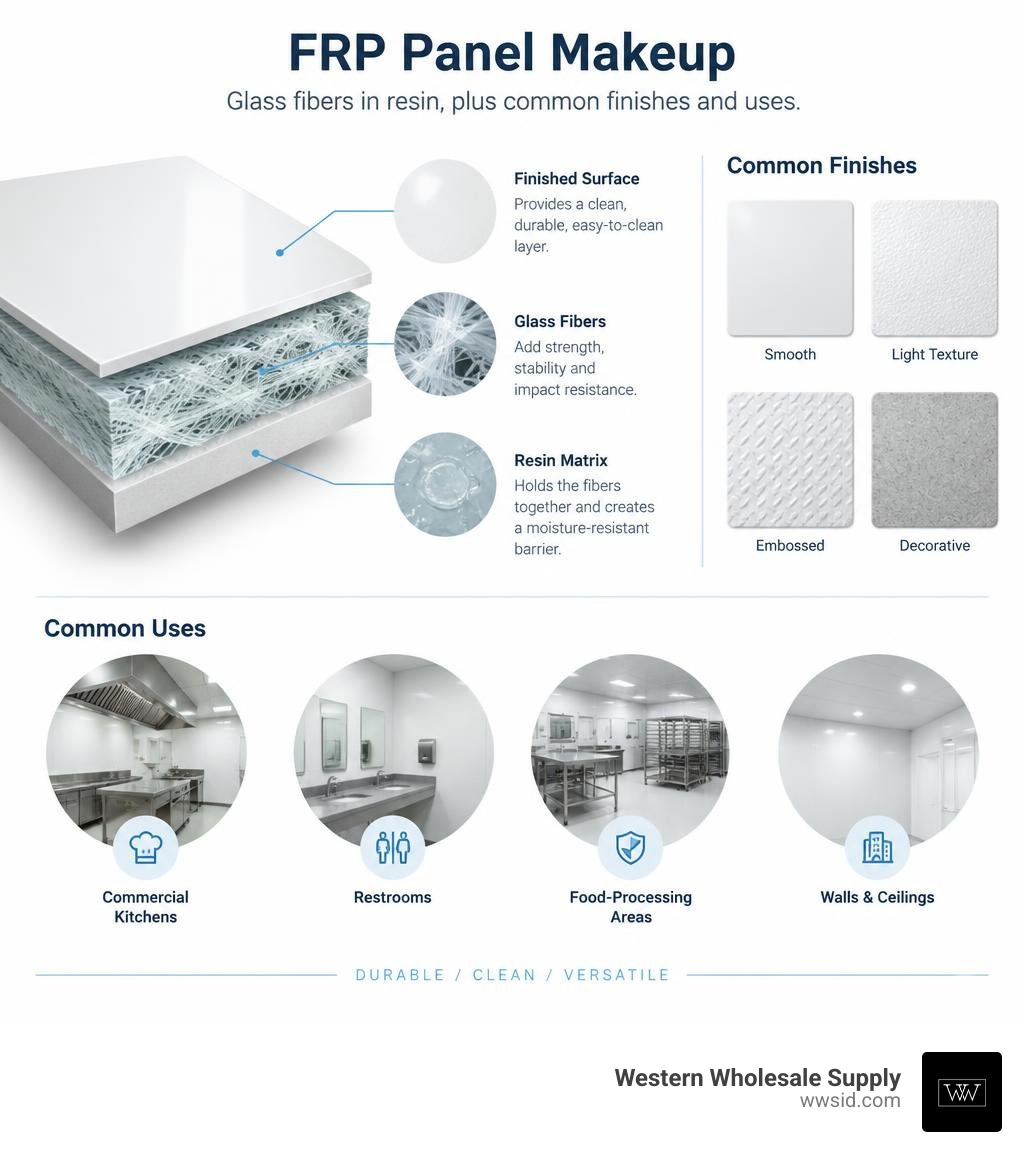
Fiberglass reinforced panels (FRP) are sheets made with glass fibers embedded in resin. They create a durable, easy-to-clean surface for walls and ceilings in places such as commercial kitchens, restrooms, and food-processing areas. FRP resists moisture and everyday impacts, but the right panel, fire rating, and installation method depend on the job.
At Western Wholesale Supply, our third-generation building materials team works directly with contractors on material selection and supply, including fiberglass reinforced panels. This guide will help you choose the right type, understand its limits, and plan for installation and upkeep.
Key Material Properties of Fiberglass Reinforced Panels
Fiberglass composites have proven their worth across transportation, marine, military, and building sectors since 1965. In commercial interiors, fiberglass reinforced panels deliver a blend of tensile strength, flexural rigidity, and chemical resistance that painted surfaces simply cannot replicate.
Standard commercial wallboard meets the rigorous ASTM D-5319 standard specification for glass-fiber reinforced polyester wall and ceiling panels. The thermoset polyester resin matrix holds chopped glass fibers securely in place, creating an impact-resistant composite shield. When evaluating panels for demanding spaces, reviewing a comprehensive guide to FRP wall panels helps ensure the physical attributes match your project load and abuse requirements.
| Physical Property | Test Standard | Standard Commercial FRP Value | Traditional Drywall (Unfaced) |
|---|---|---|---|
| Flexural Strength | ASTM D790 | 14,000 psi | ~400–600 psi |
| Tensile Strength | ASTM D638 | 4,300–10,000 psi | Low / Nominal |
| Water Absorption | ASTM D570 | 0.20% | High (absorptive paper face) |
| Surface Hardness | ASTM D2583 | 35–53 Barcol | Indents under fingernail/impact |
| Flexural Modulus | ASTM D790 | 0.69 × 10⁶ psi | Varies by gypsum core density |
| Thermal Expansion | ASTM D696 | 3.2–3.51 × 10⁻⁵ in/in/°F | Minimal movement |
Fire Safety and Code Compliance
Building codes strictly dictate surface burning characteristics depending on occupancy classification and room function. Surface flammability is evaluated via the ASTM E84 tunnel test (or CAN/ULC S102 in Canadian jurisdictions), generating a Flame Spread Index (FSI) and a Smoke Developed Index (SDI):
- Class A (Class I): Requires an FSI of 0–25 and SDI under 450. Required in educational corridors, hospital surgical suites, and specialized high-occupancy paths of egress.
- Class C (Class III): Requires an FSI of 76–200 and SDI under 450. Widely accepted in utility rooms, restrooms, repair garages, and general storage areas.
Beyond fire ratings, commercial panels frequently carry NSF/ANSI 51 certification for direct and splash food-contact zones and meet strict USDA/FSIS sanitation standards. This ensures the material will not harbor pathogens, leach harmful chemicals, or degrade under daily sanitization.
Moisture and Chemical Resistance
Moisture migration is the primary enemy of structural wall cavities. With a nominal water absorption rate of only 0.20%, FRP acts as a completely non-porous vapor barrier on wall assemblies. It will not rot, rust, corrode, or support mold and mildew growth.
Operating comfortably in temperatures ranging from -40°F up to 150°F, FRP panels withstand flash-freezing in walk-in meat lockers as well as heavy steam cleaning in commercial sculleries. The resin finish shrugs off regular contact with mild acids, alkalis, grease, and household staining agents.
Core Types, Dimensions, and Surface Finishes
Choosing the proper configuration begins with understanding dimensions and textures. Standard sheets measure 4 feet wide and come in standard lengths of 8, 9, 10, and 12 feet, with standard thickness running at 0.090 inches (3/32 inch nominal). Lighter-gauge liners (0.050 inches) and heavy-duty 0.120-inch industrial boards are also engineered for specific applications. If you are new to specifying these systems, reviewing the basics of FRP wallboard simplifies the selection process.
Surface finishes primarily fall into two categories:
- Embossed Pebble Texture: The classic textured pattern diffuses light and conceals scratches, scuffs, and minor abrasions caused by carts and equipment.
- Smooth Surface: Provides a sleek, modern look that is exceptionally easy to wipe down in sterile healthcare and cleanroom facilities.
Color options extend well beyond standard bright white and off-white to include pearl gray, almond, beige, and matte black for contemporary restaurant or retail designs.
Structural Composites and Core Formulations
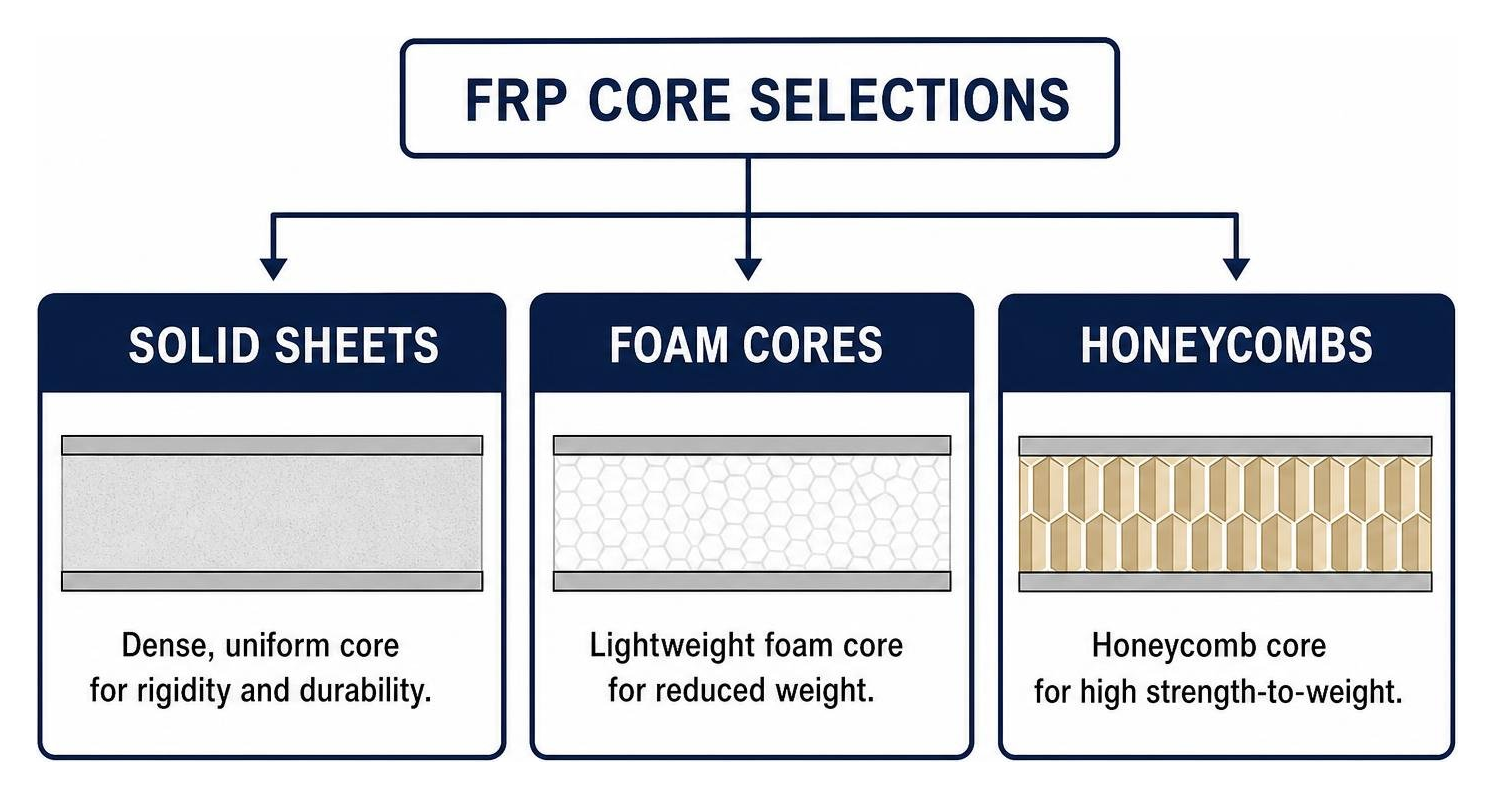
While thin 0.090-inch sheets dominate interior remodeling over gypsum board, thicker composite panels use specialized cores bonded between fiberglass roving laminates:
- Plywood Core Composites: Combine the rigidity and screw-holding power of exterior-grade plywood with impact-resistant fiberglass exterior skins.
- Foam Sandwich Panels: Utilize closed-cell polyisocyanurate foam cores to achieve thermal insulation values around R-4.0 per inch of foam thickness. Advanced RIBBED FOAM CORE panels incorporate fiberglass reinforcement ribs through the depth of the foam, delivering outstanding shear strength and post-impact durability.
- Polypropylene Honeycomb: Delivers maximum weight reduction and exceptional deflection resistance for transportation shells and specialized modular structures.
For broader project scopes involving heavy-duty framing, exploring a structural fiberglass sheets overview helps align structural cores with overall engineering loads.
Primary Applications Across Commercial and Industrial Sectors
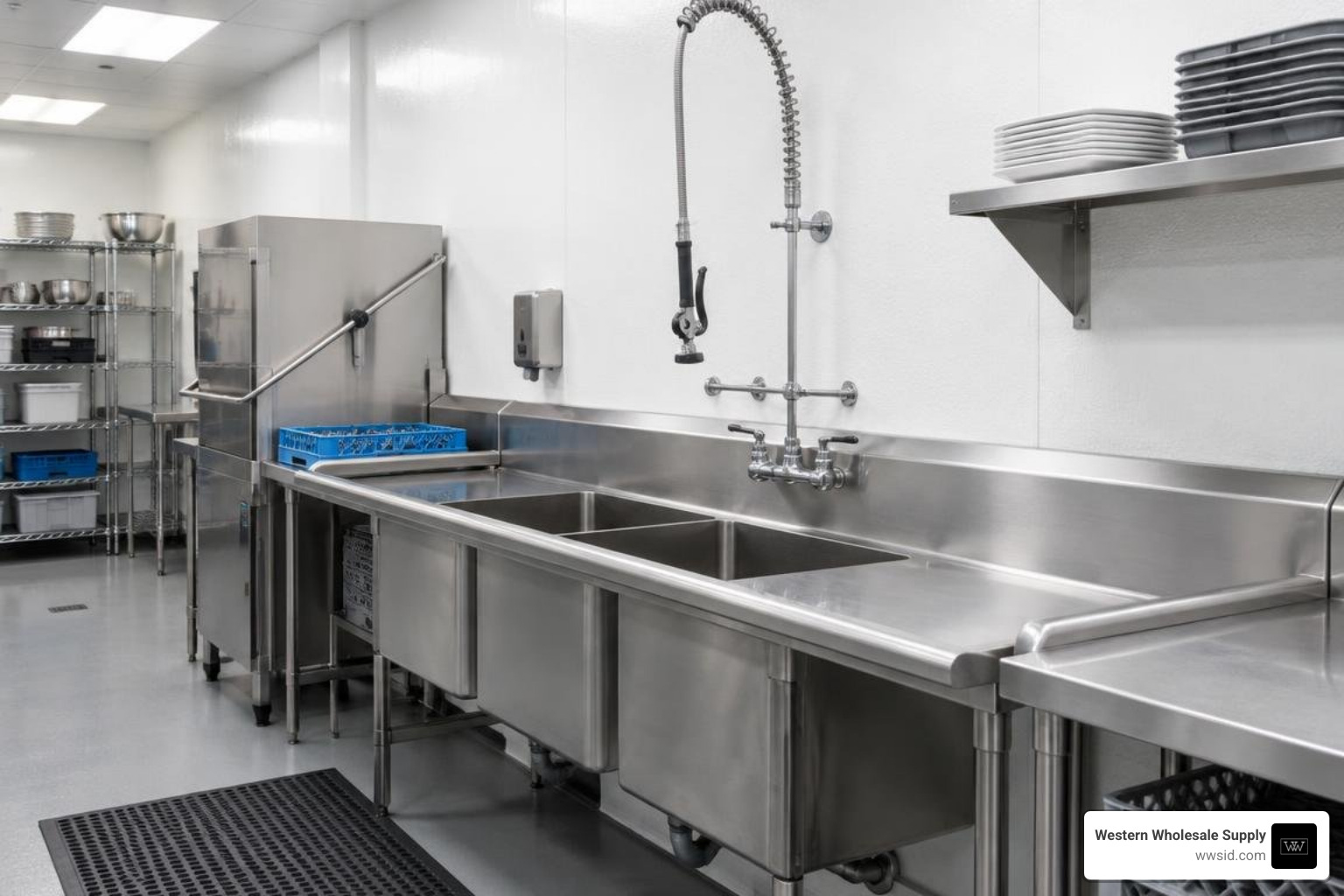
From industrial plants to retail environments, FRP panels handle punishing abuse that would destroy standard painted drywall within days. Exploring various commercial FRP panel applications reveals how versatile these composite boards have become in modern construction.
Commercial and Industrial Applications for Fiberglass Reinforced Panels
- Commercial Kitchens & Food Processing Plants: High heat, splattering grease, and daily pressure washing require non-porous surfaces that meet USDA food-safety requirements.
- Healthcare & Surgical Facilities: Smooth Class A panels prevent bacterial harborage and endure aggressive chemical wipe-downs.
- Laboratories & Clean Rooms: Choosing specialized lab panel options ensures the wall envelope resists chemical reagents and maintains airtight particulate isolation.
- Car Washes & Wet Bays: Constant water spray and detergent exposure demand 100% moisture-proof wall claddings.
- Public Restrooms & Corridors: High-traffic abuse from luggage carts, gurneys, and foot traffic is absorbed by the panel’s flexural strength.
- Workshops & Service Garages: Evaluating garage wall cladding solutions helps facility owners safeguard lower walls against chemical splashes, tools, and heavy equipment scuffs.
Installation Best Practices and Long-Term Maintenance
Achieving a flat, lasting FRP installation requires sound carpentry techniques, careful layout planning, and thorough substrate prep.
Best Practices for Installing Fiberglass Reinforced Panels
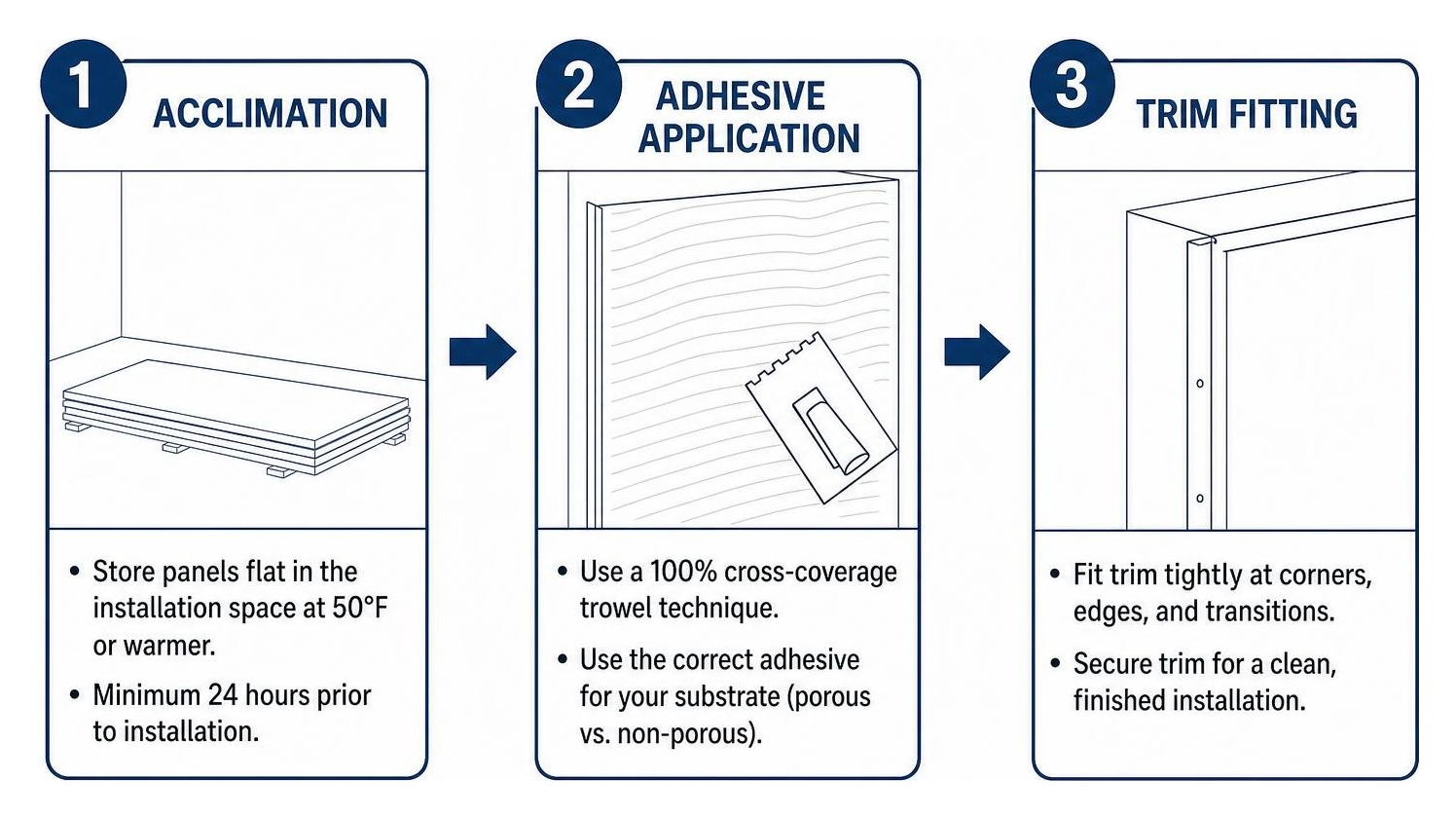
- Acclimation: Always store panels flat in the installation space at 50°F or warmer for at least 24 hours prior to mounting to prevent post-installation thermal expansion ripples.
- Substrate Preparation: Mount panels to smooth, flat, and structurally sound drywall, plywood, or cement board such as Durock. Substrates must be free of dust, grease, and peeling paint.
- Adhesive Application: Use a 100% cross-coverage trowel technique. Consult a proper adhesive selection guide to match water-based or solvent-based adhesives to your specific substrate (porous vs. non-porous).
- Fastening & Trims: Roll the panel with a heavy linoleum roller to eliminate trapped air pockets. Secure corners and edges with color-matched PVC or anodized aluminum division bars, inside/outside corners, and base moldings. Secure trim flanges using corrosion-resistant fasteners from Grabber or Brighton Best.
- Expansion Allowances: FRP moves with seasonal temperature shifts. Leave a 1/8-inch expansion gap at all moldings, ceiling transitions, and wall penetrations, and subtract 1/4 inch overall on vertical height cuts.
- Safe Cutting: Always wear safety glasses and a dust-filtering mask. Cut panels with fine-toothed, carbide-tipped circular saw blades or heavy sheet metal shears.
Cleaning, Sanitization, and Maintenance Protocols
Maintaining FRP is remarkably simple compared to tile and grout:
- Routine Washing: Use warm water (under 130°F) mixed with a 5% to 10% solution of trisodium phosphate (TSP) or a neutral pH 6.5–7.5 detergent. Apply with a sponge or soft-bristle brush, followed by a clean water rinse.
- Mineral Scale & Hard Water: Wipe with a mild 10% acetic acid (white vinegar) solution and rinse thoroughly.
- Stubborn Greases: Spot clean with mineral spirits applied to a soft cloth.
- What to Avoid: Never use steel wool, abrasive scouring pads, or aggressive ketone solvents like acetone or xylene, which can dull and compromise the gel coat surface.
Frequently Asked Questions About Fiberglass Reinforced Panels
How do Class A and Class C fire ratings differ in FRP?
Class A panels provide superior flame-retardant performance with a Flame Spread Index under 25, making them necessary for hospital operating rooms, schools, and building egress corridors. Class C panels allow a flame spread between 76 and 200, which is perfectly suited for general commercial kitchens, utility closets, and storage rooms.
Can fiberglass reinforced panels be installed over existing drywall?
Yes, provided the drywall is structurally sound, clean, flat, and securely fastened to underlying framing. Any loose tape or flaking paint should be scraped smooth, and drywall mud joints must be fully cured and sanded before troweling adhesive.
What is the standard lifespan and maintenance requirement for FRP?
When installed with appropriate expansion joints and quality adhesives, FRP wall panels routinely last 20 to 30 years without fading, chipping, or rotting. Routine maintenance requires only periodic washing with standard mild detergents or power washers.
Conclusion
Whether you are finishing out a commercial restaurant kitchen, outfitting an institutional washroom, or protecting a high-traffic warehouse hallway, fiberglass reinforced panels provide unmatched durability, hygiene, and low-maintenance longevity. For an even deeper exploration of composite specifications, consult the ultimate guide to FRP fiberglass reinforced panels.
At Western Wholesale Supply, we are an independent, veteran-owned, third-generation family business supplying top-tier building materials—including drywall, steel framing, insulation, and CertainTeed acoustical ceiling tiles. Proudly serving contractors across Eastern Idaho and Western Wyoming since 1963 from our yards in Idaho Falls, Pocatello, Jackson, WY, Driggs, Victor, Rexburg, Rigby, Shelley, Blackfoot, Chubbuck, Burley, Kimberly, and Twin Falls, we back every order with reliable, on-time delivery and over 60 years of hands-on expertise.
Contact our team today to get the right FRP panels, color-matched trims, Grabber fasteners, and finishing tools for your next commercial build.
