

Stop Guessing: Find the Right Ceiling Grid Estimator for Your Project
A ceiling grid estimator is a digital tool that calculates exactly how many main runners, cross tees, ceiling tiles, and hanger wires you need based on your room dimensions. Here are the top tools contractors rely on:
| Tool | Best For | Key Inputs |
|---|---|---|
| Professional Material Estimator | Standard commercial installs | Square footage, panel size |
| Standard Grid Calculator | Residential with custom layouts | Room shape, joist direction |
| New Ceiling Tiles Calculator | Cost estimation + material counts | Room dimensions, material pricing |
| General Grid Calculator | Quick rough estimates | Square footage, perimeter |
These tools output material lists for main runners, cross tees, hanger wire, and CertainTeed ceiling tiles — giving you a reliable starting point before you order a single piece.
Miscalculating materials on a ceiling grid project does not just cost money. It costs time. Running short mid-installation or over-ordering by 30% are both avoidable problems when you use the right estimator from the start.
At Western Wholesale Supply, we are third-generation building materials professionals who have helped contractors across the region use ceiling grid estimators to sharpen their material takeoffs and reduce costly overruns. In this guide, we’ll walk through how these tools work and which ones deliver the most reliable results.
Why Every Contractor Needs a Digital Material Takeoff

In the old days, estimating a suspended ceiling involved a crumpled piece of graph paper, a dull pencil, and a lot of “guesstimating.” Today, the margin for error in the construction industry has thinned. Whether you are working on a commercial office in Idaho Falls or a basement renovation in Jackson, precision is the name of the game.
Using a digital ceiling grid estimator is like having a personal assistant who never forgets to carry the one. One of the primary benefits is significant waste reduction. When we order exactly what we need—plus a sensible waste factor—we keep our job sites cleaner and our budgets tighter. Over-ordering leads to piles of “extra” materials that often get damaged in storage, while under-ordering leads to “emergency” runs to the warehouse that kill your labor productivity.
For professionals, these tools provide a level of budget precision that wins bids. Clients appreciate a detailed material breakdown, and Why Every Contractor Needs A Construction Material Calculator explains how these digital helpers have become non-negotiable for modern builders. If you are looking for a straightforward way to start your next takeoff, the USG Ceiling Materials Estimator offers a reliable interface for generating instant material counts.
At Western Wholesale Supply, we’ve seen how a quick digital check can save a contractor from a logistical nightmare. It’s about more than just numbers; it’s about having the confidence that when our delivery truck arrives at your site in Pocatello or Twin Falls, you have every component necessary to finish the job.
Essential Inputs for an Accurate Ceiling Grid Estimator
The accuracy of your estimate is only as good as the data you feed it. If you put in “roughly 20 by 20,” don’t be surprised when your grid doesn’t line up. To get the most out of tools like the Ceiling Material Estimator, you need to have your numbers ready.
Room Square Footage and Perimeter
The foundation of any estimate is the total area and the perimeter. Measure the length and width of the room at the ceiling height, not the floor, as walls aren’t always perfectly plumb. For irregular rooms, break the space into smaller rectangles, calculate each, and then sum them up.
Joist Direction
This is a detail many rookies miss. Joist direction is critical because your main runners—the heavy-duty backbone of the grid—must run perpendicular to the joists for proper support. Most advanced estimators, such as the Drop Ceiling Planner & Calculator – Grid, Tiles & Cost (Free 2025), will ask for this to determine the most efficient layout.
Tile Dimensions: 2×2 vs. 2×4
The choice between 2×2 and 2×4 tiles changes everything from the number of cross tees required to the final aesthetic of the room. 2×4 tiles are often favored for larger residential spaces like basements because they cover area quickly, while 2×2 tiles provide a more high-end, balanced look often seen in commercial offices.
| Material Component | 2×2 Tile Layout (Per 100 Sq Ft) | 2×4 Tile Layout (Per 100 Sq Ft) |
|---|---|---|
| Main Runners (12′) | Approx. 3 pieces | Approx. 3 pieces |
| 4′ Cross Tees | Approx. 9 pieces | Approx. 13 pieces |
| 2′ Cross Tees | Approx. 9 pieces | 0 pieces |
| CertainTeed Tiles | 25 pieces | 13 pieces |
Note: These are approximations for a standard rectangular room. Always use a dedicated ceiling grid estimator for your specific dimensions.
Calculating Core Components: Runners, Tees, and Wire
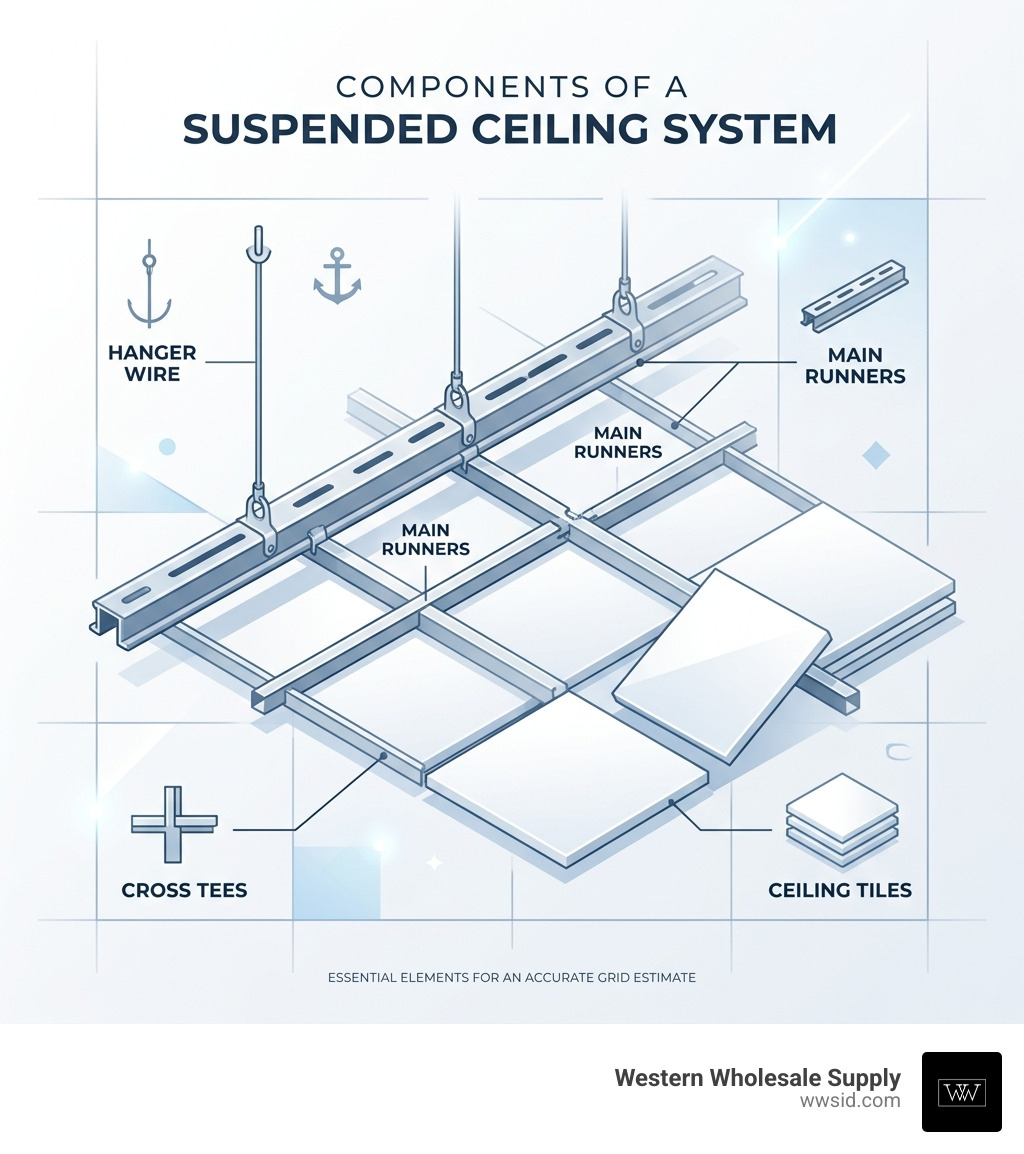
A suspended ceiling is a structural dance between several parts. Understanding these components helps you interpret the results of your estimator.
- Main Runners: These are the primary T-shaped rails that do the heavy lifting. They are typically 12 feet long and are suspended from the overhead structure by hanger wire.
- Cross Tees: These snap into the main runners to create the “boxes” that hold your tiles. Depending on your design, you will use 4-foot or 2-foot cross tees.
- Ceiling Tiles: We highly recommend CertainTeed ceiling tiles for their durability and acoustic properties. Whether you need sag-resistance for a humid environment or high sound absorption for a quiet office, there is a CertainTeed style that fits.
- Hanger Wire: Usually 12-gauge galvanized wire, this is what connects your grid to the building’s structure.
Selecting the right hardware is vital. In our guide, The Little Things That Hold It All Together Hangers Clips And Tape For Your Grid Ceiling, we dive deeper into the specialized fasteners that ensure your ceiling stays where it belongs.
Determining Hanger Wire Spacing in a Ceiling Grid Estimator
One of the most common questions we get at our locations in Rexburg and Driggs is: “How much wire do I actually need?”
For a standard metal grid system, hanger wires should be attached every 4 feet along each main runner. If you are using a lighter PVC-based grid, you might need them every 2 feet. To calculate the length of each wire, measure the distance from the structural anchor point to the desired ceiling height and add 2 feet. That extra 2 feet gives you plenty of room to wrap, tie, and adjust the level of the grid.
Standard estimators usually assume 4-foot spacing, but if you are dealing with heavy light fixtures or HVAC diffusers, you may need to add “heavy-duty” support wires. You can learn more about the nuances of 9/16″ versus 15/16″ systems in our article, Small Grid Big Impact Everything About 916 Ceiling Systems.
How to Use a Digital Ceiling Grid Estimator for Irregular Rooms
Not every room is a perfect box. In fact, in many of the older buildings in Eastern Idaho and Western Wyoming, “square” is more of a suggestion than a reality.
When dealing with L-shaped layouts or rooms with large columns, the best approach is the “sectioning method.” Divide the room into manageable rectangles and run the estimator for each. Ensure you account for the shared “imaginary” boundary where the sections meet.
Perimeter accuracy is also key. If your room has many alcoves, your perimeter grid requirements will skyrocket even if the square footage remains the same. For a professional deep dive into these complexities, check out Mastering The Grid How To Estimate Ceiling Materials Like A Pro.
Additional Supplies and Warehouse Considerations
While the grid and tiles are the stars of the show, a truly professional ceiling installation considers what’s happening above the tiles.
In our region, insulation is not just a luxury—it’s a necessity. For warehouse environments or large commercial spaces in places like Victor or Shelley, adding high-performance insulation above the grid provides massive thermal benefits, keeping heating costs down during our brutal winters.
If sound transmission is a concern—perhaps you’re building a conference room next to a noisy mechanical area—consider integrating Quietrock EZ Snap. While it’s a drywall product, it works in tandem with acoustical ceilings to create a superior sound barrier.
Always include a waste factor in your final order. We generally recommend:
- 5% waste for simple, rectangular rooms.
- 10% to 15% waste for complex rooms with many cuts, angles, or obstacles.
Ordering an extra 10% of your CertainTeed tiles is also a smart move for the building owner. Styles can be discontinued over time, and having a few boxes of matching tiles in storage makes future repairs seamless. For more on optimizing your space for sound, see Grid Ceiling Tiles Your Blueprint For Better Acoustics.
Frequently Asked Questions about Ceiling Grid Estimation
What is the typical cost per square foot for grid materials?
While we don’t list specific prices here due to market fluctuations, there is a general hierarchy to costs. DIY installation is the most budget-friendly, as you are only paying for materials. Professional installation typically adds a labor fee that can nearly double the total project cost. High-end acoustic or specialized fire-rated tiles will also sit at a higher price point than standard commercial panels.
How much extra hanger wire should I order?
As a rule of thumb, use the formula: (Distance to anchor + 2 feet) x (Number of support points). Most estimators will give you a total footage, but it is always wise to round up to the nearest coil. 12-gauge galvanized wire is inexpensive compared to the cost of stopping work because you ran out.
When should I consult a professional for my estimate?
If your project involves complex vaulted designs, seismic requirements (common in certain parts of the Intermountain West), or large-scale commercial bids, a simple online calculator might not cut it. In these cases, consulting with the experts at Western Wholesale Supply can ensure your material list meets local building codes and structural safety standards.
Conclusion
Planning a ceiling project doesn’t have to be a headache. By using a ceiling grid estimator, you can move from “guessing” to “knowing,” ensuring your project stays on track and under budget.
At Western Wholesale Supply, we are more than just a warehouse. We are a veteran-owned, third-generation family business that has served Eastern Idaho and Western Wyoming since 1963. From Idaho Falls to Jackson and everywhere in between, we pride ourselves on reliable, on-time delivery and exceptional customer service. We understand the unique challenges of building in our corner of the country, and we have the inventory—from CertainTeed tiles to 12-gauge wire—to back you up.
Ready to get started on your next project? Explore Professional Acoustical Ceiling Solutions and let us help you turn that digital estimate into a reality.
