

Why Drywall Soundproofing Clips Beat Direct Stud Fastening
Drywall soundproofing clips help block noise by separating the drywall from the studs or joists. The clips hold metal furring channel, which supports the drywall without a direct connection to the framing. This makes it harder for vibration from voices, music, or footsteps to pass through the structure.
For a reliable result, choose clips rated for the drywall load, follow the maker’s spacing plan, and fasten the drywall only to the channel. A screw that reaches the framing can undo much of the benefit.
Western Wholesale Supply is a third-generation building materials supplier that works with contractors on drywall, steel framing, and insulation projects. We’ll use that experience to help you evaluate drywall soundproofing clips as a complete system, not just a single part.
Related drywall soundproofing guides:
- Compare the best soundproofing drywall options for higher-performance wall assemblies.
- Review drywall soundproofing for ceilings before treating overhead noise.
- Estimate how soundproofing drywall costs can vary by assembly and room size.
Acoustic Decoupling: How Drywall Soundproofing Clips Eliminate Flanking Noise
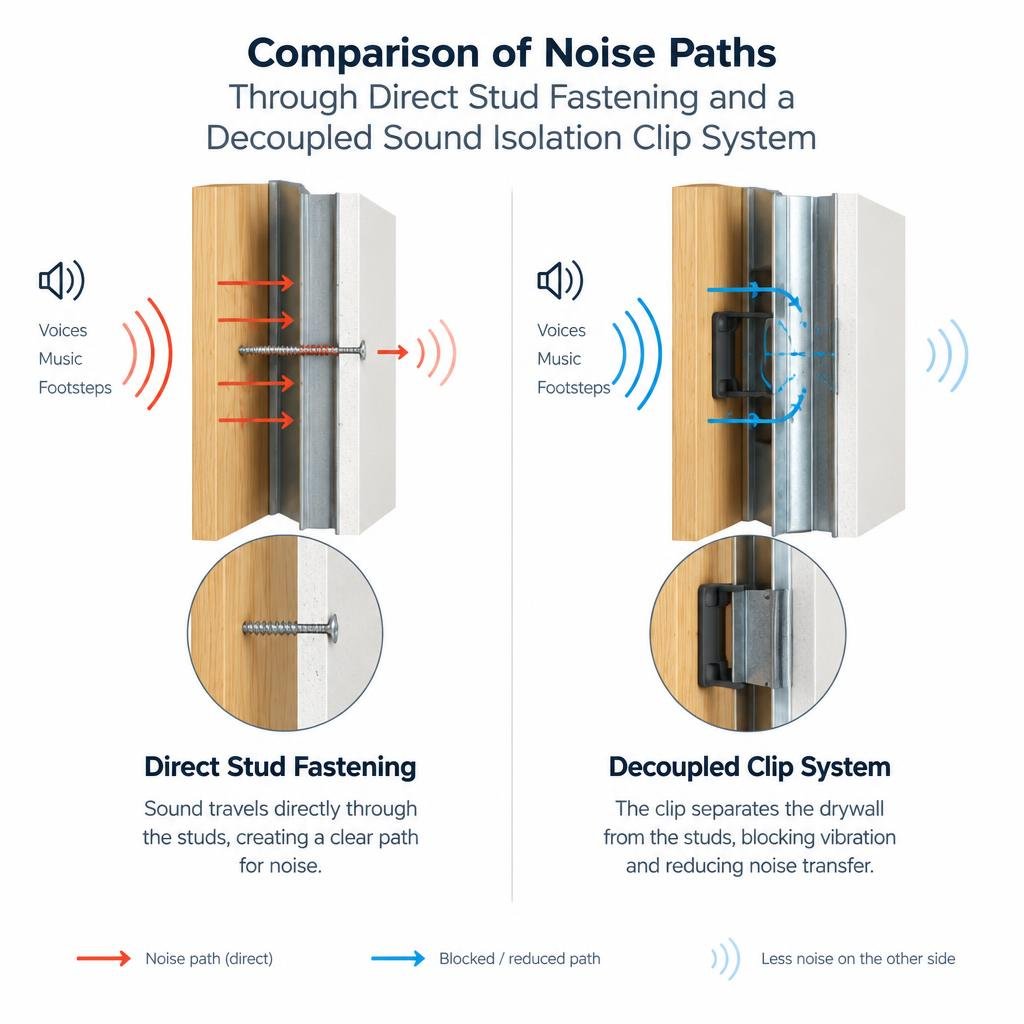
When you screw drywall directly into wall studs or floor joists, you build an efficient acoustic bridge. Sound waves hit the drywall face, convert into mechanical vibrations, travel straight through rigid screws into the framing, and radiate out into the adjacent room.
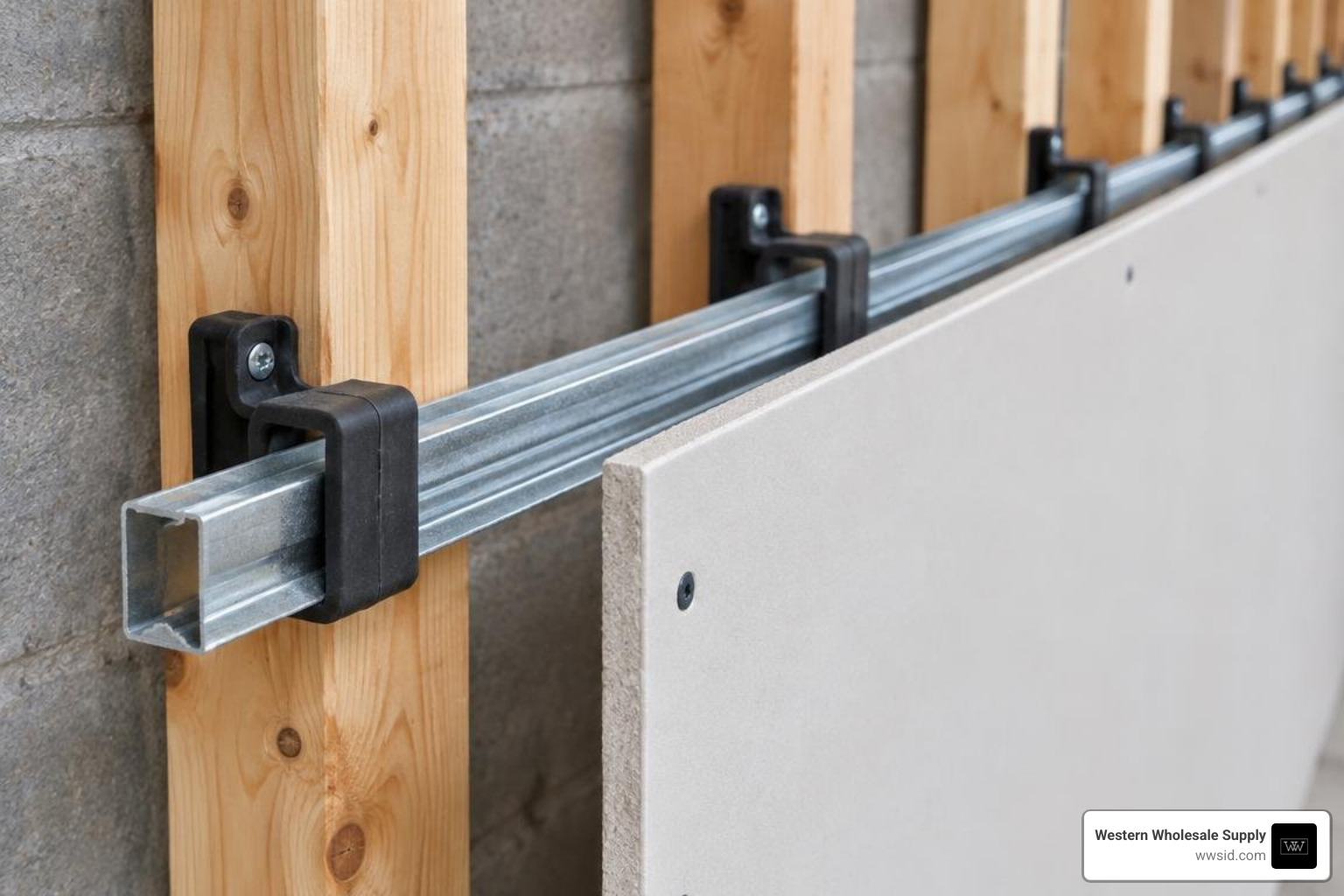
Acoustic decoupling breaks this path. By securing resilient sound isolation clips directly to your framing, you insert an engineered elastomer break between the building skeleton and the finished surface. The drywall hangs on metal furring channels snapped into the clips rather than touching the studs directly. This floating wall or ceiling forces vibration to travel through rubber isolators that absorb and dissipate the acoustic energy before it can jump between spaces.
Understanding the principles of drywall soundproofing helps explain why this separation works so effectively: breaking mechanical contact cuts flanking transmission throughout the entire structure.
Impact and Low-Frequency Damping
High-frequency sounds, such as speech or treble tones, are relatively simple to stop with mass and absorption. Low-frequency energy, including heavy footfalls upstairs or deep bass rumble from a home theater subwoofer, presents a much tougher challenge because its long wavelengths pass easily through solid materials.
Quality sound isolation clips feature heavy-duty rubber or thermoplastic elastomers designed specifically for low-frequency transmission loss. When paired with high-density drywall or a viscoelastic barrier membrane, the system flexes microscopic amounts under vibration, neutralizing heavy bass waves and upstairs footstep thumps that rigid direct fastening cannot control.
STC and IIC Rating Performance Gains
Sound isolation systems are measured by two primary metrics: Sound Transmission Class (STC) for airborne noise and Impact Insulation Class (IIC) for structure-borne impact. Standard direct-fastened drywall assemblies on wood framing often register an STC of only 34 to 38—enough to clearly hear muffled conversations through the partition.
Adding sound isolation clips can add up to 20 STC and IIC points to walls and ceilings, reducing sound transfer by 75% to 100% when installed correctly. For example, high-performance assemblies utilizing heavy-duty clips, two layers of 5/8-inch Type X gypsum board, and damping compound can achieve laboratory-tested ratings of STC 71 on standard 24-inch on-center framing. Even a basic assembly with a single gypsum layer on clips can easily yield an STC of 53, creating a substantially quieter living space.
Comparing Isolation Methods: Clips, Resilient Channel, and Direct Fastening
Choosing between direct fastening, standard resilient channel, and sound isolation clips comes down to performance, longevity, and structural safety.
| Feature / Metric | Direct Stud Fastening | Resilient Channel (RC-1) | Sound Isolation Clips & Hat Channel |
|---|---|---|---|
| Typical Assembly STC | 34 – 38 | 45 – 50 (if uncompromised) | 55 – 71+ |
| Short-Circuit Risk | N/A (100% hard-coupled) | High (screws easily hit studs) | Extremely Low (screws stay in channel) |
| Dead Load Capacity | High (limited by framing) | Very Low (often sags with 2 layers) | 36 lbs per clip (supports 2–3 layers) |
| Installation Error Rate | Low (simple, but poor acoustics) | High (crimping, misaligned screws) | Low (consistent, fool-proof spacing) |
| Long-Term Durability | Permanent structural hold | Prone to fatigue & sagging over time | Robust rubber/steel structural life |
Sound Isolation Clips vs. Resilient Channel
Resilient channel (RC-1) was once the default choice for budget decoupling, but it suffers from a remarkably high failure rate on real job sites. Standard channel relies on a thin, single-leg metal strip that easily bends, crimps, or fatigues under heavy loads.
The most common point of failure is installer error. If an installer drives a drywall screw just a fraction of an inch too deep, penetrating past the metal leg into the wood or steel stud behind it, the resilient channel is instantly short-circuited. That single rigid metal connection creates an acoustic bridge, destroying the decoupling benefit across the entire wall. Sound isolation clips, by contrast, hold a 7/8-inch furring channel out from the stud face, providing ample clearance so standard drywall screws cannot reach the underlying framing.
Engineered Clip Variations: Elastomer and Steel Designs
Modern sound clips use specialized materials engineered for maximum acoustic dampening and structural durability:
- Thermoplastic Rubber Clips: Some clip designs use patented thermoplastic sound cells that outperform standard vulcanized rubber in mechanical resistance and temperature stability across seasons.
- Molded Unibody Steel Clips: Other systems integrate heavy-gauge galvanized steel brackets with molded rubber isolators for high-strength applications.
- High-Yield Decouplers: Tested designs offer high pull-out resistance while dampening broad-spectrum vibration.
- Acoustic Screw Fasteners: Specialized fasteners create isolated micro-gaps on timber framing, reducing noise levels by roughly 9 dB where framing depth is tight.
System Engineering: Hardware, Hat Channels, and Load Capacities
A reliable clip system relies on the interplay between the clip, the metal furring channel, and the gypsum mass.
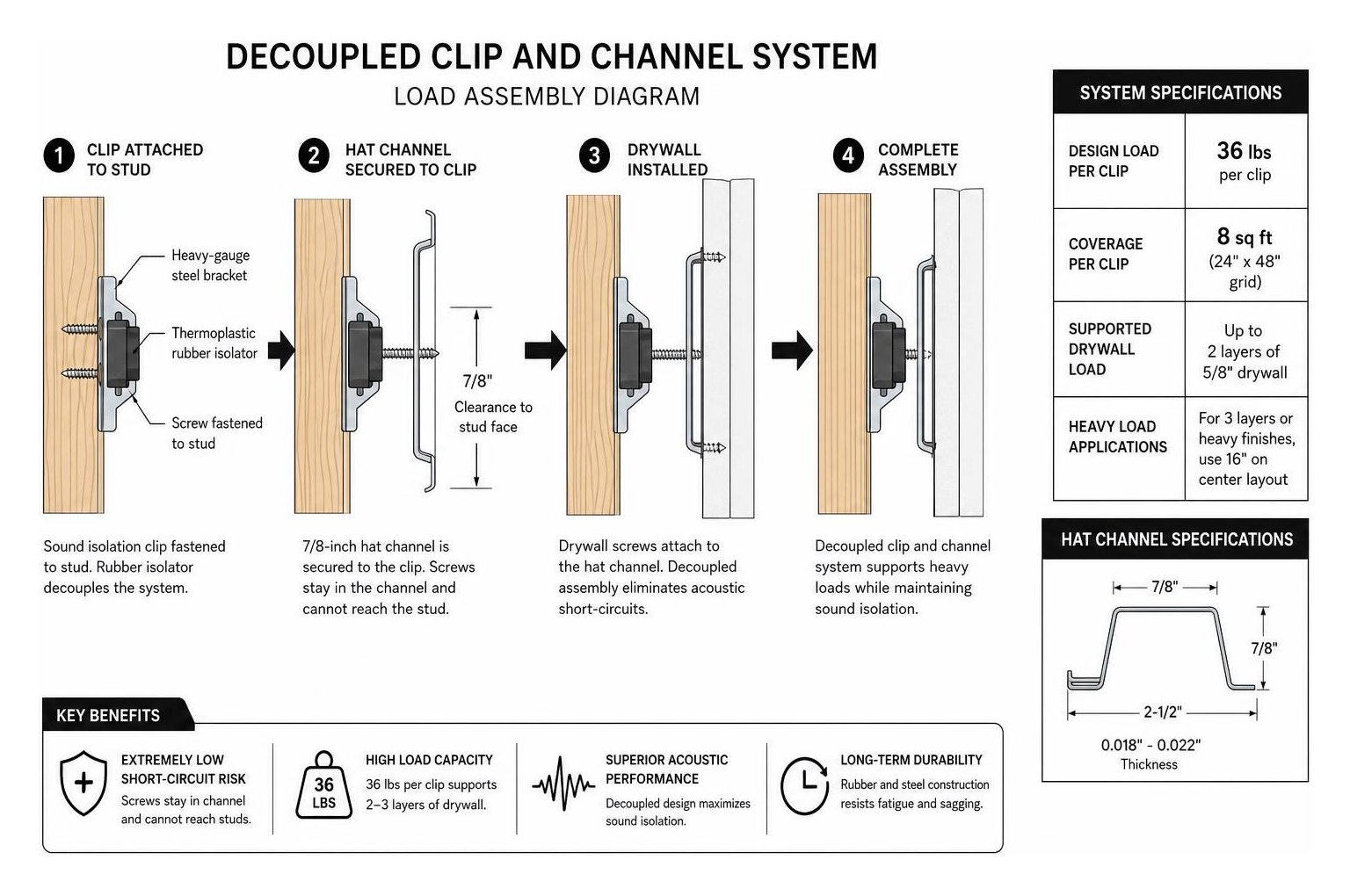
Standard sound clips are engineered to carry a design load of 36 pounds each. When laid out on a standard 24-inch by 48-inch grid pattern, each clip supports 8 square feet of wall or ceiling area, comfortably handling up to two layers of 5/8-inch drywall. For triple-layer assemblies or heavy exterior finishes, tightening the channel rows to 16 inches on center ensures structural stability while retaining dynamic deflection for sound absorption.
When building your wall cavity, pair the clips with commercial insulation to absorb cavity resonance. In commercial warehouses, maintaining thermal performance with R-30+ in ceilings and R-13+ in walls complements your acoustic goals.
Hat Channel Specifications and Splicing Rules
The only approved channel for standard sound isolation clips is standard 25-gauge drywall furring channel (commonly called hat channel) meeting ASTM C645 specifications. The dimensions must measure:
- Depth: 7/8 inch
- Top Width: 1-1/4 inches
- Bottom Flange Width: 2-1/2 inches to 2-5/8 inches with hemmed edges
When running channel runs wider than 10 or 12 feet, splice overlapping channels between clips—never directly inside a clip. Overlap the channel ends by 6 to 12 inches and secure them together with two 1/2-inch framing screws or steel mechanical wire ties.
Multi-Layer Drywall and Viscoelastic Damping
Mass is essential for sound containment. Combining sound isolation clips with a double drywall assembly yields dramatic acoustic improvements.
For the highest performance, install a damping board like Quietrock EZ Snap, or sandwich a viscoelastic damping compound between two sheets of standard 5/8-inch Type X drywall. The viscoelastic layer converts mechanical shear energy from sound waves into harmless heat, smoothing out the mass-air-mass resonance frequency of the isolated cavity.
Installation Masterclass: Layout Patterns and Critical Fastener Specs
Proper planning makes installation straightforward and ensures maximum sound reduction.
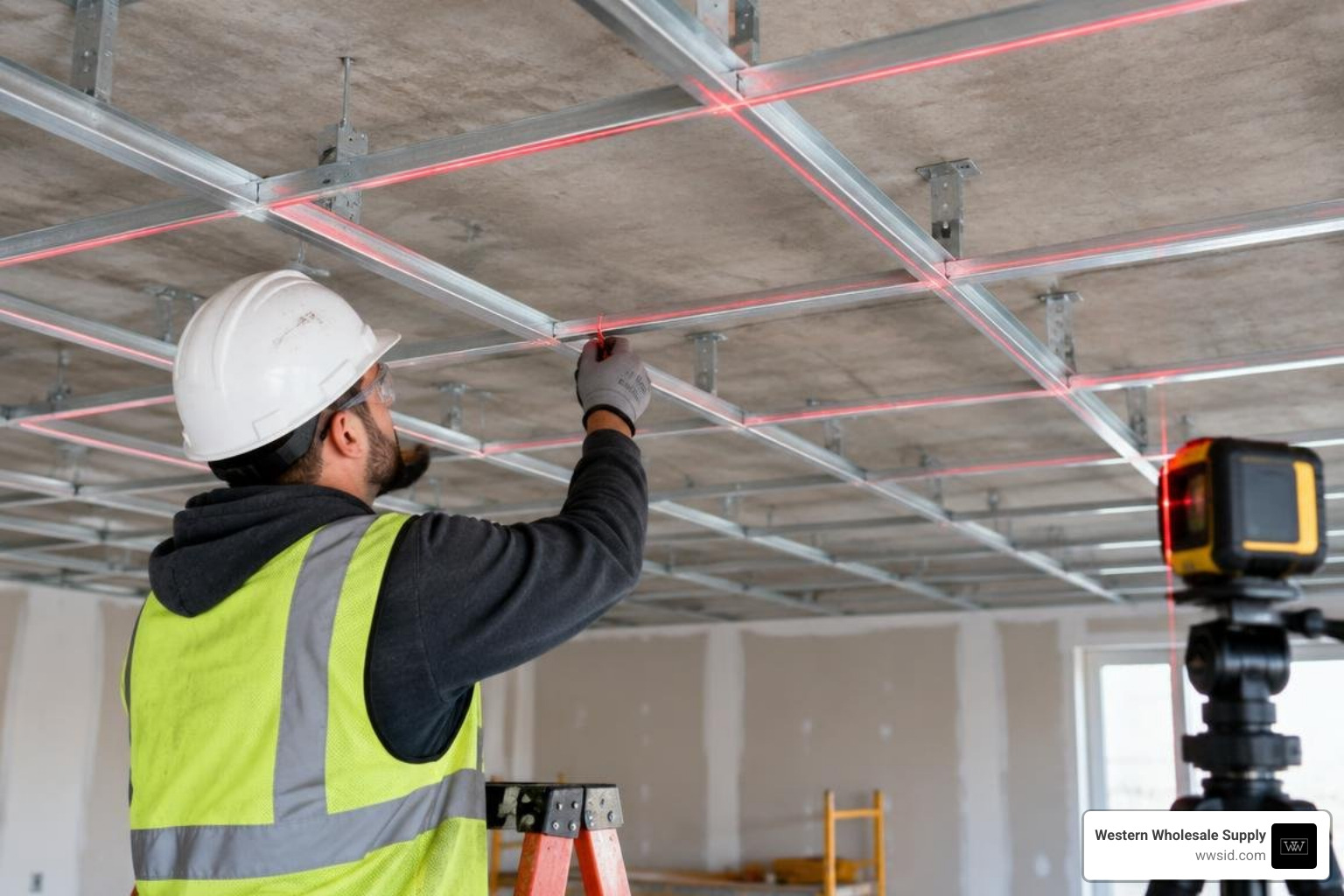
Before fastening your first clip, review the Whisper Clip installation guide or manufacturer specs for your specific hardware. Maintain tight grid tolerances using a chalk line or cross-line laser. When fastening to metal partitions, align with proper steel framing systems and choose the correct drywall screws for your gauge.
Step-by-Step Installation of Drywall Soundproofing Clips
- Mark the Grid: On walls, mark your bottom row no more than 6 inches from the floor and your top row within 6 inches of the ceiling. On ceilings, locate perimeter clips within 6 inches of adjacent walls.
- Mount the Clips: Fasten clips along framing at intervals not exceeding 48 inches on center. Space channel rows no more than 24 inches on center vertically on walls or along ceiling joists.
- Fasten Securely: Fasteners must achieve at least 120 pounds of pull-out or shear strength. Use Grabber fasteners or Brighton Best heavy-duty screws suited to your substrate.
- Snap the Hat Channel: Seat 25-gauge 7/8-inch hat channel firmly into the clip jaws until it clicks into place.
- Hang the Drywall: Hang your first layer of drywall horizontally across the channels using 1-inch or 1-1/4-inch drywall screws driven directly into the metal channel. Never drive screws into the framing behind the channel.
- Seal Perimeters: Leave a 1/4-inch perimeter gap between all drywall edges and adjacent floors, ceilings, and walls. Fill this perimeter with flexible acoustic sealant.
If you are treating an overhead structure, check our dedicated walkthrough on soundproofing a ceiling for overhead safety and staging advice.
Staggered vs. Standard Spacing Configurations
In a standard grid, clips sit aligned in uniform rows and columns. In a staggered configuration, alternating channel rows offset clip positions by one framing bay:
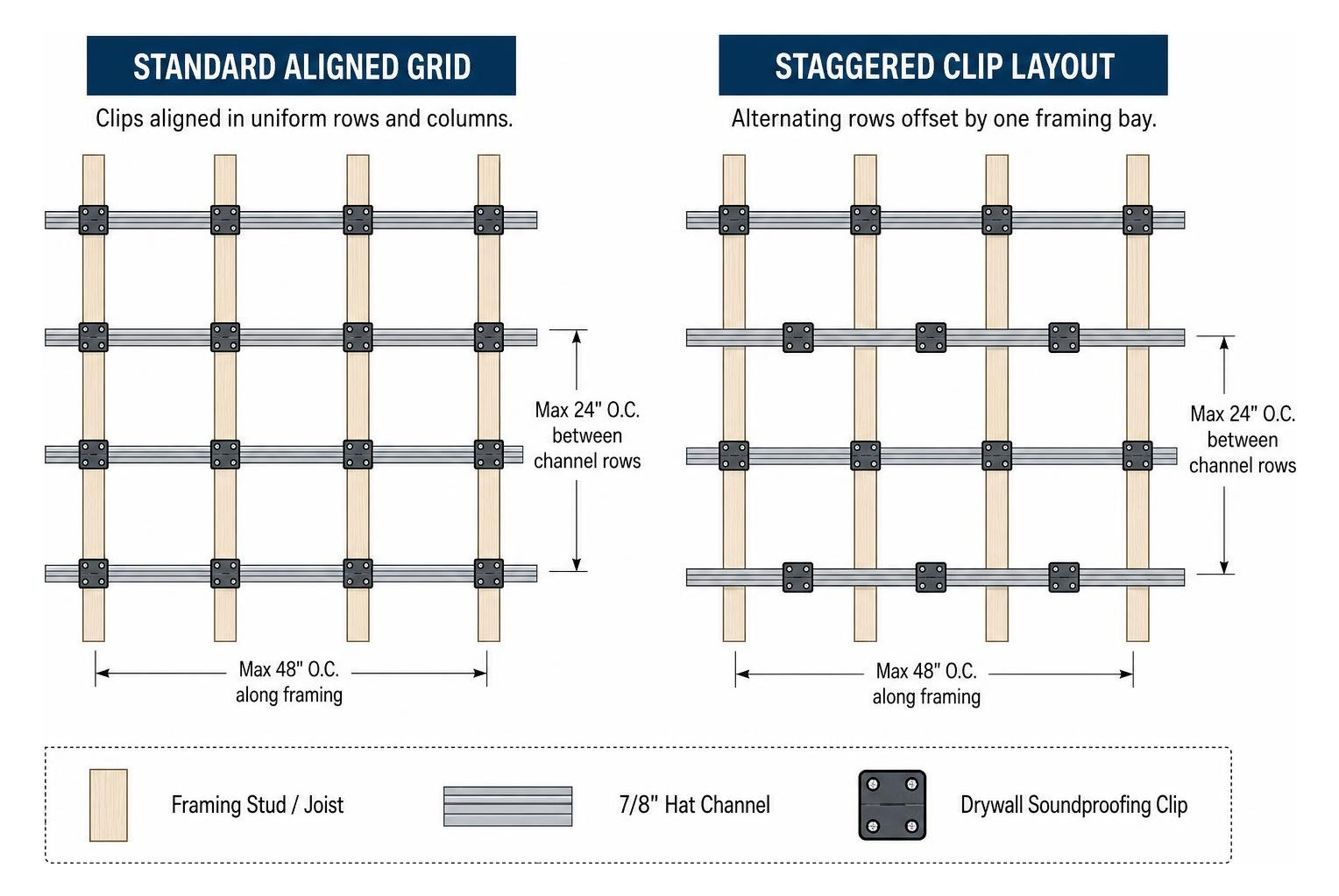
A staggered layout uses roughly 10% more clips, but it offers two clear benefits: it balances dead load across older or uneven framing joists, and it disrupts uniform acoustic transfer paths, which can improve sound attenuation by up to 5 dB in problematic low-frequency bands.
Common Pitfalls When Installing Drywall Soundproofing Clips
Avoid these frequent mistakes to keep your assembly performing at its best:
- Over-Torquing the Fastener: Tighten screws until they seat firmly against the clip’s steel washer. Driving screws too tight crushes the rubber isolator and limits its vibration dampening.
- Direct-Fastening Baseboards: Nailing baseboards into the bottom wall plate bridges the floating wall to the floor. Fasten trim strictly into the bottom drywall furring channel.
- Rigid Electrical Penetrations: If an electrical box is attached solidly to a stud, the drywall cutout must not touch the metal box edge. Maintain a 1/8-inch to 1/4-inch gap around boxes and seal with non-hardening acoustic sealant.
- Improper Channel Splicing: Never splice hat channel ends directly inside a clip rubber mount; overlap channels 6 to 12 inches between clips.
- Screw Bridging: Using drywall screws that are too long will puncture past the channel depth and drive into the framing, creating an acoustic bridge.
Frequently Asked Questions About Sound Isolation Clips
How many drywall soundproofing clips are required per sheet of drywall?
For standard 24-inch by 48-inch spacing, calculate your clip count based on wall area:
- Calculate the total square footage of the wall or ceiling (Length × Height).
- Divide the total square footage by 5 to determine baseline clip requirements.
- Add a 10% to 15% allowance for perimeter edges, doorways, and window framing.
For an average 4×8 sheet (32 sq ft), plan for 6 to 7 clips per sheet across the assembly.
Can sound isolation clips be installed over existing drywall in a retrofit?
Yes. In retrofit applications where tearing down existing drywall is impractical, clips can be mounted over the existing gypsum board. You must use a stud finder to locate framing members and select longer fasteners (such as 3-inch or 3-1/2-inch screws) to ensure a minimum of 1-1/2 inches of direct thread penetration into structural wood studs or full engagement into steel framing. That adding clips, hat channels, and new drywall will reduce room dimensions by roughly 1-1/2 to 1-5/8 inches per wall.
What fasteners are approved for securing clips to steel, wood, and concrete framing?
Fasteners must meet building code pull-out ratings:
- Wood Framing: #8 or #10 × 2-1/2-inch coarse-thread wood screws driven a minimum of 1-1/2 inches into solid wood.
- Steel Framing: #8, #10, or #12 × 1-5/8-inch self-tapping fine-thread Type S pan-head screws.
- Concrete / CMU: 3/16-inch or 1/4-inch × 2-1/4-inch concrete anchor screws (such as Tapcon fasteners) with minimum 1-1/4-inch embedment.
Conclusion
Decoupling your walls and ceilings with drywall soundproofing clips is one of the most reliable ways to control airborne noise and structure-borne vibration. By isolating drywall from the framing with heavy-duty rubber isolators and 25-gauge hat channels, you prevent sound from bridging between spaces.
For commercial and residential builders across Eastern Idaho and Western Wyoming—from Idaho Falls, Pocatello, and Rexburg to Jackson, Driggs, and Twin Falls—Western Wholesale Supply provides the commercial-grade acoustic materials you need. We carry top-performing gypsum wallboards, including Quietrock EZ Snap and Durock cement boards, CertainTeed acoustical ceiling tiles, high-grade insulation, and reliable fasteners from Grabber and Brighton Best. When you are ready to tape and finish your isolated assemblies, our showroom floors stock professional drywall finishing tools from Hyde, USG Sheetrock Tools, Columbia Taping Tools, and Marshalltown.
Ready to optimize your next build for high acoustic performance? Explore our detailed guide to drywall soundproofing or contact our team to source high-performance clips, channels, and fasteners for your job site today.
