

Why Choosing the Right Commercial Insulation Products Matters
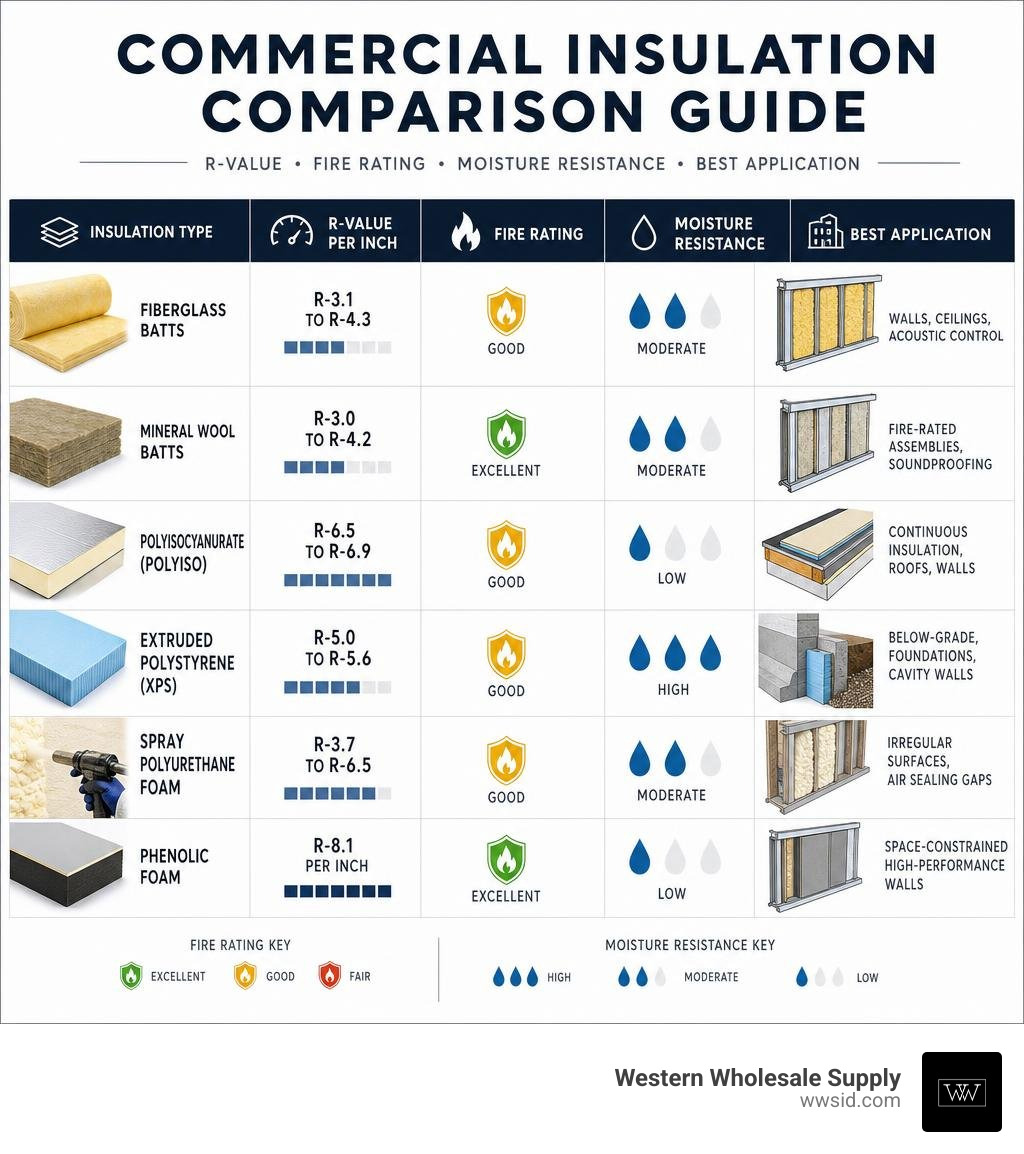
Commercial insulation products are materials used in non-residential buildings to control heat, sound, fire, and moisture. Here’s a quick breakdown of the most common types and what they’re best for:
| Insulation Type | Best For | R-Value Per Inch |
|---|---|---|
| Fiberglass Batts | Walls, ceilings, acoustic control | R-3.1 to R-4.3 |
| Mineral Wool Batts | Fire-rated assemblies, soundproofing | R-3.0 to R-4.2 |
| Polyisocyanurate (Polyiso) | Continuous insulation, roofs, walls | R-6.5 to R-6.9 |
| Extruded Polystyrene (XPS) | Below-grade, foundations, cavity walls | R-5.0 to R-5.6 |
| Spray Polyurethane Foam | Irregular surfaces, filling gaps | R-3.7 to R-6.5 |
| Phenolic Foam | Space-constrained high-performance walls | R-8.1 |
Getting insulation wrong on a commercial project is expensive. You might fail an energy code inspection, miss a fire rating requirement, or end up with moisture problems inside your walls months after the job is done. With energy codes like IECC and ASHRAE 90.1 tightening every cycle, the pressure to spec the right product the first time has never been higher. As of June 2026, most commercial wall assemblies require continuous insulation to meet minimum energy performance thresholds — and not all products perform the same way once installed.
At Western Wholesale Supply, we have direct experience sourcing and supplying commercial insulation products across a wide range of project types, from warehouses to mixed-use developments. In the sections ahead, we’ll walk you through everything you need to know to make confident decisions on your next build.
Terms related to Commercial insulation products:
Core Types of Commercial Insulation Products
Selecting the right commercial insulation material is a balancing act between thermal performance, fire safety, structural integrity, and moisture control. Depending on the construction style—whether it is steel framing, heavy masonry, or a large open-span warehouse—different materials will be required to meet building codes.
For a deeper dive into how these materials compare across different structural systems, check out Beyond Batts: A Comprehensive Look at Building Insulation Materials.
Fiberglass and Mineral Wool Batts
Traditional batt insulation remains a staple in commercial construction, particularly for interior partition walls and cavity assemblies.
- Fiberglass Batts: Modern fiberglass batts contain 40% to 60% recycled content. High-density fiberglass batts designed for a 2 by 4-inch stud wall offer up to an R-15 value, compared to R-11 for standard low-density types. Unfaced fiberglass batts are naturally non-combustible and serve as an excellent, cost-effective method for thermal and acoustical control.
- Mineral Wool: Made from basalt volcanic rock and slag, mineral wool contains an average of 75% post-industrial recycled content. It is highly resistant to heat, withstanding temperatures up to 2150°F without melting, producing smoke, or propagating flames.
Both fiberglass and mineral wool excel in acoustic control. In a standard 2″x4″ wood-framed wall system, they can achieve a Sound Transmission Class (STC) rating of 43. Additionally, both materials can achieve a Noise Reduction Coefficient (NRC) of up to 1.00, meaning they absorb 100% of the sound striking them, compared to just 0.75 for standard spray foam and cellulose.
Rigid Board Commercial Insulation Products
When continuous insulation is required to eliminate thermal bridging, rigid board insulation is the industry standard. These boards are durable, maintain their R-value over time, and can be integrated into the building envelope to provide continuous thermal coverage.
- Polyisocyanurate (Polyiso): Polyiso is a closed-cell foam that offers one of the highest R-values per inch of any rigid board (typically R-6.0 to R-6.9). It can insulate 30% to 40% better than Expanded Polystyrene (EPS) for a given thickness.
- Extruded Polystyrene (XPS): XPS is highly moisture-resistant, making it the preferred choice for below-grade applications, foundations, and cavity walls. Products like DuPont™ Styrofoam™ Brand Square Edge XPS Insulation provide a reliable R-5.0 per inch and have a water absorption rate of just 0.1% by volume, ensuring long-term thermal performance in wet environments.
- Expanded Polystyrene (EPS): EPS is a budget-friendly rigid foam option with a lower R-value per inch (around R-3.6 to R-4.0), commonly used in roofing and structural insulated panels.
Spray Foam and Loose-Fill Systems
For hard-to-reach cavities, irregular surfaces, and assemblies requiring high-performance thermal coverage, spray foam and loose-fill materials are highly effective.
- Spray Polyurethane Foam (SPF): SPF is available in open-cell and closed-cell formulations. Open-cell spray foam (such as SucraSeal, which provides R-3.8 per inch) is highly flexible and absorbs sound, while closed-cell foam offers structural strength and an integrated vapor barrier. However, closed-cell foams are subject to “thermal drift”—a process where the insulating blowing gases slowly escape over the first two years, stabilizing at a slightly lower R-value.
- Loose-Fill/Blow-In Systems: Typically made of fiberglass or cellulose, these systems fill wall cavities completely, reducing voids. While cellulose contains 82% to 85% recycled paper, it can absorb 5% to 20% of its weight in moisture, whereas inorganic fiberglass and mineral wool absorb less than 1%.
Key Performance Factors for Commercial Projects
Choosing the correct insulation is not just about maximizing R-value; it requires evaluating how the material interacts with fire, water, and sound within the entire building assembly. To avoid costly installation mistakes, refer to Don’t Get Burned by Choosing the Wrong Insulation.
Thermal Efficiency and R-Value Requirements
In commercial construction, thermal performance must align with local energy codes. For instance, in warehouse construction across South East Idaho and Western Wyoming, the thermal requirements for maintaining conditioned space are strict. We focus heavily on the thermal benefits of these assemblies:
- Ceilings: Must achieve R-30+ to prevent heat loss through the massive roof spans of commercial warehouses.
- Walls: Must achieve R-13+ in the cavities, often paired with continuous exterior insulation to meet code.
For a comprehensive breakdown of these thermal targets, see The Ultimate Guide to Warehouse Insulation Materials.
Fire Safety and Building Code Compliance
Fire safety is non-negotiable in commercial building design. Under the International Building Code (IBC), materials must meet strict flame spread and smoke development indexes (typically Flame Spread ≤ 25 and Smoke Developed ≤ 450).
While spray foam will ignite at approximately 700°F, inorganic fiber glass and mineral wool are naturally non-combustible. For exposed interior applications, polyiso boards must meet specific fire tests. For example, DuPont™ Thermax™ Basic NH Insulation Product Information Sheet shows that this glass-fiber-reinforced polyiso can be left exposed to the interior without a thermal barrier, meeting NFPA 286 and UL 1715 standards.
Moisture Management and Vapor Permeability
Moisture accumulation can lead to mold, structural rot, and a severe drop in insulation performance.
- Vapor-Permeable Systems: Some designs require the wall assembly to breathe. High-density stone wool boards like Comfortboard (ROCKWOOL Comfortboard 110) have a high vapor permeance rating of 35 perms. This allows moisture to escape easily, reducing condensation risk.
- Vapor-Impermeable Systems: Below-grade walls and high-moisture interiors require vapor-retarding materials like XPS or foil-faced polyiso to stop water vapor from migrating into the structure.
For guidance on managing moisture in below-grade or high-humidity zones, see Banish Basement Blues: Choosing the Right Water-Resistant Insulation.
Continuous Insulation and Reducing Thermal Bridging
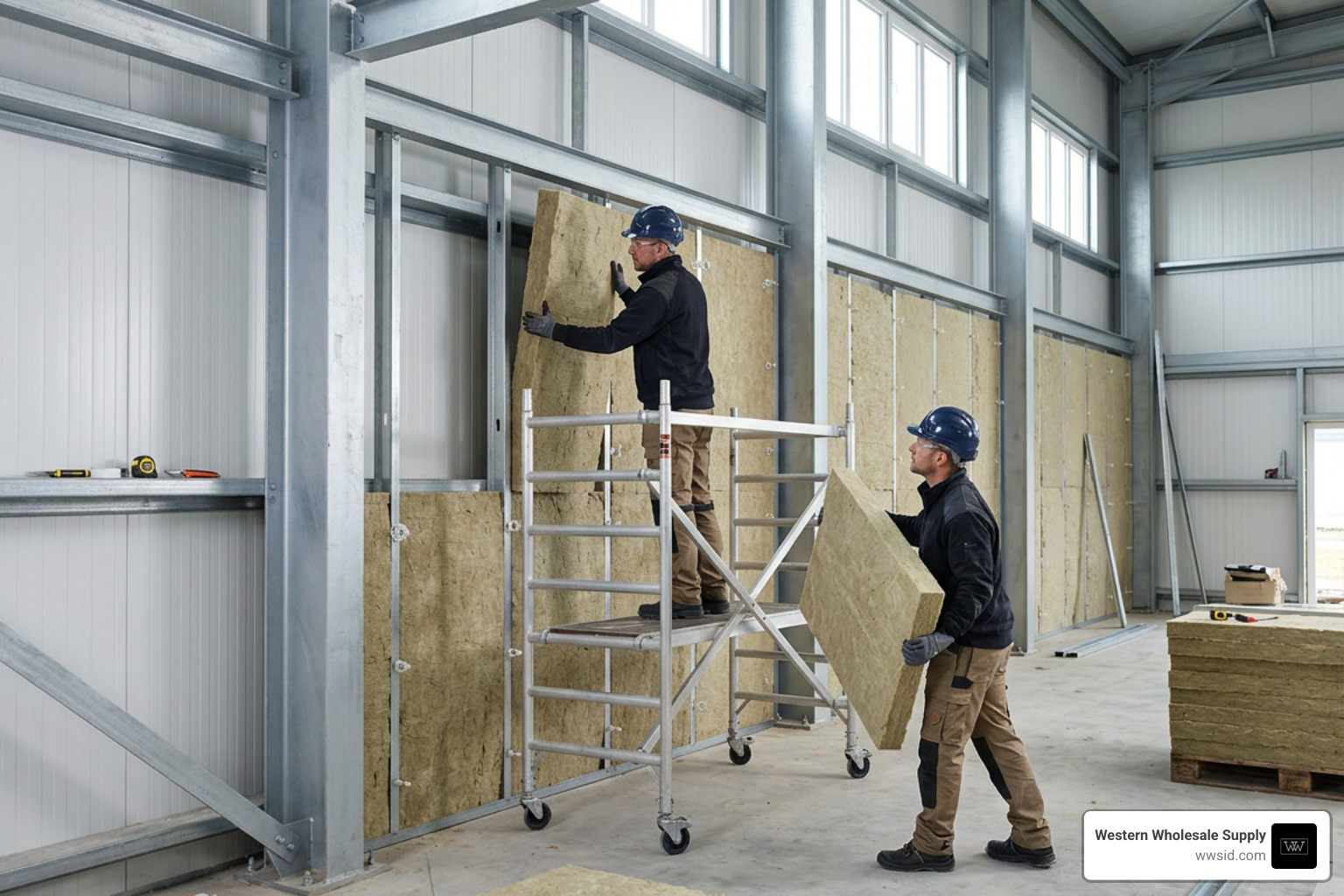
Steel studs are highly efficient conductors of heat. When insulation is placed only inside the wall cavities, the steel studs act as “thermal bridges,” allowing heat to bypass the insulation. This can reduce the overall thermal performance of a wall assembly by as much as 50%. To combat this, modern energy codes like ASHRAE 90.1 and the IECC mandate the use of continuous insulation (CI) on exterior commercial walls.

High-Performance Polyiso and Phenolic Boards
Continuous insulation boards are installed over the exterior sheathing to create an unbroken thermal barrier.
- DuPont™ Thermax™ Sheathing: This nonstructural, glass-fiber-infused rigid polyiso features a foil facer and offers an R-value of 6.9 at 1 inch thickness. It is engineered to perform as a class-A fire-rated material that provides an excellent thermal barrier. For detailed specifications, view the DuPont™ Thermax™ Sheathing Insulation Product Information Sheet .
- Kingspan Kooltherm K110: For projects where space is at a premium, phenolic core boards like the Kooltherm K110 Insulation Board | Kingspan US offer an exceptional R-value of 8.1 per inch, allowing for ultra-thin wall profiles without sacrificing thermal performance.
Extruded Polystyrene (XPS) for Below-Grade and Cavity Walls
XPS is the ideal continuous insulation for high-moisture environments, such as foundation walls and concrete slab edges.
Products like the DuPont™ Styrofoam™ Brand Ultra SL XPS Insulation Product Information Sheet feature patented carbon-black technology, which boosts its thermal performance to R-5.6 per inch. This product is designed with shiplap edges, allowing the boards to interlock tightly. This design creates a continuous thermal barrier behind masonry or stone veneers without requiring frequent cuts for masonry ties.
Sourcing and Specifying Commercial Insulation
Sourcing the right materials for commercial projects in Eastern Idaho, Western Wyoming, and Western Montana requires working with a distributor that understands local climate demands and logistics challenges.
Sourcing High-Quality Commercial Insulation Products
Managing logistics on a commercial jobsite is critical. Sourcing from a wholesale partner ensures that your materials are delivered on time, minimizing downtime. To learn more about optimizing your supply chain, read Everything You Need to Know About Sourcing Commercial Insulation and How to Master the World of Wholesale Building Insulation.
Contractor Considerations for Large-Scale Projects
For commercial contractors, the focus is on maximizing R-value per dollar spent while maintaining high installation efficiency. Our team at Western Wholesale Supply supports contractors across our service areas—including Idaho Falls, Pocatello, Jackson, Driggs, Victor, Rexburg, Rigby, Shelley, Blackfoot, Chubbuck, Burley, and Twin Falls—by coordinating deliveries directly to the jobsite.
For more insights on selecting high-efficiency materials for your next project, see The Contractor’s Guide to High-Performance Insulation Supplies.
Frequently Asked Questions about Commercial Insulation
What is the difference between XPS and Polyiso insulation?
XPS is highly moisture-resistant, making it ideal for below-grade, slab, and wet cavity wall applications, typically offering R-5.0 per inch. Polyiso offers a higher R-value (up to R-6.9 per inch) and is excellent for roofs and above-grade walls, but it is more vapor-permeable and can absorb more water than XPS.
How does continuous insulation prevent thermal bridging?
Continuous insulation is installed across the exterior face of studs or masonry blocks without interruption. This covers structural members like steel studs, preventing them from acting as thermal conduits and significantly improving the building’s overall energy efficiency.
Why is mineral wool preferred for fire-rated assemblies?
Mineral wool is made from volcanic rock and steel slag, giving it a melting point above 2150°F. It is completely non-combustible, does not produce toxic smoke, and helps contain fire within wall cavities, making it a critical component of fire-rated commercial assemblies.
Conclusion
Whether you are building a commercial warehouse in Idaho Falls, a retail space in Jackson, or a multifamily complex in Twin Falls, choosing the right commercial insulation products is essential for long-term efficiency, safety, and code compliance.
At Western Wholesale Supply, we are an independent, veteran-owned, third-generation family business. We have supplied quality building materials—including drywall, steel framing, insulation, and acoustical ceilings—to Eastern Idaho and Western Wyoming since 1963. We carry trusted commercial brands, including CertainTeed for high-performance ceiling tiles, Quietrock EZ Snap for superior acoustic drywall, and Durock cement boards. For secure, code-compliant installations, we supply heavy-duty fasteners from Brighton Best and Grabber.
Ready to specify the insulation for your next commercial project? Explore our range of solutions on our Western Wholesale Supply Insulation Products page, or contact our team today to coordinate on-time jobsite delivery.
