

Choose the Right Wall Anchor for Metal Studs
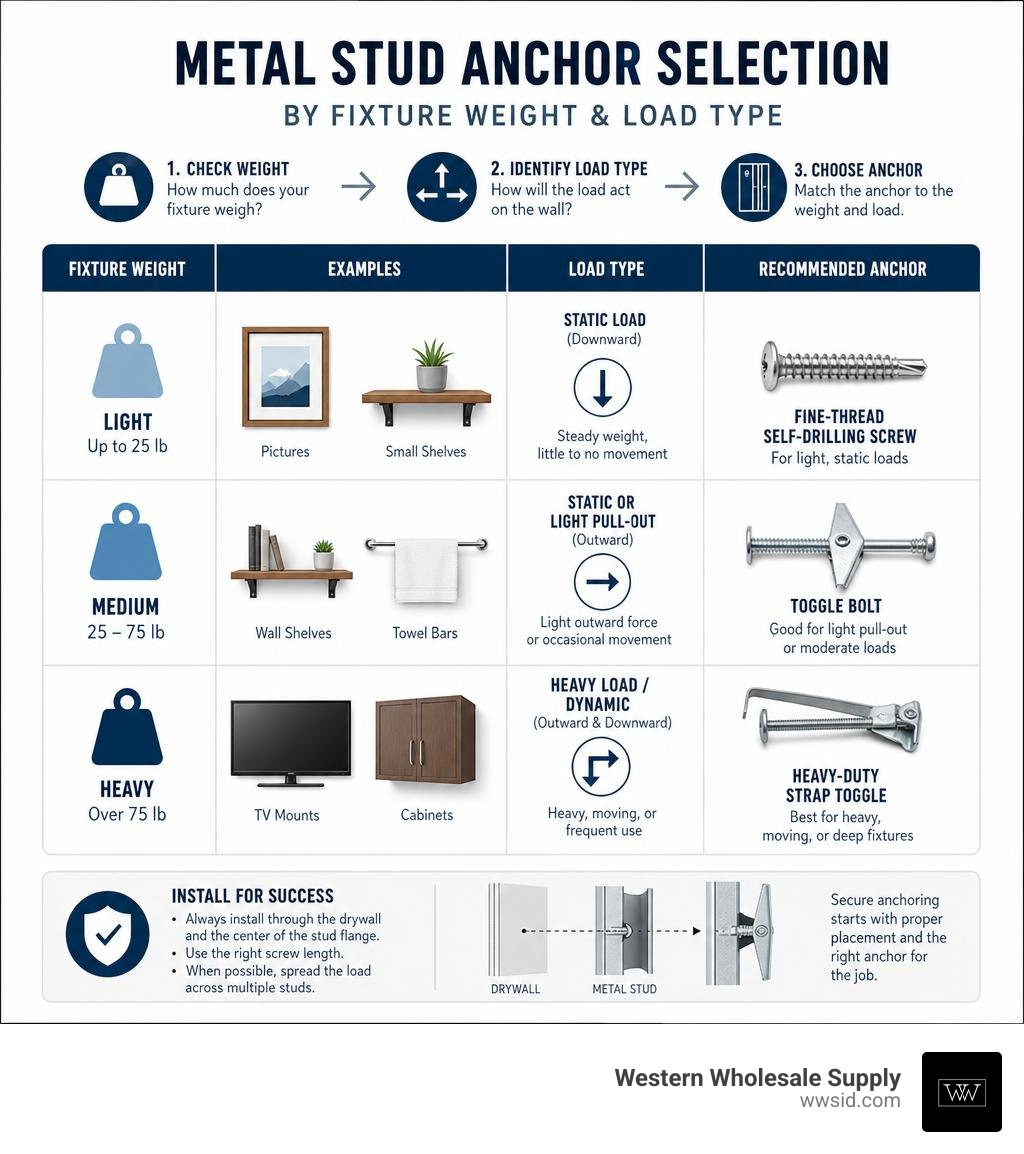
For most heavy fixtures, the best wall anchor for metal studs is a heavy-duty strap toggle installed through the drywall and the center of the stud flange. It spreads the load across a metal channel behind the wall and is a better choice than a basic plastic drywall anchor for cabinets, shelves, and TV mounts. For lighter, static fixtures, fine-thread self-drilling screws or metal-stud-rated anchors can be a faster option.
Metal studs are thin, hollow, and often made from light-gauge steel. That means the right fastener depends on the fixture weight, whether the load pulls away from the wall, and how many studs share the load. A large, moving, or deep fixture needs more than a drywall-only rating; it needs secure stud engagement and a sensible safety margin.
At Western Wholesale Supply, we work directly with contractors using drywall and steel framing on residential and commercial projects. In this guide to the best wall anchor for metal studs, we will help you match the anchor to the load, wall assembly, and installation method.
Basic best wall anchor for metal studs glossary:
Top Contenders: Choosing the Best Wall Anchor for Metal Studs
Fastening to cold-formed steel framing presents a completely different mechanical challenge than screwing into traditional timber. While wood provides a solid core that bites into wood screw threads along its entire embedment depth, metal framing is hollow and relies on a thin steel flange-often only 0.018 to 0.033 inches thick in residential and commercial partitions. Selecting the wrong fastener can lead to stripped framing, crushed gypsum board, or catastrophic fixture failure.
To choose the best wall anchor for metal studs, we categorize mounting hardware into three primary mechanical classes: solid-channel strap toggles, self-drilling stud-piercing fasteners, and hollow-wall expansion sleeves. For a foundational overview of general cavity mounting styles, check out The Definitive Guide to Drywall Anchor Types for Easy Installation.
Heavy-Duty Strap Toggles: The Best Wall Anchor for Metal Studs and Dynamic Loads
When you need unmatched structural holding capacity, heavy-duty strap toggle anchors are the gold standard. Unlike traditional spring-wing toggle bolts that fall into the wall cavity the second you remove the machine screw, strap toggles utilize a solid metal anchoring channel secured by durable plastic guide straps and a sliding ratcheting collar.
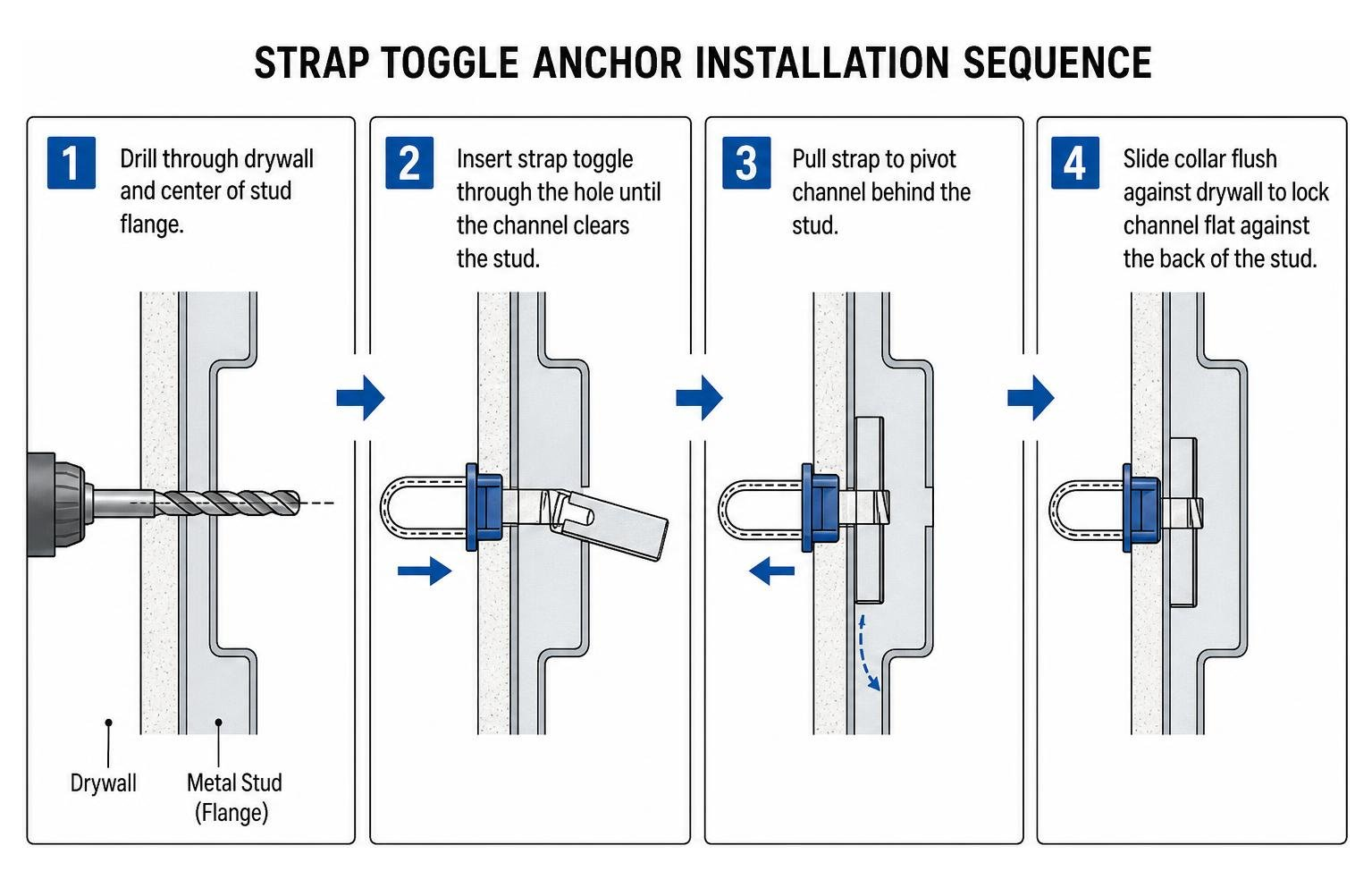
When you drill through both the drywall and the center of the steel stud flange, the solid steel channel pivots behind the metal framing. Sliding the collar flush against the drywall locks the channel flat against the inside face of the steel stud. This transforms the thin steel framing into a structural backer plate, distributing pulling forces across a wide surface area.
Strap toggles are indispensable for:
- Heavy commercial cabinetry and cantilevered storage units.
- Articulating and swivel-arm TV wall mounts that exert severe rotational torque.
- Deep utility shelving holding concentrated, heavy loads.
- Restroom grab bars and commercial plumbing fixtures.
Self-Drilling Stud Fasteners: The Best Wall Anchor for Metal Studs with Light-to-Medium Fixtures
For lighter wall fixtures where drilling massive clearance holes is unnecessary, engineered self-drilling anchors and framing screws provide exceptional speed. Heavy-duty zinc self-drilling metal-stud anchors feature a piercing point designed to pass cleanly through 1/2-inch or 5/8-inch gypsum and bore directly into 25-gauge to 20-gauge steel studs without requiring a pilot bit.
For direct surface mounting of flat brackets, electrical enclosures, or conduit clamps, high-grade fine-thread framing fasteners from trusted manufacturers like Grabber or Brighton Best bite directly into steel framing. To dive deeper into screw thread geometry and drill-point selections, read The Ultimate Guide to Drywall to Metal Screws.
Hollow-Wall Drive and Expansion Fasteners
Hollow-wall expansion sleeves, commonly known as molly bolts, are one-piece metal anchors that collapse their expandable slotted legs against the back of the wall when tightened. While traditionally utilized in hollow drywall cavities, specialized heavy-duty steel variants can grip through light-gauge steel when pre-drilled with precision.
To understand how mechanical expansion sleeves differ from hollow cavity toggles, explore The Definitive Guide to Molly Fasteners. That sleeve anchors require exact length sizing; if the grip range does not match your specific drywall thickness plus the steel flange thickness, the sleeve will fail to collapse flat, severely reducing shear strength.
Load Capacities and Steel Stud Engineering Considerations
When anchoring fixtures, you must account for two distinct structural forces: tensile pullout (the force pulling straight out, perpendicular to the wall) and shear strength (the downward, gravitational force pulling parallel to the wall).
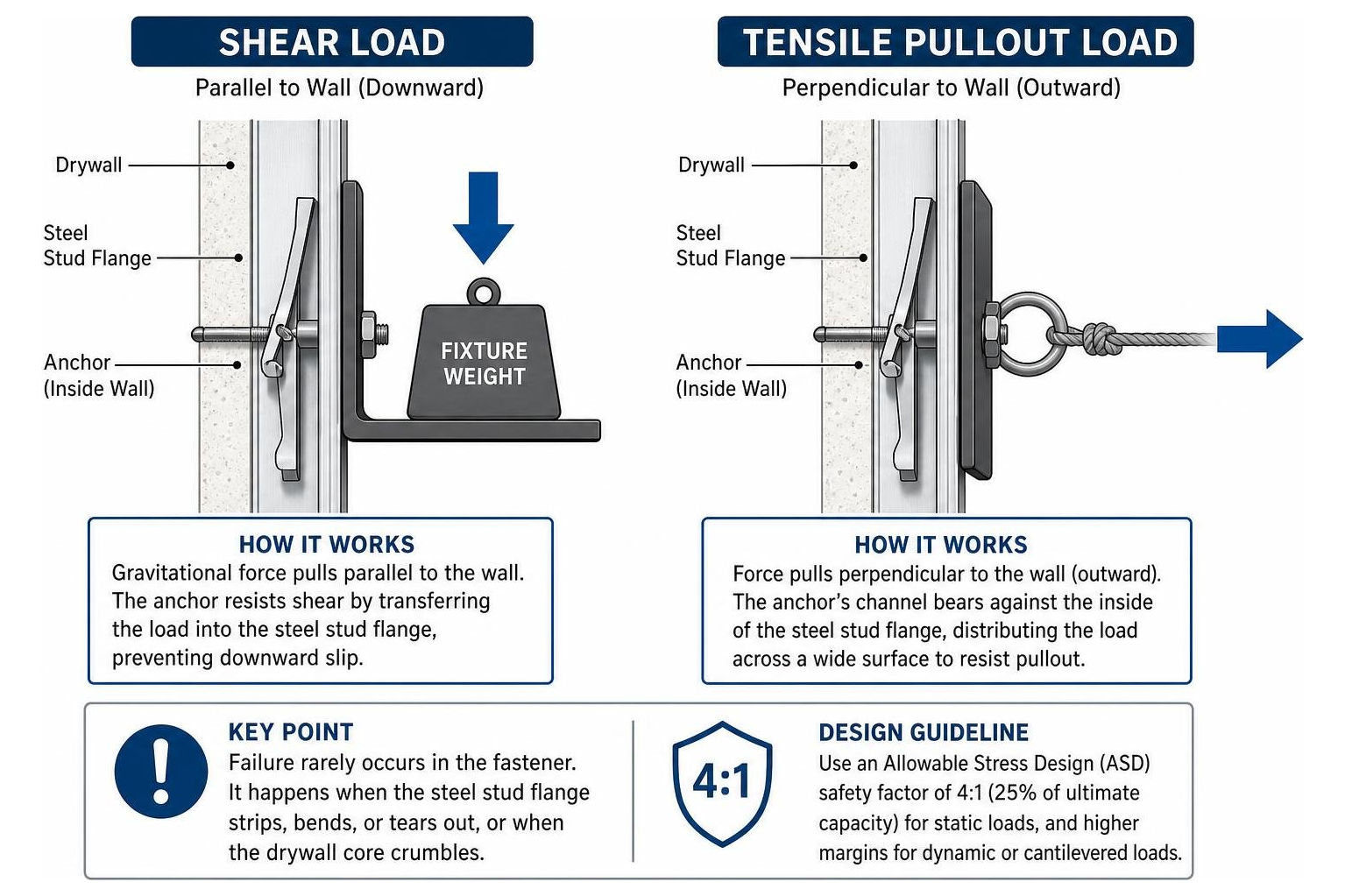
In steel stud construction, failure rarely stems from the fastener shearing in half. Instead, failure happens when the thin steel stud flange strips, bends, or tears out under stress, or when the drywall core crumbles beneath an unanchored fastener.
Non-structural partition framing typically uses 25-gauge steel (approx. 18 mils), which acts like thin sheet metal. In contrast, load-bearing commercial framing utilizes heavy 20-gauge to 16-gauge cold-formed steel. To master the specifications behind these materials, read Everything You Need to Know About Steel Framing.
Structural engineering guidelines mandate applying an Allowable Stress Design (ASD) safety factor of 4:1 (or 25% of laboratory ultimate failure capacity) for static loads, and even higher safety margins for dynamic, moving, or cantilevered loads like deep cabinets or swinging monitor arms. For reference on baseline drywall fastener capacities, consult technical data sheets such as the WallDriver TM Anchors & Kits.
| Anchor Type | Target Substrate | Lab Ultimate Shear (lbs) | Lab Ultimate Tension (lbs) | Safe Working Load (4:1 Safety Factor) | Best Application |
|---|---|---|---|---|---|
| 1/4″ Heavy-Duty Strap Toggle | 1/2″ Drywall + 25-ga Steel Stud | ~600–800+ | ~400–600 | 150 lbs | TV mounts, heavy shelving, upper cabinets |
| Zinc Self-Drilling Stud Solver | 1/2″ Drywall + 25-ga Steel Stud | ~200 | ~100 | 50 lbs | Medium mirrors, clocks, wall sconces |
| #12 Fine-Thread Steel Screw | Direct into 20-ga Structural Stud | ~450 | ~220 | 80–110 lbs | Electrical subpanels, equipment tracks |
| Threaded Drywall-Only Anchor | 1/2″ Hollow Gypsum Cavity | ~100–120 | ~40–50 | 25–30 lbs | Small picture frames, light canvas art |
Note: Always ensure the total load across multiple fasteners does not exceed the overall structural capacity of the partition wall.
Step-by-Step Installation Guide for Metal Stud Framing
Proper installation ensures that your fastener engages the strongest portion of the metal stud without compromising the framing flange.
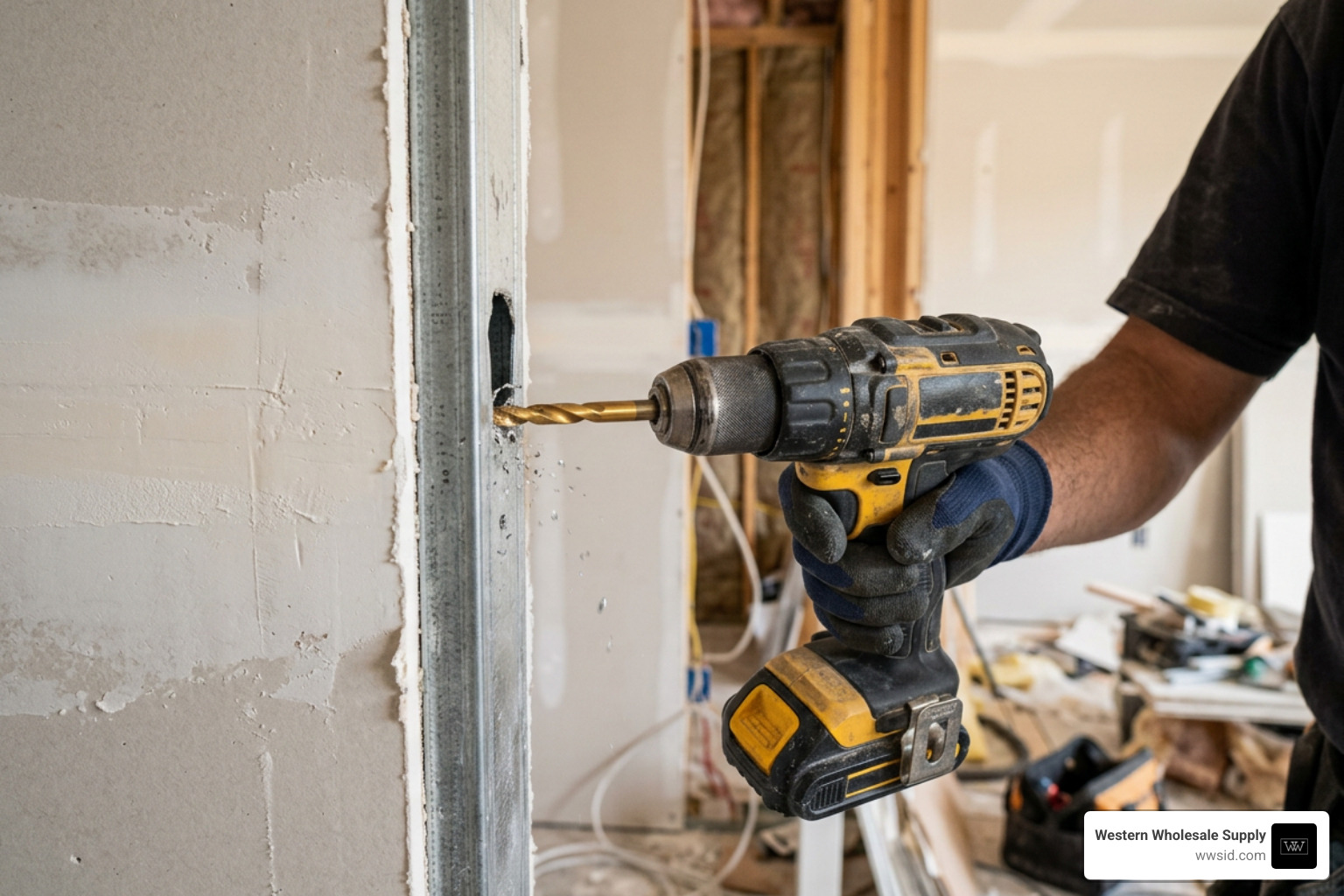
Follow these professional steps for installing heavy-duty strap toggle anchors through steel studs:
- Locate the Center of the Stud: Use a strong rare-earth magnetic stud finder to locate the drywall screws holding the gypsum board to the stud. This pinpoints the exact centerline of the metal stud flange. Avoid drilling near the outer edges of the stud, as the bit can slip off the flange.
- Drill a Pilot Hole: Metal framing can cause standard drill bits to wander. Start by drilling a small 1/8-inch or 1/4-inch pilot hole using a sharp titanium-coated drill bit running at medium speed. Titanium-coated bits cut through cold-formed steel cleanly without overheating.
- Enlarge to Final Clearance Size: Step up to a 1/2-inch titanium drill bit to create the clearance hole required for the strap toggle channel. Maintain steady, firm forward pressure to cleanly punch through the steel without dimpling the metal flange inward.
- Insert the Strap Toggle: Turn the solid metal channel parallel to the plastic straps and push it through the 1/2-inch hole until it clears the backside of the steel stud. Tug the straps toward you to pivot the channel horizontally flush against the back of the steel flange.
- Slide the Collar and Snap Straps: Slide the translucent plastic cap down the straps until it sits firmly flush against the drywall face. Bend the straps side to side at the drywall surface to snap them off flush.
- Fasten the Fixture: Align your mounting bracket over the collar and thread the matching 1/4-20 machine bolt through the bracket into the metal channel. Tighten by hand or with a low-torque clutch drill setting to seat the bracket firmly. Never over-torque fasteners with a high-impact driver into light-gauge steel!
For a comprehensive job-site guide on commercial hardware, review The Pros Checklist for Commercial Construction Fasteners and Supplies.
Frequently Asked Questions About Anchoring into Metal Studs
Can standard plastic drywall anchors be used on metal studs?
No, standard plastic expansion plugs should never be installed into metal studs. Plastic anchors rely on expanding against solid masonry or binding behind a soft drywall core. When pushed against a steel stud flange, the plastic collar crumples or distorts, failing to open properly. This crushes the surrounding gypsum core, creates severe shear failure risks, and provides virtually zero tensile holding capacity. Always use purpose-built steel toggles or stud-rated zinc fasteners.
What drill bit is required to drill through metal studs?
High-speed steel (HSS) titanium-coated or cobalt drill bits are required to drill through cold-formed metal studs cleanly. Standard black oxide bits tend to dull quickly, overheat, and skate across the galvanized steel surface. For large clearance holes (such as 1/2-inch toggle holes), use a two-step drilling process: drill a 1/4-inch pilot hole first, followed by the final 1/2-inch titanium bit to prevent tearing the light-gauge metal flange.
How much weight can a toggle bolt hold in 25-gauge metal studs?
While laboratory ultimate tensile failure ratings for a 1/4-inch strap toggle in 25-gauge steel can exceed 600 to 800 pounds, engineering standards require applying a 4:1 safety factor. This establishes a reliable, safe working load limit of approximately 150 pounds per anchor for static vertical loads. For dynamic, vibrating, or outward-cantilevered loads, distribute the weight across multiple studs and toggle fasteners.
Conclusion
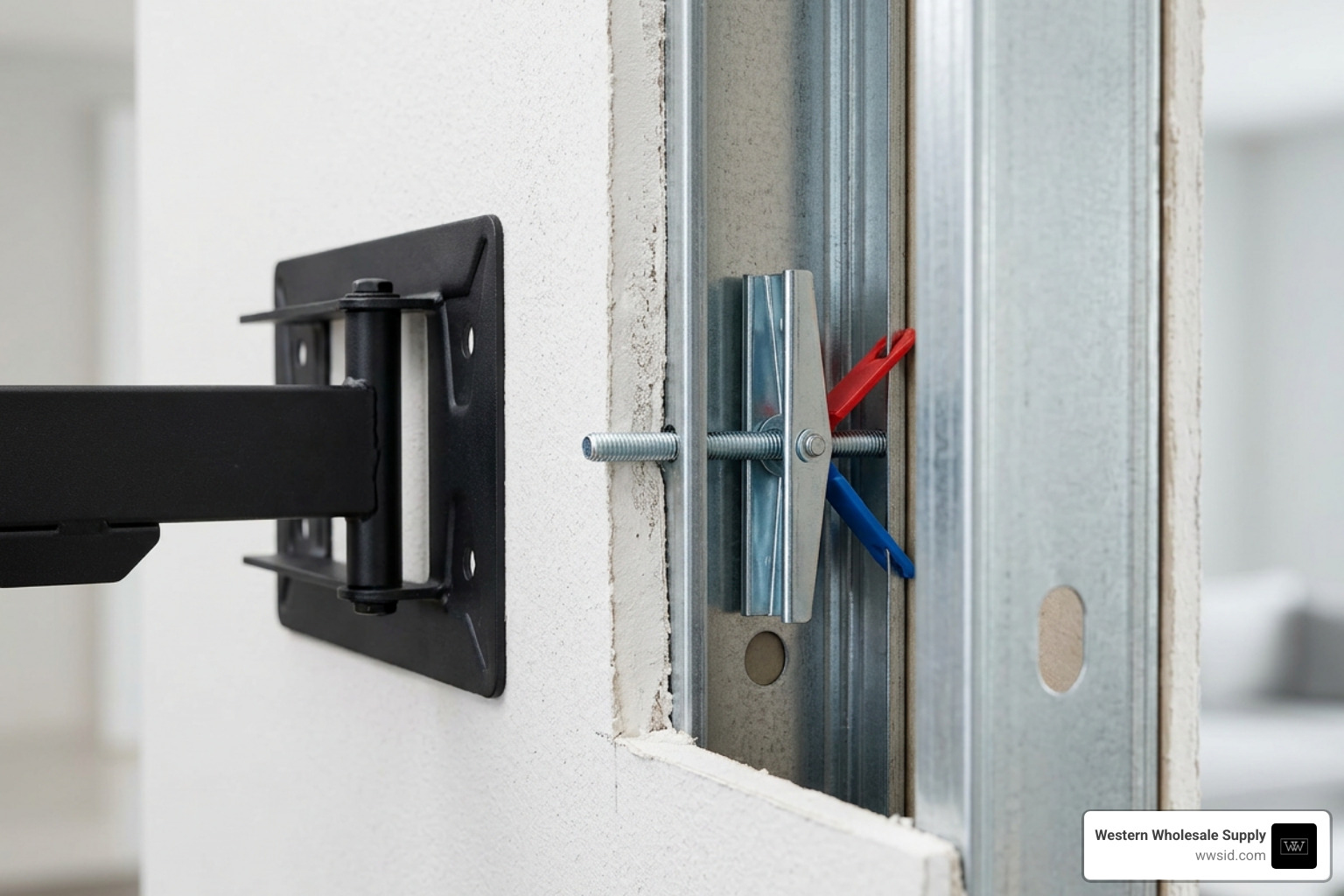
Selecting the best wall anchor for metal studs comes down to understanding your wall’s internal framing and matching your hardware to the forces at play. For heavy, cantilevered, or dynamic loads like flat-screen televisions and kitchen cabinets, heavy-duty solid-channel strap toggles deliver unbeatable strength by clamping directly behind the steel stud flange. For moderate decorative fixtures, specialized self-drilling metal stud anchors offer speed and security without weakening the wall cavity.
At Western Wholesale Supply, we take pride in supporting contractors, builders, and trades across Eastern Idaho and Western Wyoming. As an independent, veteran-owned, third-generation family business serving our region since 1963, we provide dependable job-site delivery and over six decades of industry expertise. Whether you are framing commercial interiors with structural steel studs, hanging CertainTeed acoustical ceiling systems, installing Quietrock EZ Snap drywall and Durock cement board, or stocking up on Brighton Best and Grabber fasteners, our team is here to ensure your build is rock-solid.
Stop by one of our local branch showrooms in Idaho Falls, Pocatello, Twin Falls, Rexburg, or Jackson, WY, or explore our complete catalog of commercial drywall and framing supplies to get the right fasteners for your next project.
