

Start With the Right Drywall Tools
For a complete drywall job, organize your tools around five phases: measure and cut, hang and fasten, tape and finish, sand and control dust, then mix and restock supplies. A practical starter setup includes a drywall T-square, tape measure, utility knife, jab saw, screw gun, 6-inch and 12-inch taping knives, mud pan, joint tape, sanding sponge or pole sander, safety glasses, and a properly fitted N95 respirator.
The right gear prevents slowdowns before the first sheet goes up. Use a lift or panel carrier when handling large boards, choose Brighton Best or Grabber fasteners for fastening work, and plan specialty materials early, including Quietrock EZ Snap, Durock, and CertainTeed ceiling tiles where the build calls for them. For finishing, dependable hand tools from Hyde, USG Sheetrock Tools, Columbia Taping Tools, and Marshalltown cover most residential and commercial work.
At Western Wholesale Supply, we are third-generation building materials professionals in Idaho with experience supporting contractors across drywall, steel framing, insulation, and related jobsite needs. We share practical guidance on all drywall tools to help crews plan better, avoid delays, and keep work moving.
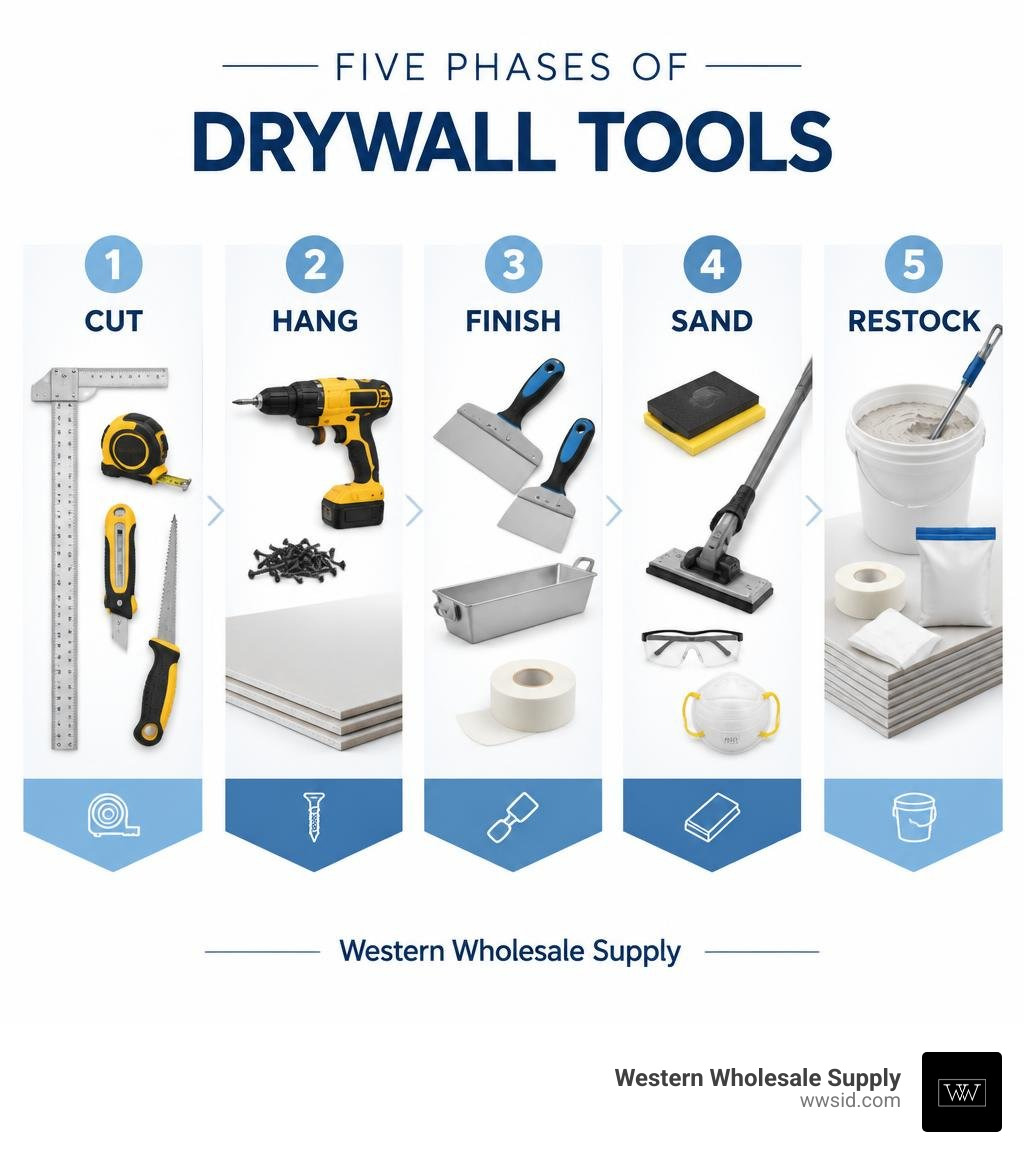
Explore more about all drywall tools:
Core Measuring, Cutting, and Hanging Tools

Before you can finish a smooth wall, you have to get the boards securely onto the framing. Layout precision prevents gaps, tapered edge mismatches, and broken corners that cost precious hours during the mudding stages.
Whether you are working with standard gypsum, sound-dampening panels like Quietrock EZ Snap, wet-area backer boards like Durock, or integrating grid layouts alongside CertainTeed ceiling tiles, having accurate measuring gear is essential. A 25-foot or 30-foot tape measure with a rigid standout allows solo workers to measure full spans across ceilings and tall partitions without the blade collapsing. To refine your measuring setup, review our checklist for adjustable T-squares before starting layout work, and consult our guide to choosing a drywall utility knife to keep clean cuts moving quickly.
Layout and Precision Cutting Equipment
A standard 48-inch drywall T-square is the backbone of straight factory-edge cuts across full 4-foot sheet widths. When combined with a heavy-duty utility knife featuring fixed or retractable razor blades, you can score the face paper in a single smooth stroke, snap the gypsum core cleanly over your knee, and slice the backing paper from behind. For a complete step-by-step breakdown of scoring and snapping methods, see how to cut drywall.
For cutouts around electrical junction boxes, HVAC vents, and plumbing penetrations, a rigid jab saw with aggressive, hardened teeth punches directly through the board face without requiring a pilot hole. If your cuts leave a rough or jagged edge, running an edge rasp or drywall planer levels the gypsum core flush against adjacent framing. You can learn more about tuning edges in our overview of drywall edge tools.
Fastening Equipment and Board Hanging Gear
Hanging ceiling sheets or 12-foot commercial boards is tough on the shoulders. A mechanical drywall lift acts as an indispensable extra set of hands, hoisting 50-to-100-pound panels up to 11 or 15 feet high and holding them flat against joists while you drive fasteners. For moving boards around the site, ergonomic panel carriers distribute weight to your forearm and leg, sparing your fingers and lower back.
Driving fasteners to the exact depth—dimpling the paper without piercing the core—requires a dedicated drywall screw gun. Learn how to choose the right cordless platform in our checklist for battery screw gun buyers. Always pair your driver with premium fasteners such as Grabber or Brighton Best screws to prevent snapped shanks and cam-outs. For specialized framing conditions, review our recommendations on self-drilling drywall screws.
The Complete Spectrum of All Drywall Tools for Finishing

Finishing drywall transforms individual boards into a continuous, monolithic surface ready for primer and paint. Drywall finishing accounts for roughly 30% of total construction labor time on residential interior projects, making your tool choices critical to jobsite profitability.
A thorough understanding of drywall finishing supplies helps you pick the right gear for each stage, especially when you use quick-set compounds on base coats to expedite your finishing schedule.
Essential Manual Finishing Sets Among All Drywall Tools
For detail work, remodeling, and complete residential rooms, manual hand tools provide unrivaled tactile control. The essential manual kit includes:
- Mud Pans: Heavy-gauge stainless steel mud pans with contoured bottoms and sheared scraping edges make scooping compound effortless while keeping your working edges clean.
- Joint and Taping Knives: High-carbon and flexible stainless steel knives from industry-standard makers like Hyde, USG Sheetrock Tools, and Marshalltown allow you to bed tape and feather joints cleanly. Check out our A-Z guide to taping knives and our detailed breakdown of 12-inch taping knives for advice on blade flex and handle ergonomics.
- Skimming Blades: Wide skimming blades spanning 14 to 32 inches help level entire butt joints and apply flawless Level 5 skim coats. You can upgrade your toolkit with 24-inch skimming blades to dramatically cut down on sanding passes.
Mechanical and Automatic Systems in All Drywall Tools
When tackling high-production commercial builds or large residential subdivisions, automatic taping and finishing tools apply joint compound and embed tape in a single pass.
- Automatic Taper: Dispenses paper tape and precisely metered compound simultaneously across flat joints and internal corners, dramatically increasing taping output over manual bedding.
- Flat Boxes: Spring-loaded finishing boxes (ranging from 7, 10, and 12 inches) meter mud over flat seams, crowning joints with micro-precision. Discover the benefits of these systems in our feature on Columbia drywall box tools.
- Corner Finishers and Applicators: Corner rollers and angle heads wipe down both sides of an inside 90-degree corner in a single continuous glide.
- Compound Loading Pump and Gooseneck: A mechanical compound pump equipped with a gooseneck filler fills automatic tapers, boxes, and corner boxes in seconds without creating jobsite mess.
Sanding Equipment and Jobsite Dust Control Systems
Sanding is the final step before paint inspection. Drywall dust is extraordinarily fine and remains suspended in the air if not managed properly. Equipping your crew with modern abrasives and dust extraction gear protects worker health and eliminates hours of post-construction cleanup.
Manual Sanding Blocks and Pole Systems
For spot touch-ups, dual-grit sanding sponges (medium 120-grit for leveling ridges and fine 220-grit for final feathering) provide direct control along outside corner beads and delicate transitions. For broader wall and ceiling areas, radial sanders mounted on lightweight aluminum extendable poles allow finishers to smooth joints from floor level without setting up staging or stilts. Specialized triangular and inside-corner sanders prevent gouging adjacent wall faces in tight corners.
Dust Extraction and Power Sanding Gear
Powered rotary drywall sanders paired with certified HEPA dust extractors capture up to 99% of airborne particulates right at the wall surface. Fitted with anti-clog mesh sanding discs and long-reach flexible vacuum hoses, these systems protect indoor air quality during commercial tenant buildouts. When sanding manually, workers must wear properly fitted N95 or HEPA respirators alongside sealed eye protection to guard against airborne dust.
Mixing Supplies, Hardware, and Jobsite Accessories
Proper compound preparation and having the right jobsite hardware on hand keep your workflow smooth from morning to teardown.
Mud Preparation and Handling Accessories
Joint compound settling during transit requires thorough mixing to achieve a creamy, lump-free consistency. Heavy-duty 1/2-inch variable-speed drills paired with ribbon or paddle mud mixers blend boxed or bucketed mud in minutes. Mud pan grips provide non-slip insulation against cold stainless pans, while heavy bucket scoops prevent waste when transferring mud from buckets into pans or loading pumps.
Joint Fasteners, Tapes, and Beads
Consumables and structural accessories tie the whole assembly together:
- Tapes: Standard spark-perforated paper tape remains the benchmark for flat seam strength, while self-adhesive fiberglass mesh tape excels with setting-type compounds.
- Corner Trims and Adhesives: Paper-faced metal, vinyl, and composite corner beads create crisp 90-degree outside corners. Fast-tack spray adhesives anchor vinyl beads quickly before mudding.
- Bulk Fasteners: Running out of screws mid-hang halts progress immediately. Learn why buying drywall screws in bulk keeps projects on schedule and lowers your overall fastening costs.
Manual vs. Automatic Finishing Tools: Comparison and ROI
Choosing between manual hand tools and automatic finishing systems comes down to project scope, crew size, and production volume.
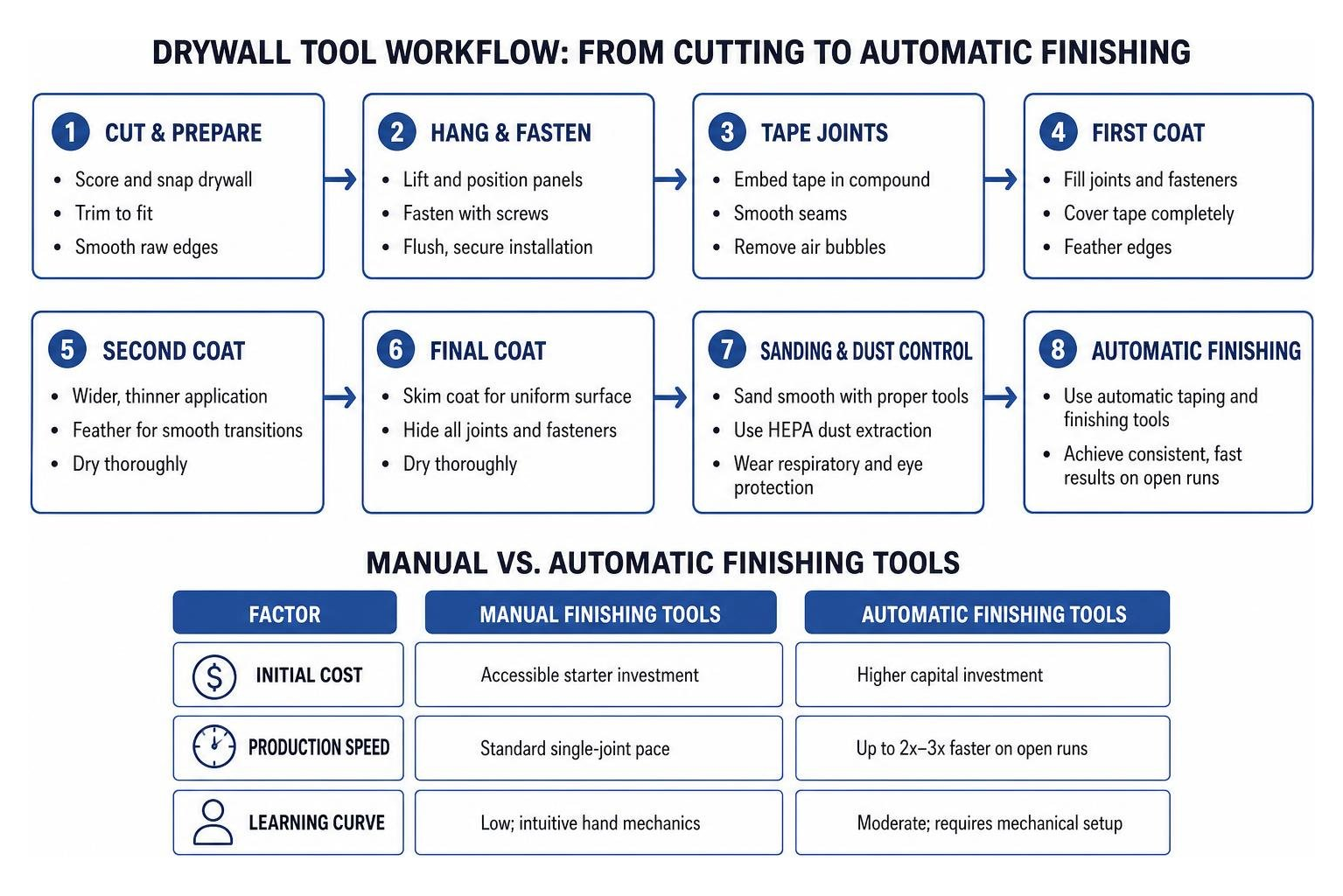
| Factor | Manual Finishing Tools (Hyde, USG, Marshalltown) | Automatic Finishing Tools (Columbia Taping Tools) |
|---|---|---|
| Initial Cost | Accessible starter investment | Higher capital investment |
| Production Speed | Standard single-joint pace | Up to 2x–3x faster on open runs |
| Learning Curve | Low; intuitive hand mechanics | Moderate; requires mechanical setup |
| Ideal Project Size | Small-to-medium residential, remodels | Large commercial, multi-family tracts |
| Maintenance | Quick water wash and dry | Daily teardown, seal lubrication, wear parts |
| Versatility | Excellent in tight closets and offsets | Best on long, unobstructed walls |
For a broader breakdown of core gear fundamentals, review our beginner overview in Drywall Tools 101.
Hand Finishing Tool Advantages
Manual hand finishing tools offer unmatched agility. When detailing tight soffits, small powder rooms, or custom architectural niches, a set of flexible stainless steel taping knives allows finishers to feather compound around complex angles where bulky mechanical boxes cannot fit. Cleanup requires only a bucket of clean water, a scrub brush, and a dry towel.
Automatic Finishing Tool Advantages and Financing
For high-volume commercial runs and expansive multi-story developments, automatic tools cut labor costs significantly. By mechanically laying down tape and metering uniform mud thicknesses across flat seams, crews cover thousands of square feet in a fraction of the time.
Many contractors take advantage of commercial equipment financing—such as vendor lines of credit and structured low-rate equipment loans—to acquire complete automatic sets while covering monthly payments through labor savings. High-end tool lines from manufacturers like Columbia Taping Tools also feature multi-year warranties (often up to 5 to 7 years) covering mechanical defects, protecting your long-term capital investment.
Frequently Asked Questions About Drywall Tools
What basic drywall tools does a beginner need to start?
A practical starter kit requires a 48-inch drywall T-square, heavy-duty utility knife, jab saw, 25-foot tape measure, cordless drywall screw gun, mud pan, 6-inch joint knife, 10-inch or 12-inch taping knife, dual-grit sanding sponge, safety glasses, and an N95 dust mask.
When should a contractor upgrade from hand tools to automatic taping tools?
Contractors typically upgrade when regular job volume exceeds 100 to 150 sheets per week or when managing commercial tenant improvements with tight delivery deadlines. The labor savings generated on large, open wall spans quickly offset equipment financing costs.
How do you properly clean and maintain drywall taping tools?
Wash hand knives and automatic tools with clean water and a stiff nylon brush immediately after each work session. Dry carbon steel blades completely and apply a light coat of multi-purpose oil to prevent surface rust. For automatic tools, flush out pumps and boxes thoroughly, lubricate rubber gaskets and o-rings, and inspect cutting blades and wiper seals regularly for wear.
Conclusion
Equipping your crew with dependable drywall tools ensures clean seams, structural integrity, and efficient jobsites from the moment the first board is cut to the final sanding pass.
At Western Wholesale Supply, we are an independent, veteran-owned, third-generation family business supplying premium building materials—including drywall, steel framing, acoustical ceilings, and commercial insulation—across Eastern Idaho and Western Wyoming since 1963. Whether you are stocking up on CertainTeed ceiling tiles, Grabber fasteners, Durock underlayment, or professional finishing gear from Hyde, USG Sheetrock Tools, Columbia Taping Tools, and Marshalltown, visit our showrooms or contact our team to source your professional drywall tools and fasteners with reliable, on-time jobsite delivery.
