

What Are Grid Ceiling Materials? A Quick-Start Guide
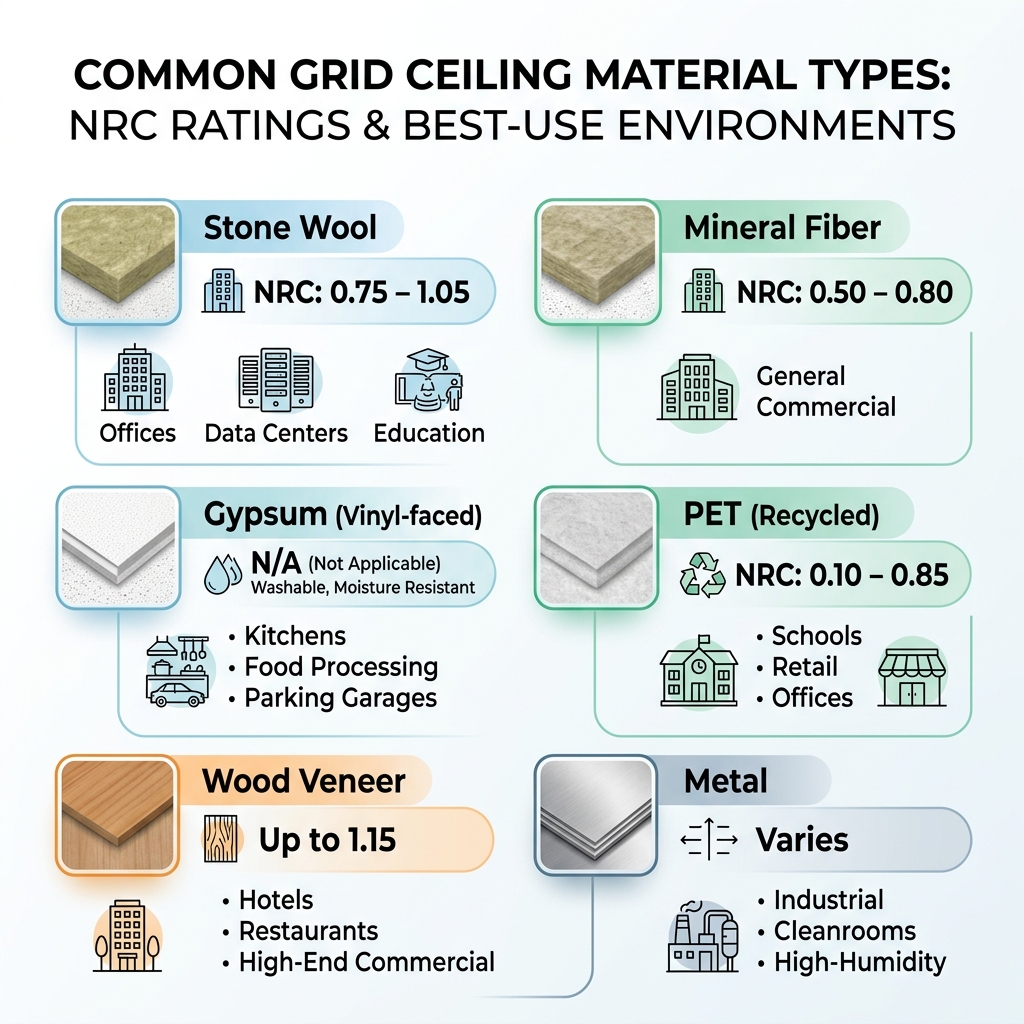
Grid ceiling materials are the tiles, panels, and boards that sit inside a suspended T-bar framework to form a finished ceiling. Here are the most common types and what they’re best for:
| Material | Best For | NRC Range | Key Strength |
|---|---|---|---|
| Stone wool | Offices, data centers, education | 0.75 – 1.05 | High sound absorption, fire resistant |
| Mineral fiber | General commercial use | 0.50 – 0.80 | Affordable, Class A fire rated |
| Gypsum (vinyl-faced) | Kitchens, food processing, parking garages | N/A | Washable, moisture resistant, durable |
| PET (recycled) | Schools, retail, offices | 0.10 – 0.85 | Sustainable, lightweight, customizable |
| Wood veneer | Hotels, restaurants, high-end commercial | Up to 1.15 | Aesthetic appeal, acoustic options |
| Metal | Industrial, cleanrooms, high-humidity | Varies | Durable, non-particulating |
| Fiberglass | Labs, pools, spas | Varies | Moisture and chemical resistant |
Every material fits into one of two grid types: exposed grid (the T-bar is visible) or concealed grid (the tile hides the frame). Your choice of material and grid type affects acoustics, fire safety, moisture resistance, maintenance, and cost.
Suspended ceiling systems also do more than just look good. They hide ductwork, plumbing, and electrical wiring while keeping everything accessible through removable tiles. That combination of function and flexibility is why grid ceilings are the go-to solution in commercial construction.
At Western Wholesale Supply, we are third-generation building materials professionals with hands-on experience supplying contractors and builders with grid ceiling materials across residential and commercial projects. In the sections below, we’ll walk through everything you need to choose the right material for your specific job.
Basic grid ceiling materials terms:
Understanding the Core Components of a Suspended System
When we talk about grid ceiling materials, we aren’t just talking about the tiles. A suspended ceiling is a team effort between the metal framework and the panels it supports. At Western Wholesale Supply, we’ve seen how the right grid choice makes or breaks an installation, especially in the variable climates of Eastern Idaho and Western Wyoming.
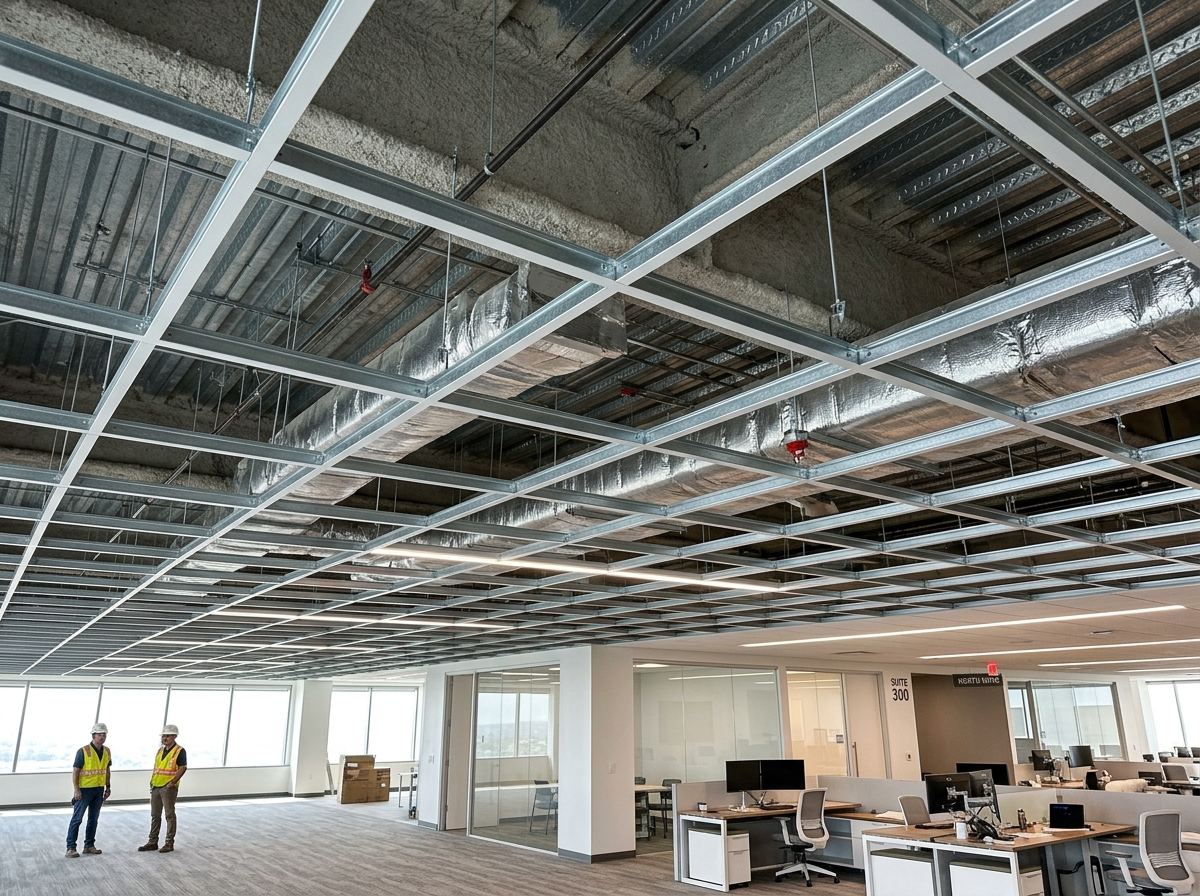
The skeleton of the system consists of three primary metal parts:
- Main Runners (Main Tees): These are the heavy lifters. They run the length of the room and are suspended from the overhead structure by hanger wires.
- Cross Tees: These snap into the main runners at right angles to create the “grid” openings (usually 2’x2′ or 2’x4′) where your tiles will rest.
- Perimeter Wall Angle: This L-shaped metal trim is fastened to the wall to support the edges of the grid.
Choosing Your Grid Profile: 15/16″ vs. 9/16″
The “face” of the grid—the part you see from below—comes in different widths. The 15/16″ standard grid is the workhorse of the industry. It’s versatile, easy to install, and compatible with almost every tile on the market. If you want a more modern, high-end look, you might opt for a 9/16″ narrow grid. This “slim” profile reduces the visible metal lines, giving the ceiling a more monolithic, upscale appearance. You can learn more about this in our article small-grid-big-impact-everything-about-916-ceiling-systems.
Material and Durability
Most commercial grids are made from hot-dipped galvanized steel. This coating protects the steel from rust, which is vital in our region where humidity can fluctuate. For standard commercial jobs, we recommend intermediate-duty beams. These are designed to hold up to 12.8 lbs. per linear foot on a 4-foot span, which is plenty for most acoustical tiles.
Before you start ordering, it’s a good idea to brush up on mastering-the-grid-how-to-estimate-ceiling-materials-like-a-pro to ensure you have exactly what you need for your square footage.
Comparing Popular Grid Ceiling Materials for Performance
Choosing the right grid ceiling materials is a balancing act between how a room looks, how it sounds, and how it handles fire safety. In our 60 years of serving Idaho Falls and the surrounding areas, we’ve found that performance metrics like NRC and fire ratings are usually the deciding factors for local contractors.
| Feature | Stone Wool (Rockfon) | Mineral Fiber (CertainTeed) | Gypsum (Gold Bond) |
|---|---|---|---|
| NRC (Sound Absorption) | 0.75 – 1.05 (Excellent) | 0.50 – 0.80 (Good) | Low (Reflective) |
| Fire Resistance | Non-combustible | Class A | Up to 2-hour rated |
| Moisture Resistance | High | Standard | Excellent (Vinyl-faced) |
| Durability | High (Sag resistant) | Moderate | High (Impact resistant) |
Sound Absorption (NRC) and Sound Blocking (CAC)
The NRC (Noise Reduction Coefficient) measures how much sound a tile absorbs. A rating of 0.95 means the tile absorbs 95% of the sound that hits it. This is crucial for open-concept offices or schools in Rexburg or Jackson where echo can be a nightmare. On the other hand, CAC (Ceiling Attenuation Class) measures how well the tile blocks sound from traveling to the next room. For a deep dive into these technicalities, check out our a-comprehensive-guide-to-acoustical-ceilings.
Fire Safety and Ratings
Safety is non-negotiable. Most of the grid ceiling materials we supply, such as CertainTeed mineral fiber tiles, carry a Class A fire resistance rating. For specific assemblies, you might need a fire-rated system that can withstand heat for 1.5 to 2 hours. We discuss these critical safety features in our guide on building-safety-from-the-top-down-fire-rated-ceiling-solutions.
High-Performance Grid Ceiling Materials for Cleanrooms and Data Centers
In specialized environments like data centers or medical labs in South East Idaho, standard tiles won’t cut it. We often recommend Rockfon Sonar-DC. These stone wool tiles are powerhouses, offering an NRC of 0.95 and an ISO 5 cleanroom certification according to ISO 14644.
Because they are made of stone wool, they don’t provide a food source for microorganisms and are naturally non-particulating. They also carry the UL GREENGUARD Gold Certification for low emissions, ensuring that the air quality in your high-tech space remains pristine.
Moisture-Resistant Grid Ceiling Materials for High-Humidity Areas
If you’re working on a commercial kitchen in Driggs or a parking garage soffit in Twin Falls, you need materials that won’t sag when things get damp. This is where Gold Bond Gridstone Hi-Strength panels shine. These are gypsum-core panels faced with a 2-mil vinyl laminate.
According to the Gold Bond Gridstone technical specifications, these panels are USDA accepted for food service areas because they are washable and durable. Plus, the Hi-Strength version is 40% lighter than standard gypsum, making it much easier for your crew to install. You can explore more about these specialized fixes at elevate-your-projects-discover-western-wholesale-supplys-acoustical-ceiling-solutions.
Aesthetic and Sustainable Material Options
Ceilings don’t have to be boring white squares. Modern grid ceiling materials allow for incredible design flexibility while meeting sustainability goals like LEED certification.
CertainTeed Wood Panels
For projects in Jackson or Sun Valley where a high-end, warm aesthetic is required, CertainTeed wood panels are a fantastic choice. These can be used with a semi-concealed grid, which hides most of the metal framework to create a sleek, refined visual. They are available in various veneers and can be perforated to achieve an NRC of up to 0.95 (or even 1.15 with specific infills). These panels support green building initiatives by using low-VOC materials and offering FSC certification options.
Autex PET Tiles
If sustainability is the top priority, Autex PET tiles are a game-changer. Made from 100% polyester fiber (with a minimum of 80% recycled content), these tiles are carbon neutral and lightweight. They come in a variety of styles—like “Hatch,” “Linear,” or “Vault”—and can even be custom-printed with local imagery or Ngunnawal stories to bring a space to life. They are a brilliant way to turn a ceiling into a piece of art while maintaining an NRC range of 0.10 to 0.85. For more on how these quiet a room, see sound-absorbing-ceilings-the-secret-to-a-quieter-environment and grid-ceiling-tiles-your-blueprint-for-better-acoustics.
Installation and Structural Considerations for Grid Systems
Installing a grid is a precision job. If the grid isn’t square and level, the tiles won’t sit right, and the whole ceiling will look “off.” We always suggest starting with a clear plan and the right tools.
Key Installation Steps:
- Layout: Determine your border tile sizes so you don’t end up with a tiny sliver of tile at one end of the room.
- Hanger Wires: These must be securely fastened to the structure above. For standard grids, they are usually spaced every 4 feet along the main runners.
- Leveling: Use a laser level to ensure your main runners are perfectly horizontal.
- Squaring: As you snap in your cross tees, check for squareness constantly. If the first few are off, the error will multiply as you move across the room.
For a more detailed walkthrough, our acoustic-ceiling-installation-a-diyers-dream-come-true is a great resource.
Load Capacity and Structural Requirements
Not all grids are created equal. A standard intermediate-duty grid (like the Prelude 15/16″ system) is rated to hold about 12.8 lbs per linear foot. This is more than enough for stone wool or mineral fiber tiles. However, if you are using heavy grid ceiling materials like 1/2″ Gridstone gypsum panels, you must ensure your suspension system is rated for the extra weight.
To help you figure out exactly how much metal and tile you need, we recommend using the usg-ceiling-material-estimator tool. It takes the guesswork out of the ordering process.
Frequently Asked Questions about Grid Ceiling Materials
What is the difference between exposed and concealed grid systems?
In an exposed grid system, the metal T-bars are visible, creating a traditional “square” look. This is the most common and cost-effective method. A concealed grid uses tiles with specially carved edges (kerfed) that slide over the grid, hiding the metal entirely for a smooth, monolithic look. There are also “semi-concealed” options that offer a middle ground.
Which material offers the highest sound absorption (NRC)?
Stone wool products, like Rockfon Industrial Black, offer the highest ratings, sometimes reaching an NRC of 1.05. This means they absorb more sound than actually hits them (due to the way sound wraps around the edges of the panels). PET and certain perforated wood panels also offer excellent performance.
Are grid ceilings suitable for residential basements?
Absolutely! In fact, they are often the best choice for basements in Idaho and Wyoming. They provide easy access to the “mess” of plumbing and electrical work in the joists while hiding it from view. Using a direct-mount grid can also help save headroom if your basement ceiling is low.
Conclusion
Selecting the right grid ceiling materials is about more than just picking a pretty tile. It’s about understanding the specific needs of your environment—whether that’s the high-humidity of a commercial kitchen, the acoustic demands of a school, or the aesthetic requirements of a high-end hotel.
At Western Wholesale Supply, we’ve spent over 60 years helping the folks in Eastern Idaho, Western Wyoming, and South East Idaho get their projects done right. As a third-generation, veteran-owned family business, we take pride in our deep knowledge of brands like CertainTeed, Rockfon, and Gold Bond. We don’t just sell materials; we provide the reliable, on-time delivery and expertise you need to succeed.
Whether you’re in Idaho Falls, Jackson, or Twin Falls, we’re here to help you master your next ceiling project. Explore our Acoustical Ceilings Solutions today and let’s get to work!
