

Why Insulating Wall Board Is a Critical Decision for Every Wall Assembly
Author: Western Wholesale Supply
Insulating wall board is a category of rigid panel products used to add thermal resistance, moisture control, and structural continuity to wall systems — in both residential and commercial construction. If you’re trying to figure out which type to use, here’s a quick breakdown:
| Type | R-Value per Inch | Best For |
|---|---|---|
| EPS (Expanded Polystyrene) | 3.6 – 4.2 | Below-grade, budget-conscious projects |
| XPS (Extruded Polystyrene) | ~5.0 | Foundations, exterior walls, wet exposure |
| Polyiso (Polyisocyanurate) | 6.0 – 6.5 | Above-grade walls, commercial construction |
| Mineral Wool Board | ~4.2 | Fire-sensitive assemblies, rainscreen walls |
These four types cover most residential and commercial wall applications. Each performs differently when it comes to R-value, moisture resistance, fire behavior, and cost.
Unlike batt insulation, rigid foam boards create a continuous layer across the wall — eliminating gaps around studs that drain energy from your building. For warehouses, the rule of thumb is R-13+ in walls and R-30+ in ceilings. For other wall assemblies, your local energy code sets the minimum.
We are Western Wholesale Supply, a third-generation, veteran-owned building materials supplier with hands-on experience helping contractors and builders spec and source insulating wall board for projects across residential and commercial applications. In the sections below, we’ll walk you through everything you need to choose, install, and code-comply with the right product for your wall assembly.
Basic insulating wall board terms:
What Is Insulating Wall Board and When Should You Use It?
Insulating wall board refers to rigid panel insulation used in wall, roofline, foundation, crawlspace, and specialty building assemblies. Most people mean foam board when they use the term, but mineral wool boards and calcium silicate boards can also be part of the conversation depending on the application.
Rigid boards are common in both homes and commercial buildings because they add thermal resistance in a thin, durable panel. They are especially useful when a wall needs continuous insulation, moisture control, or better performance than cavity insulation alone can provide.
If you want a wider overview of insulation material choices, we recommend starting with Beyond Batts: A Comprehensive Look at Building Insulation Materials.
Common Uses for Insulating Wall Board
You will commonly see insulating wall board used in:
- Basement walls
- Exterior wall sheathing
- Interior retrofit walls
- Foundation insulation
- Rim joists
- Slab edges
- Crawlspaces
- Garages
- Cathedral ceilings
- Attics
- Metal buildings
- Warehouse walls and roofline assemblies
- Commercial masonry and steel stud walls
For warehouse thermal performance, we typically think in terms of R-13+ in walls and R-30+ in ceilings. The right board helps reduce heat transfer through large wall and roof areas, which matters when you are conditioning a big space with big surfaces and big utility bills. Big buildings have a way of making small insulation decisions feel very large later.
Why Rigid Boards Are Different from Cavity Insulation
Cavity insulation fits between framing members. Rigid board can run continuously over framing, masonry, concrete, or sheathing. That difference matters.
Wood and steel framing conduct heat differently than insulation. When insulation only sits between studs, the studs interrupt the thermal layer. A continuous board layer reduces that thermal bridging and helps the full wall assembly perform closer to its intended R-value.
Rigid boards also offer:
- High R-value per inch
- Better dimensional stability than many loose or flexible products
- Moisture resistance in many foam products
- Compressive strength for foundation and slab-edge applications
- Faced and unfaced options
- Compatibility with many exterior and interior assemblies
Where Wall Boards Fit in the Building Envelope
Insulating wall board can be used above grade, below grade, behind cladding, against masonry, over wood studs, over steel studs, and in metal building assemblies.
Common locations include:
- Exterior continuous insulation behind siding or cladding
- Rainscreen walls
- Masonry cavity walls
- Concrete and CMU walls
- Interior basement wall systems
- Foundation perimeter insulation
- Metal building walls and roofs
- Structural insulated panel systems, such as those described by sPanels | Structural Insulated Panels | Idaho Falls, ID
For commercial and industrial projects, rigid board is often part of a broader system that includes drywall, steel framing, fasteners, acoustical ceilings, and specialty insulation. For more on that bigger-picture approach, see The Ultimate Guide to Warehouse Insulation Materials.
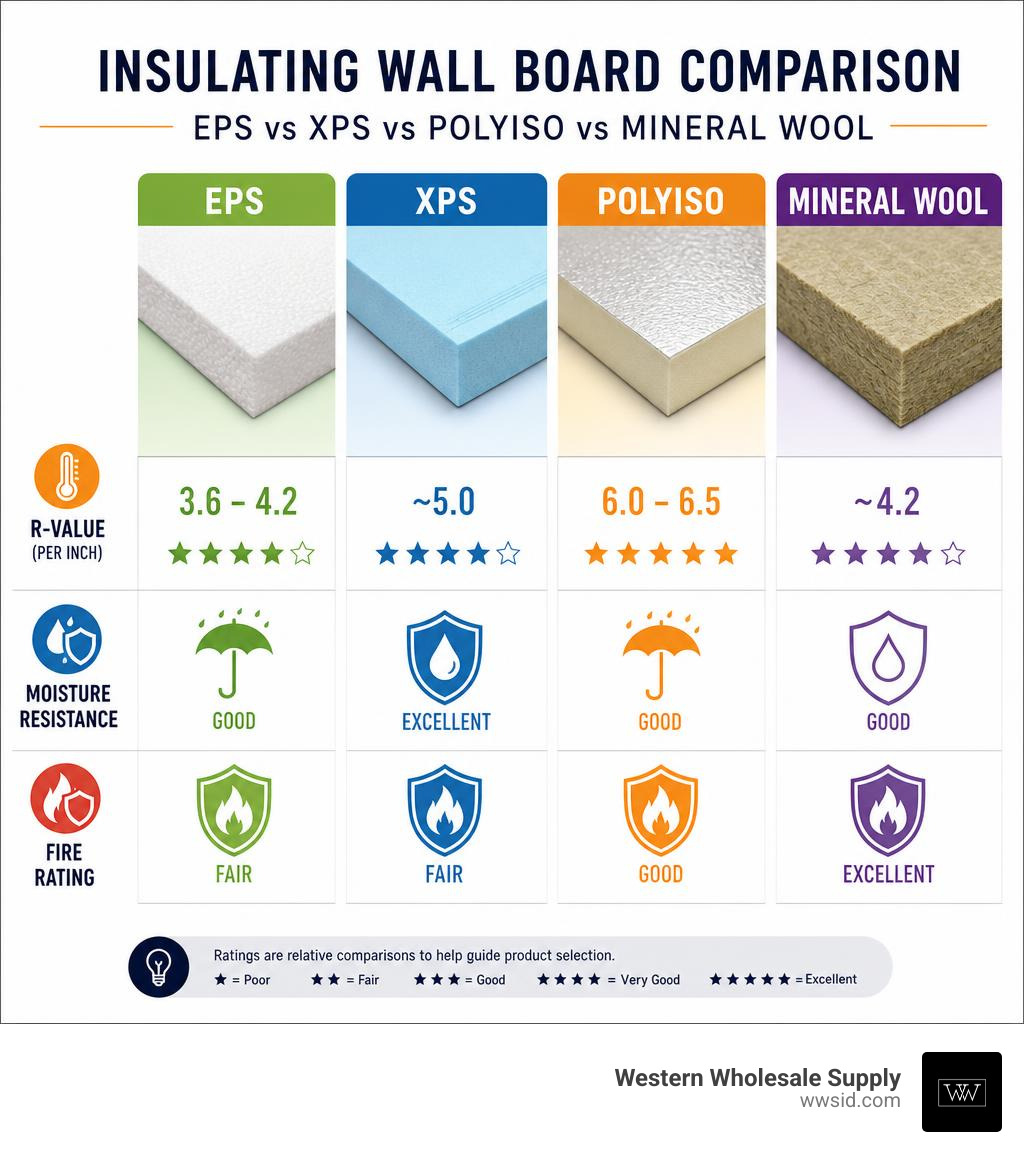
EPS, XPS, Polyiso, and Mineral Wool Insulating Wall Board Types Compared
| Board Type | Typical R-Value per Inch | Relative Cost | Moisture Resistance | Vapor Control | Fire Performance | Compressive Strength | Best Use |
|---|---|---|---|---|---|---|---|
| EPS | 3.6 – 4.2 | Lowest | Moderate to good, varies by density and facing | More vapor open than XPS or foil-faced polyiso | Combustible foam; needs approved protection | Varies by density | Budget-conscious walls, below-grade options, drainage boards |
| XPS | About 5.0 | Medium to high | Very good | More vapor resistant than EPS | Combustible foam; needs approved protection | Often 15 – 25 PSI | Foundations, exterior walls, wet exposure |
| Polyiso | 6.0 – 6.5 | Medium to high | Good above grade; facer dependent | Foil facers can be very low perm | Combustible foam; some products have tested exposed-use approvals | Varies by product | Above-grade walls, commercial construction, metal buildings |
| Mineral Wool Board | About 4.2 | Medium to high | Water-repellent and vapor permeable | Allows drying | Noncombustible | Semi-rigid; not typically used where high compression is required | Rainscreens, fire-conscious walls, acoustic assemblies |
EPS Insulating Wall Board
EPS, or expanded polystyrene, is usually the most economical rigid foam board option. It offers about R-3.6 to R-4.2 per inch and is lightweight, easy to cut, and available in multiple densities.
EPS is often used for:
- Foundation walls
- Basement walls
- Exterior insulation
- Drainage boards
- Siding underlayment
- Large-area projects where budget matters
EPS is more vapor open than XPS and foil-faced polyiso, which can be helpful in assemblies that need some drying potential. Higher-density EPS products can also be used below grade when approved for that application.
XPS Insulating Wall Board
XPS, or extruded polystyrene, is known for strength and water resistance. It commonly delivers about R-5 per inch and is frequently available in compressive strengths such as 15 PSI and 25 PSI, depending on the product.
XPS is a strong fit for:
- Foundation walls
- Exterior continuous insulation
- Crawlspaces
- Slab edges
- Freeze-thaw exposure
- Areas where durability matters
Because XPS handles moisture exposure well, it is often chosen for foundations and exterior wall assemblies. It generally costs more than EPS but offers higher R-value per inch and stronger moisture performance.
Polyiso Insulating Wall Board
Polyiso, short for polyisocyanurate, provides one of the highest R-values among common rigid foam boards. Typical polyiso boards offer around R-6 to R-6.5 per inch, while some specialty products report even higher performance. For example, certain advanced insulated metal panel cores can reach around R-8 per inch, and thick cold-storage panels may reach very high total R-values.
Polyiso is commonly used in:
- Above-grade exterior walls
- Commercial walls
- Metal buildings
- Interior wall upgrades
- Roof-adjacent assemblies
- Continuous insulation applications
Foil-faced polyiso can also act as a vapor retarder when seams and transitions are detailed according to the manufacturer’s instructions. Product sheets such as the DuPont Thermax Sheathing Insulation Product Information Sheet show how specific polyiso boards are tested for thermal performance, fire performance, vapor permeance, and code compliance.
For metal building applications, products like DuPont Thermax Metal Building Board NH Insulation are designed to combine insulation performance with a finished interior-facing surface in approved assemblies.
Mineral Wool Board Alternatives
Mineral wool board is not foam, but it belongs in the comparison because it solves problems foam does not always solve as easily.
Mineral wool boards typically provide about R-4.2 per inch. They are:
- Noncombustible
- Vapor permeable
- Water-repellent
- Inorganic and mold resistant
- Good for sound absorption
- Useful in exterior cavity walls and rainscreen assemblies
Mineral wool is a smart choice when fire performance, drying potential, and acoustics are top priorities. It is often used in commercial exterior wall assemblies and multi-story projects where noncombustibility is a major design requirement.
Specialty non-foam boards also exist. For example, Calcium silicate board for wall insulation is used in certain interior wall applications where indoor climate, moisture buffering, and mineral-based composition are priorities, though its R-value per inch is much lower than foam insulation.
R-Values, Energy Efficiency, and Cost of Insulating Wall Board
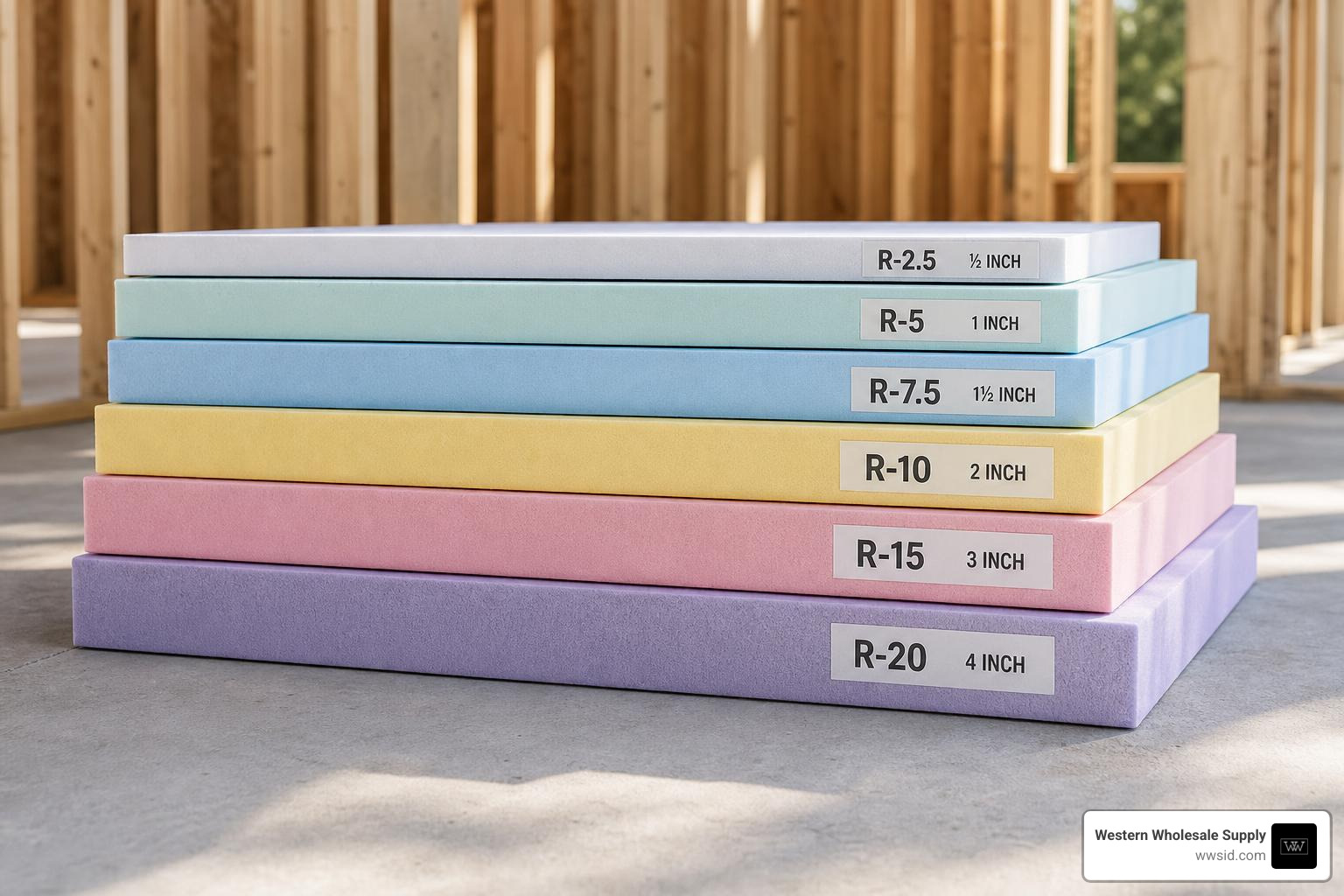
R-value measures resistance to heat flow. Higher R-value means better thermal resistance. The right R-value depends on climate, wall type, interior conditions, and applicable code requirements.
In Eastern Idaho and Western Wyoming, cold winters make wall and ceiling insulation decisions especially important. A board that looks “good enough” on paper may not be enough for a large warehouse, a metal building, or a foundation wall exposed to cold soil.
For commercial sourcing decisions, see Everything You Need to Know About Sourcing Commercial Insulation.
Typical R-Values by Thickness
Approximate R-values vary by manufacturer, facer, temperature, and product type, but these ranges are useful for planning:
| Thickness | EPS Approx. R-Value | XPS Approx. R-Value | Polyiso Approx. R-Value |
|---|---|---|---|
| 1/2 inch | R-2 | R-2.5 | R-3 to R-3.3 |
| 1 inch | R-3.6 to R-4.2 | R-5 | R-6 to R-6.5 |
| 1.5 inch | R-5.4 to R-6.3 | R-7.5 | R-9 to R-9.8 |
| 2 inch | R-7.2 to R-8.4 | R-10 | R-12 to R-13 |
| 3 inch | R-10.8 to R-12.6 | R-15 | R-18 to R-19.5 |
| 4 inch | R-14.4 to R-16.8 | R-20 | R-24 to R-26 |
For warehouse thermal planning, walls are commonly targeted at R-13+ and ceilings at R-30+. In many assemblies, rigid board is combined with other insulation materials to reach the desired total R-value.
How R-Value Impacts Energy Performance
R-value affects how quickly heat moves through a wall or ceiling. In cold weather, higher R-value slows heat loss. In warm weather, it slows heat gain. That improves comfort and can reduce heating and cooling loads.
Rigid board also helps with surface temperature. Warmer interior wall surfaces can reduce comfort complaints and help lower condensation risk when the assembly is designed correctly.
The most important point: R-value is not just about the board. It is about the whole assembly. Framing, sheathing, cladding, interior drywall, fasteners, facers, and vapor control all affect performance.
What Affects Insulating Wall Board Pricing?
We will skip specific prices because they change with market conditions, freight, volume, and availability. Instead, here are the factors that usually drive cost:
- Material type: EPS is usually lowest, XPS and polyiso are higher.
- Thickness: More inches means more material and higher total R-value.
- Facer type: Foil, coated glass, reinforced facers, and specialty finishes affect cost.
- Compressive strength: Higher PSI boards usually cost more.
- Sheet size: Standard and oversized boards differ in handling and freight.
- Project volume: Commercial quantities can affect sourcing strategy.
- Availability: Lead times and regional inventory matter.
- Code requirements: Fire-rated or specialty listed assemblies may require specific products.
- Freight and delivery: Rigid boards are bulky, so logistics matter.
For larger orders, smart sourcing can matter as much as product selection. We cover that in How to Master the World of Wholesale Building Insulation.
Installation Best Practices: Cutting, Fastening, and Sealing Boards

Good installation is where insulation performance becomes real. A high-R board with sloppy cuts, crushed edges, or open seams is like a winter coat with the zipper stuck open. Technically warm. Practically annoying.
Always follow the manufacturer’s written instructions and the approved wall assembly. For a broader look at high-performance products and jobsite planning, visit The Contractor’s Guide to High Performance Insulation Supplies.
How to Cut Foam Board Cleanly
Most foam boards can be cut with common jobsite tools:
- Utility knife and straightedge for score-and-snap cuts
- Fine-tooth saw for thicker boards
- Table saw or circular saw with proper dust control for repetitive cuts
- Handsaw for field trimming
- Hot knife only when permitted and safe for that product
Best practices:
- Measure twice, cut once, and then measure again because walls like to surprise us.
- Use a straightedge for clean seams.
- Keep cuts tight around openings and transitions.
- Avoid ragged edges that create gaps.
- Wear eye protection, gloves, and respiratory protection when dust is generated.
How to Fasten Boards to Walls
Fastening depends on the substrate and assembly. Common methods include:
- Cap nails for wood framing or sheathing
- Screws with insulation washers
- Masonry fasteners for concrete or CMU
- Compatible construction adhesives
- Clip systems for certain panel products
- Furring strips installed over the insulation
- Cladding attachment systems for exterior walls
Use fasteners that match the substrate, board type, and required holding power. We commonly support contractors sourcing Brighton Best and Grabber fasteners for wall systems, drywall, and related assemblies.
Be careful not to overdrive fasteners. Crushed foam loses thickness, and lost thickness means lost performance.
How to Seal Joints and Edges
Joint treatment depends on the product and whether the board is part of a water, vapor, or weather-resistive strategy.
Common materials include:
- Compatible sheathing tape
- Foil tape for foil-faced boards
- Manufacturer-approved sealant
- Canned foam for larger gaps
- Liquid flashing at transitions and penetrations
- Compatible flashing tapes at openings
Pay special attention to:
- Board seams
- Corners
- Window and door openings
- Pipe and conduit penetrations
- Transitions to rooflines, foundations, and slabs
- Terminations at grade
Do not assume every tape works with every facer. Adhesion, temperature, UV exposure, and moisture conditions all matter.
Installation Mistakes to Avoid
Avoid these common problems:
- Leaving gaps between boards
- Crushing boards with fasteners
- Using adhesive that melts foam
- Installing over wet, dirty, icy, or uneven substrates
- Leaving foam exposed when code requires a covering
- Ignoring UV exposure limits
- Using the wrong board below grade
- Mixing incompatible tapes, facers, or sealants
- Forgetting fire and thermal barrier requirements
- Treating product data sheets like optional bedtime reading
The data sheet is not decoration. It is the instruction manual for keeping inspectors, owners, and future-you happy.
Moisture, Vapor, Mold, Fire, and Code Considerations
Insulating wall board is not only about R-value. Moisture behavior, vapor control, mold resistance, fire safety, and code compliance all matter.
For a deeper fire-safety discussion, see Don’t Get Burned by Choosing the Wrong Insulation.
Moisture Resistance and Below-Grade Performance
Below-grade and foundation applications need careful product selection.
- EPS can work below grade when rated for that use, and some EPS products are made with drainage features.
- XPS is often selected for wet exposure because of its water resistance and compressive strength.
- Polyiso is generally better suited to above-grade wall applications unless the manufacturer specifically approves the use.
- Mineral wool is water-repellent and vapor permeable, but it is not typically used where high compressive strength is required against soil pressure.
Foundation walls, basements, crawlspaces, slab edges, and rim joists need products that can tolerate moisture exposure and protect the assembly. For more detail, read Banish Basement Blues: Choosing the Right Water-Resistant Insulation.
Vapor Barrier and Condensation Control
Different boards handle vapor differently.
- Foil-faced polyiso can have very low permeance and may function as a vapor retarder in the right assembly.
- XPS is more vapor resistant than EPS.
- EPS allows more drying potential than many closed-cell foam boards.
- Mineral wool is vapor permeable and supports drying in rainscreen and cavity wall assemblies.
Condensation control depends on climate, wall design, temperature, interior humidity, and placement of vapor-retarding layers. In cold regions like Eastern Idaho and Western Wyoming, vapor strategy should be coordinated with the full wall assembly and local code requirements.
Mold Resistance and Indoor Air Quality
Foam boards are generally resistant to mold growth because they do not provide the same food source as organic materials. Mineral wool is inorganic and does not support mold, mildew, or decay.
That said, mold problems are usually assembly problems, not just insulation problems. Wet drywall, wood, dust, paper facers, and trapped moisture can still create issues.
Good practice includes:
- Starting with clean, dry substrates
- Choosing moisture-appropriate products
- Protecting stored materials from weather
- Using low-VOC and formaldehyde-free options where available
- Replacing insulation materials that have been contaminated
Fire Safety and Building Code Requirements
Most foam plastic insulation is combustible and must be separated from occupied spaces by an approved thermal barrier, commonly gypsum board, unless the product and assembly have specific approval for exposed use.
Important fire and code concepts include:
- Thermal barriers
- Ignition barriers
- Flame spread index
- Smoke developed index
- ASTM E84 testing
- NFPA 286 room corner testing
- Fire-rated wall assemblies
- Product listings and evaluation reports
- Local inspection requirements
Some polyiso products are tested for exposed interior use in specific assemblies, but that approval is product-specific and application-specific. Never assume one board’s listing applies to another board.
Mineral wool is often chosen where noncombustibility is a priority. It can provide a strong alternative in fire-conscious exterior wall and commercial assemblies.
Foam Board vs. Fiberglass and Mineral Wool
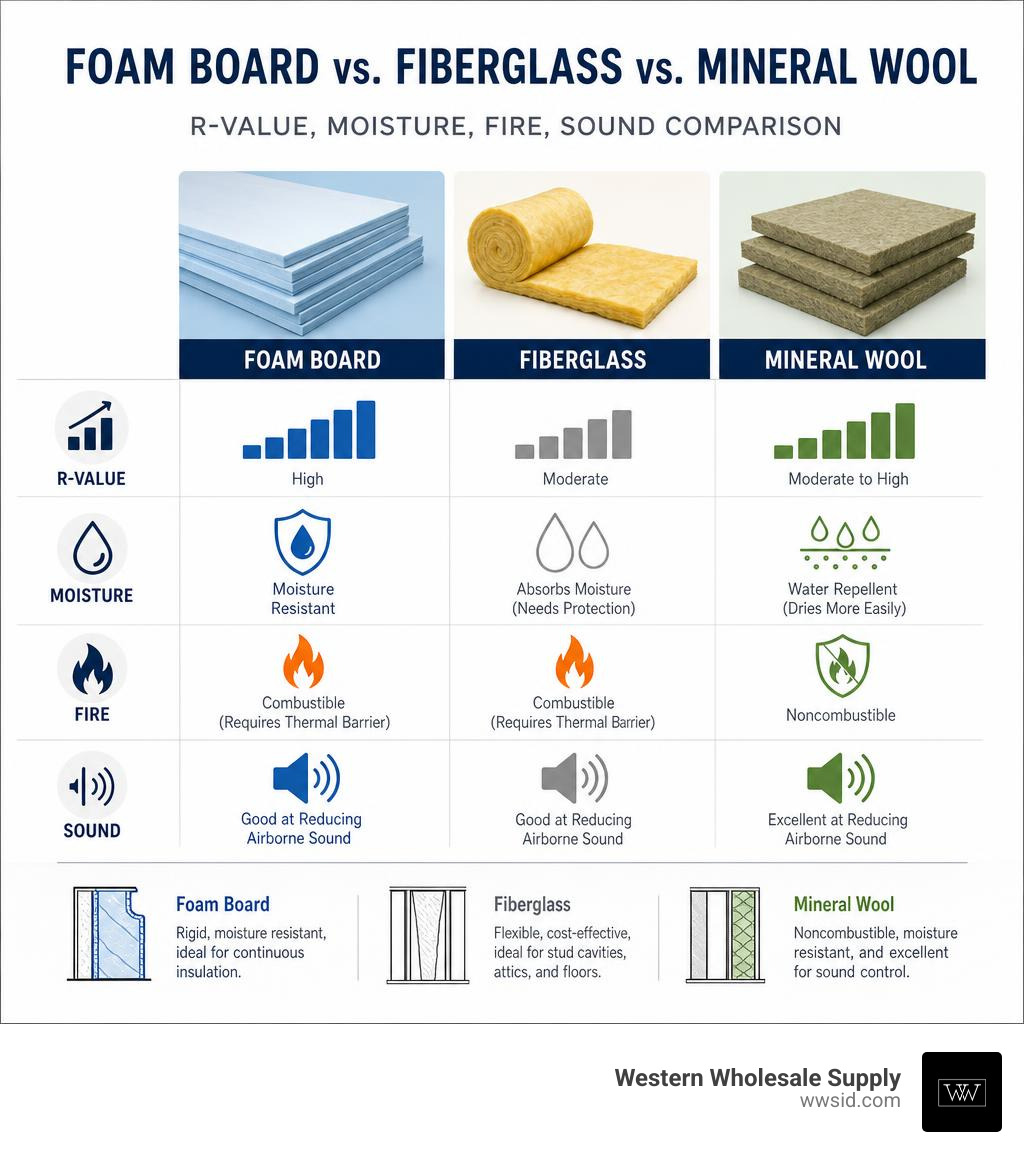
Rigid foam, fiberglass, and mineral wool all have a place. The best choice depends on where the insulation is going and what problem it needs to solve.
Foam Board vs. Fiberglass
Foam board is rigid, moisture resistant, and useful as continuous insulation. Fiberglass is flexible, usually lower cost, and commonly used in stud cavities, attics, and floors.
Foam board advantages:
- Higher R-value per inch
- Works as continuous insulation
- Better suited to many basement and foundation applications
- Available with vapor-retarding facers
- Adds durable thermal performance in thin spaces
Fiberglass advantages:
- Often lower material cost
- Easy to install in standard cavities
- Good for attics and interior framed walls
- Less cutting waste in some cavity applications
Fiberglass should not be used where it is likely to stay wet. Wet fiberglass loses performance and may need replacement, especially if contaminated.
Foam Board vs. Mineral Wool
Foam board usually wins on R-value per inch, especially polyiso. Mineral wool wins on fire performance, vapor permeability, and sound absorption.
Foam board is often preferred for:
- Foundations
- Continuous exterior insulation
- Thin high-R wall upgrades
- Below-grade applications with approved products
- Projects needing vapor-retarding facers
Mineral wool is often preferred for:
- Noncombustible assemblies
- Rainscreen walls
- Commercial exterior cavity walls
- Sound-sensitive spaces
- Assemblies that need drying potential
Both can be excellent choices. The trick is not asking, “Which insulation is best?” The better question is, “Best for what wall, in what building, under what conditions?”
Frequently Asked Questions About Insulating Wall Board
Here are quick answers to the questions we hear most often from builders, contractors, and owners comparing rigid foam board options.
What is the best insulating wall board for exterior walls?
For above-grade exterior walls, polyiso is often selected because it offers high R-value per inch and is widely used in commercial construction. XPS is a strong choice where moisture exposure and durability are major concerns. EPS can be a cost-effective option, especially in thicker assemblies. Mineral wool is excellent where fire performance, vapor permeability, or acoustics are priorities.
The best choice depends on:
- Required R-value
- Local energy code
- Cladding type
- Moisture exposure
- Fire requirements
- Vapor strategy
- Attachment method
- Budget and availability
Can foam board insulation be left exposed indoors?
Usually, no. Most foam plastic insulation must be covered with an approved thermal barrier, such as gypsum board, unless the specific product and assembly are approved for exposed use.
Some specialty polyiso boards have tested approvals for exposed interior applications in certain commercial, industrial, agricultural, or metal building assemblies. Always confirm the product listing, installation instructions, and local code requirements before leaving foam exposed.
When in doubt, ask the code official before installation, not after the walls are finished and everyone is staring at each other.
Is insulating wall board waterproof?
No insulating wall board should be treated as completely waterproof. Some boards are highly water resistant, but that is not the same as waterproof.
- XPS is very water resistant and commonly used in foundation applications.
- EPS can be used in moisture-prone areas when rated for that use.
- Polyiso performance depends heavily on facer type and application.
- Mineral wool is water-repellent but vapor permeable.
- Taped seams and facers can help manage moisture, but they do not replace proper drainage or waterproofing membranes where those are required.
For below-grade walls, waterproofing and drainage should be handled as a system.
Conclusion
Choosing the right insulating wall board comes down to matching the board to the wall. EPS, XPS, polyiso, and mineral wool each bring different strengths in R-value, moisture behavior, vapor control, fire performance, and cost planning.
At Western Wholesale Supply, we have served Eastern Idaho and Western Wyoming since 1963 as an independent, veteran-owned, third-generation family business. We supply quality building materials including insulation, drywall, steel framing, acoustical ceilings, CertainTeed ceiling tiles, Durock cement board, Quietrock EZ Snap, and Brighton Best and Grabber fasteners.
Whether you are working on a home, warehouse, metal building, commercial wall system, or foundation project, we can help you source the right insulation materials and keep the job moving with reliable, on-time delivery and customer service backed by more than 60 years of experience.
Ready to compare options for your next project? Explore insulation materials and support.
